






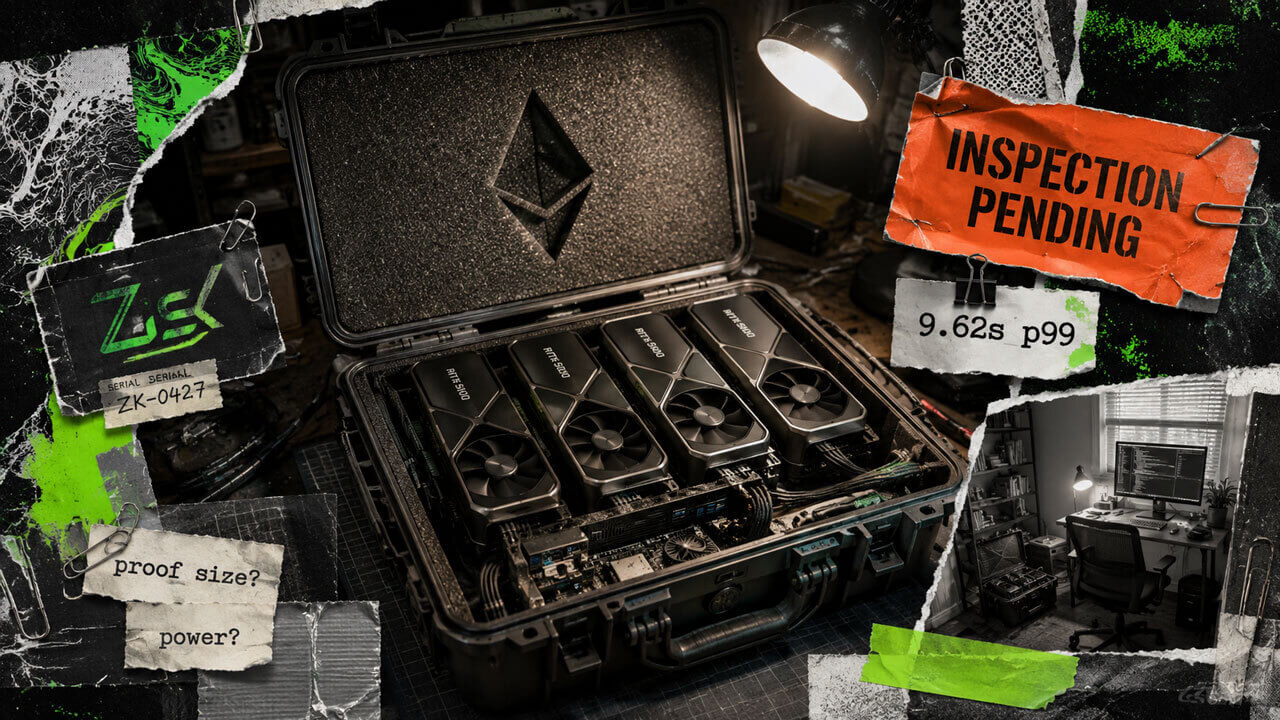
ZisK’s latest benchmark demonstrates that Ethereum proof generation can now operate efficiently on four RTX 5090 GPUs. This contrasts with prior Ethereum Foundation analyses suggesting a 12-GPU configuration posed centralization risks. The new result indicates potential democratization of proofing capabilities, assuming comparable operational parameters and workloads.
Developed as an open-source zero-knowledge virtual machine, ZisK’s v1.1.0-alpha prover achieved a 9.62-second p99 latency on four RTX 5090 GPUs. According to project updates, 99.7% of tested Ethereum blocks completed verification under 10 seconds.


Ethereum’s massive fee shock: New post-quantum signatures are 40x larger, threatening to crush network throughput and user costs
Competing chains like Coinbase, Solana, Polkadot, and Bitcoin have all progressed in post-quantum signature planning, with wallet user experience and proof aggregation likely determining technological success.
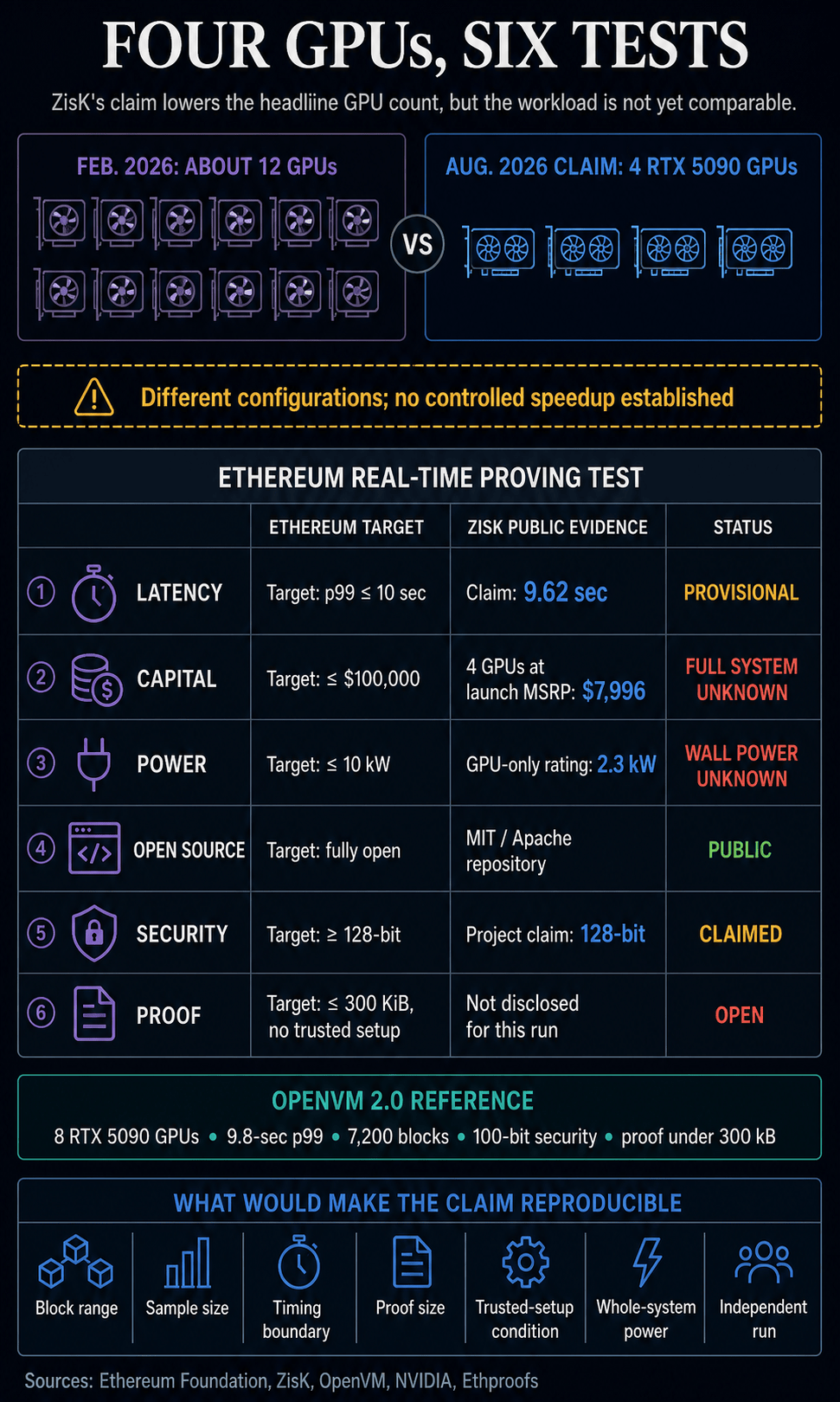
Ethereum’s consensus requires at least 99% of blocks to be proven within 10 seconds. ZisK’s 9.62-second p99 would meet this standard if measured under equivalent mainnet conditions and timing parameters.
Key technical details remain undisclosed in ZisK’s announcement, including specific block ranges, sample size, p99 calculation methodology, and power consumption metrics. This positions the finding as a benchmark claim rather than fully validated evidence.
The six-part test
The Ethereum Foundation’s decentralization criteria include: on-premises hardware costs ≤$100,000, power consumption ≤10kW, open-source codebase, 128-bit cryptographic security, and proof sizes ≤300 KiB without trusted setups.
The Foundation has emphasized security standards more strongly than throughput considerations in recent communications.
Ethereum Foundation refocuses to security over speed – sets strict 128-bit rule for 2026
While speed remains important, the Foundation warns that unverified proving solutions could enable state manipulation attacks, making security verification critical.
ZisK operates under MIT/Apache 2.0 licensing and claims 128-bit security for its latest result. The latency metric remains qualify as preliminary due to incomplete operational disclosure.
The hardware specifications suggest practical feasibility while pending full system validation. Nvidia’s RTX 5090 specifies 575W per GPU, totaling 2.3kW for four cards – below the 10kW threshold before accounting for system-wide power demands.
At $1,999 per card, four RTX 5090 GPUs consume $7,996 at launch MSRP, leaving considerable budget room for complementary system components.
A single rig could theoretically meet hardware requirements but might stress residential power infrastructure, cooling systems, or host equipment capacity. Equally important are Ethereum’s proof size and setup validation rules.

OpenVM shows why benchmark boundaries matter
OpenVM’s production benchmark achieved 9.8-second p99 latency on eight RTX 5090 GPUs processing 7,200 Ethereum blocks from block 24,000,000. This used 100-bit security with sub-300-kB proofs.
ZisK’s four-GPU result may represent genuine efficiency improvements, though direct comparison requires identical operational parameters. Security levels, proof sizes, and testing methodologies differ between the two implementations.
The Ethproofs API considers witness generation in proving time calculations but excludes data fetching and submission latency. Different testing intervals could produce similar p99 figures while measuring different operational burdens.
Ethproofs maintains ZisK versions through v0.18.0 and currently lists a 16-GPU RTX 5090 configuration. It has not yet replicated the stated four-GPU v1.1.0-alpha result.
ZisK’s release history identifies v1.1.0-alpha as current development, with active security and correctness audits underway.
An independent OpenZeppelin review from November 2025 examined ZisK binaries and constraints at a historical commit, identifying 13 issues including one critical and two high-severity vulnerabilities that remained unresolved.
Prior CryptoSlate analysis dated February 2026 characterized a 12-GPU, seven-second setup as a potential centralization risk. ZisK’s four-GPU claim introduces new variables without equivalent validation against the original benchmark.
Also Read
- Study Suggests AI Agents Account for Minimal Share of Crypto Payments
- EU Mandates 24-Hour Reporting for Exploited Vulnerabilities in Connected Crypto Wallets
- AMC CEO Denounces Robinhood’s Tokenized Shares as Undermining Investor Protections
- Ringgit Forecast to Trade in Narrow Band Near RM4.06-RM4.08 Next Week


