






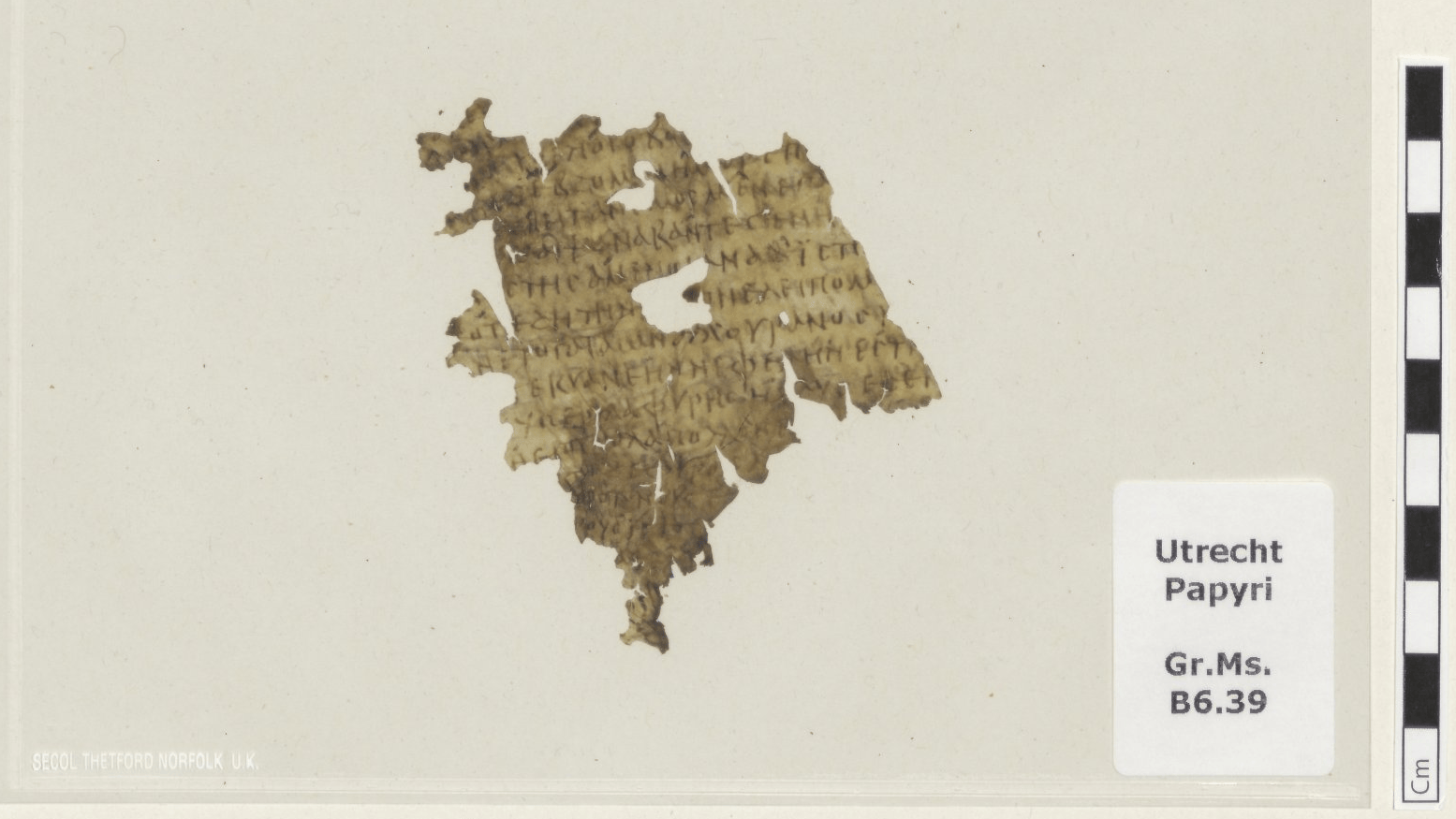
A researcher examining ancient Egyptian texts in a Dutch library made a remarkable discovery: a torn piece of parchment containing a section from Homer’s “Odyssey.” The fragment, dating back approximately 1,700 years to around A.D. 300, appears to originate from a pocket edition of the epic produced in Egypt.
Mark de Kreij, a Greek literature expert and professor at Radboud University in the Netherlands, identified the parchment while studying early Christian manuscripts in the collection of Utrecht University. The library acquired these manuscripts in the mid-20th century. Among a diverse collection of Egyptian and Greek texts, de Kreij recognized a tiny piece of parchment inscribed with familiar lines from Homer’s epic.
“There are so many boring parts in the Odyssey,” de Kreij told RTV Utrecht. “This happens to be a really fun passage.”
Measuring just 2.6 by 3 inches (6.6 by 7.7 centimeters), the newly found fragment contains verses from Book 12 of the epic. This section describes the moment the sun god Helios discovers that Odysseus’ men have slaughtered and consumed his “immortal” cattle.
In the narrative, Odysseus was warned by the goddess Circe to avoid the island of Thrinacia, home to Helios. However, after surviving the six-headed monster Scylla and the monstrous whirlpool Charybdis, Odysseus and his men are forced to land on the island to find food. Odysseus instructs his crew not to harm the sacred cattle, but after a month of severe storms depletes their food supplies, Eurylochus and the men kill and eat the cattle. Upon learning of this transgression, Helios demands vengeance from the gods, and Zeus destroys their ship, leaving Odysseus as the sole survivor.
This discovery marks the second time in 2024 that a fragment of a Homeric epic has been unexpectedly found. In the spring, archaeologists in Egypt recovered papyrus fragments of the “Iliad,” which recounts the legendary Trojan War, from inside a Roman-era mummy.
Both the “Iliad” and the “Odyssey” were composed in the late eighth or early seventh century B.C., detailing the ten-year Trojan War and Odysseus’s ten-year journey back to Ithaca, respectively.
The newly discovered fragment likely belonged to a parchment codex from the third or fourth century A.D. originating from the Fayum oasis in Egypt. Experts estimate that only about 30 similar fragments have ever been found. De Kreij noted that the fragment’s survival may be attributed to its position in the middle of the pocket-sized “Odyssey,” where it was protected by surrounding pages.
It remains unclear how the fragment ended up integrated into the larger collection of ancient Egyptian texts. Although de Kreij first spotted the fragment in 2024, his comprehensive study of Utrecht University’s collection of Greco-Roman texts from Egypt will soon be published as a book titled “Hieratic, Demotic, Greek, and Coptic Texts in the Utrecht University Collection.”


