




Bitcoin and gold are exhibiting their tightest trading relationship in years, even as recent macro volatility has tested the boundaries of that convergence.
Their 90-day correlation has climbed to approximately 0.55, the highest level recorded in nearly six years. Meanwhile, Bitcoin’s volatility sits at 36.2% compared to gold’s 25.3%, placing Bitcoin at just 1.43 times the volatility of the precious metal—a dramatic decline from the 5.6 times ratio observed in 2021.
However, the latest period of macroeconomic stress has generated a notable divergence between the two assets. Gold fell from nearly $4,700 on August 25 to as low as $4,342 on September 1 as Treasury yields climbed and Federal Reserve rate-hike expectations intensified.
During this same period, Bitcoin maintained levels around $77,000, only a few percentage points below its late August mark, and has since recovered beyond $80,000 as of the time of writing.
Gold Closes the Volatility Gap Once Dominated by Bitcoin
The most unusual dimension of this shift lies in how much of the convergence has been driven by gold becoming increasingly volatile.
Bitcoin’s current 90-day volatility places it around the 10th percentile of its own historical range, while gold sits in the 93rd percentile, according to Bitcoin analyst Adam Livingston. The ratio between the two assets’ volatility has remained below two for 177 consecutive sessions.

Between 2020 and 2025, only 82 such sessions occurred in total.
Bitcoin continues to move actively. Its average volatility has risen to roughly 44% this year from 41%, while gold’s has climbed to approximately 30% from 18%, according to Livingston. Every trading session over the past six years in which gold’s 90-day volatility exceeded 25% has taken place during 2026.
This places the traditional safe-haven asset in one of its most turbulent periods, as Bitcoin navigates an unusually subdued stretch by cryptocurrency benchmarks.
The narrowing gap has coincided with a stronger relationship between their returns. Bitwise reported that Bitcoin’s three-month rolling correlation with gold reached its highest level since 2020 at the end of August, utilizing Bloomberg data extending back to 2015.

Macro Stress Drew the Two Assets Closer Together
The previous correlation peak followed the COVID crisis, which triggered unprecedented fiscal spending and monetary stimulus. Bitwise identifies a comparable dynamic now reasserting itself.
Long-term Treasury yields climbed sharply in August before the US Treasury expanded its purchases of longer-dated securities. Bitcoin gained 22.4% in the week following the intervention, while gold rose approximately 5% and equities declined, according to Bitwise.
The underlying conditions have renewed concerns regarding deficits, sovereign borrowing, and currency debasement as US federal debt surpassed $40 trillion.
Grayscale observed the same shift from a different vantage point. Bitcoin’s 90-day correlation with the Nasdaq 100 has declined from above 60% to roughly 33%, while its correlation with gold has risen from barely above zero at the start of the year to more than 50%.
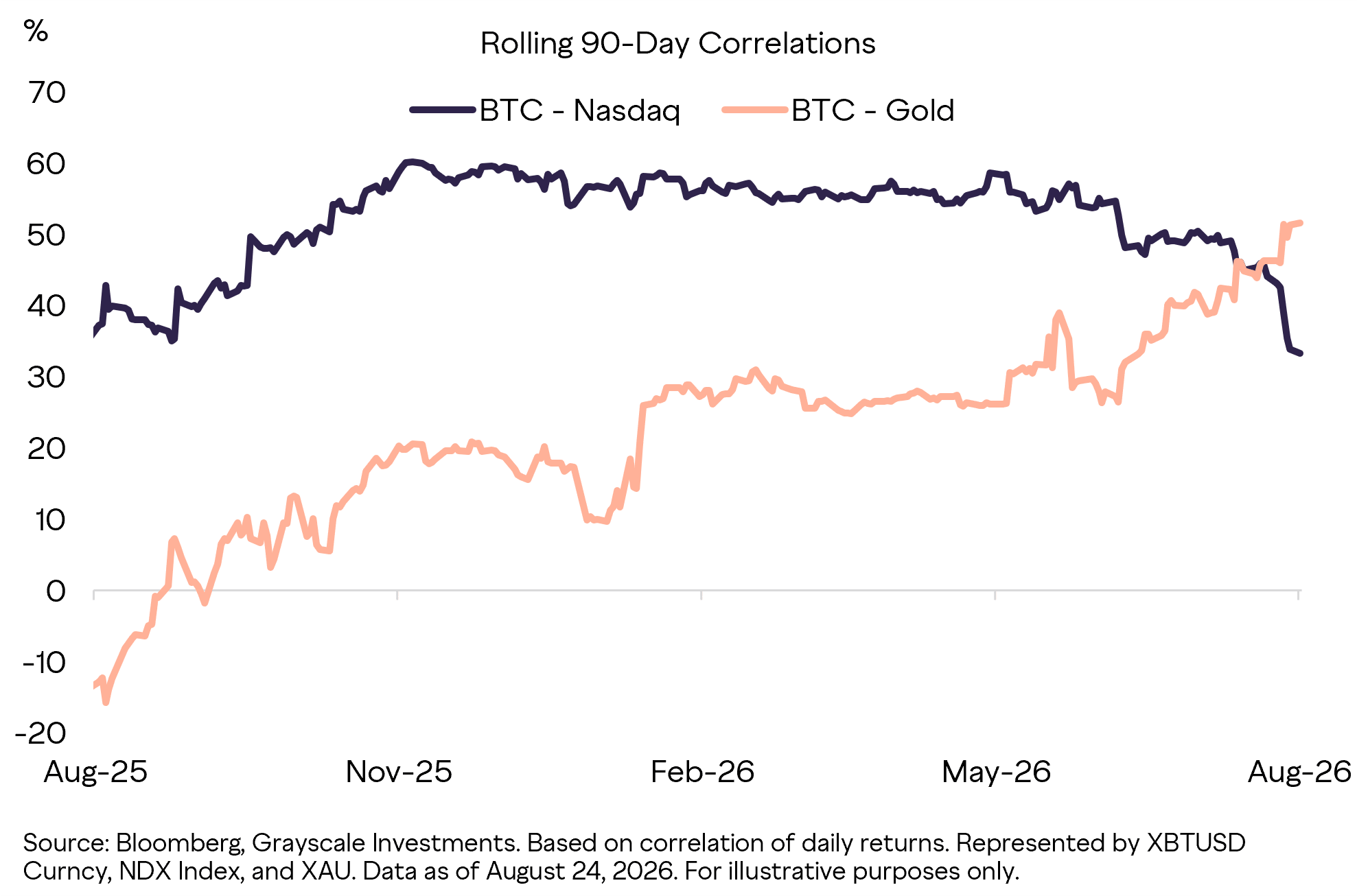
Bloomberg Intelligence senior ETF analyst Eric Balchunas observed that Bitcoin has maintained a lower correlation with US stocks over the past six months than gold, small-cap equities, emerging-market stocks, and even Treasuries.
Balchunas cautioned that the observation window remains short and noted that Bitcoin’s historical relationship with stocks has averaged approximately 0.40. Some of the recent shifts reflect gold and Treasuries becoming more correlated with equities rather than Bitcoin undergoing a fundamental transformation.
The data indicates that both markets have grown increasingly responsive to many of the same macroeconomic forces.
Gold’s Selloff Tests the Convergence
This week provided the first meaningful stress test of this evolving relationship.
Gold declined more than 7% from its August 25 peak near $4,696 to approximately $4,342 on September 1 as Treasury yields climbed and traders rapidly repriced Federal Reserve policy expectations. The US 10-year yield approached 4.8%, while elevated oil prices intensified concerns that inflation could keep monetary policy restrictive for an extended period.
Traders had assigned roughly a 38% probability to a September rate increase when gold approached $4,700. By Thursday, that probability had climbed above 60% before remarks from Fed Governor Christopher Waller prompted markets to pare back those bets.
These developments have left gold unusually sensitive to changes in interest rates, energy markets, and currencies, even as longer-term concerns regarding government debt and fiat debasement continue to provide underlying support.
Ole Hansen, head of commodity strategy at Saxo Bank, noted that precious metals had rebounded for a second session as softer US economic data and easing oil-related pressure helped temper the climb in bond yields. A weaker dollar, particularly against the Japanese yen, provided additional support.
He remarked:
“For now, gold’s inverse correlation with oil prices and bond yields remains a key focus, sidelining other potentially supportive drivers.”
This dynamic helps explain why gold can weaken even while longer-term concerns over debt and currency debasement persist. Higher oil prices can elevate inflation expectations and bond yields, increasing the opportunity cost of holding non-yielding bullion.
Bitcoin has absorbed the same tightening shock with considerably less damage, with the leading cryptocurrency trading above $80,000.
Ryan Lee, chief analyst at Bitget, explained that BTC’s resilience can be attributed to cleaner positioning following recent liquidations that cleared excess leverage from the market. Moderate perpetual funding rates and ETF demand have provided additional support, even as daily fund flows remain inconsistent.
US spot Bitcoin ETFs recorded $101.2 million in inflows on September 2 after posting $236.5 million in outflows the previous day. The funds have nonetheless attracted more than $3 billion over the past 30 days, establishing a substantial spot-demand foundation beneath a market that has thus far avoided another major liquidation cascade.
Lee indicated that a sustained hold around $76,000 to $77,000, combined with contained funding rates and steadier ETF demand, would reinforce the case that spot buyers are underpinning the market. Persistent ETF redemptions, a stronger dollar, or another surge in rate expectations would place that support under greater pressure.
September 3 demonstrated how rapidly these inputs can shift. Waller indicated that he could support maintaining rates unchanged in September if incoming inflation data showed further improvement, prompting traders to reduce the probability of a rate hike from above 60% toward even odds.
Gold rose approximately 2% toward $4,473 as Treasury yields and the dollar eased, while Bitcoin reached an intraday high above $81,000.
Bitcoin and gold are increasingly being shaped by the same fiscal, currency, and interest-rate dynamics, though the transmission mechanisms differ.
Gold remains acutely sensitive to real yields, the dollar, and energy-driven inflation expectations, while Bitcoin’s recent performance also reflects cryptocurrency-specific conditions including leverage, funding rates, and ETF flows.
Their longer-term relationship continues to tighten. The more challenging question is whether this convergence will persist when the same macroeconomic shock generates distinctly different pressures within each market.
Also Read
- Swiss Franc Softens as Unemployment Data Nears Release
- Reserve Bank Deputy Governor Suggests Year-End Rate Hike Is More Probable Than October Move
- EUR/JPY Price Forecast: Trades near 181.50 after rebounding from descending channel bottom
- Monad Mainnet Upgrade Drastically Cuts Data Storage Costs with Page-Based Gas Pricing