




Without warning, a woman experienced uncontrollable shaking in her right arm and leg. In the moments preceding the episode, she appeared perfectly healthy—reporting no headache, confusion, or weakness. Yet for approximately a minute, her right side jerked involuntarily.
The woman, a rice farmer from the Philippines, went to the emergency department. A physical examination revealed no abnormalities. However, when doctors imaged her brain, they found a bright cluster of nodules surrounded by fluid in her left frontal lobe. The medical team immediately suspected worm eggs.
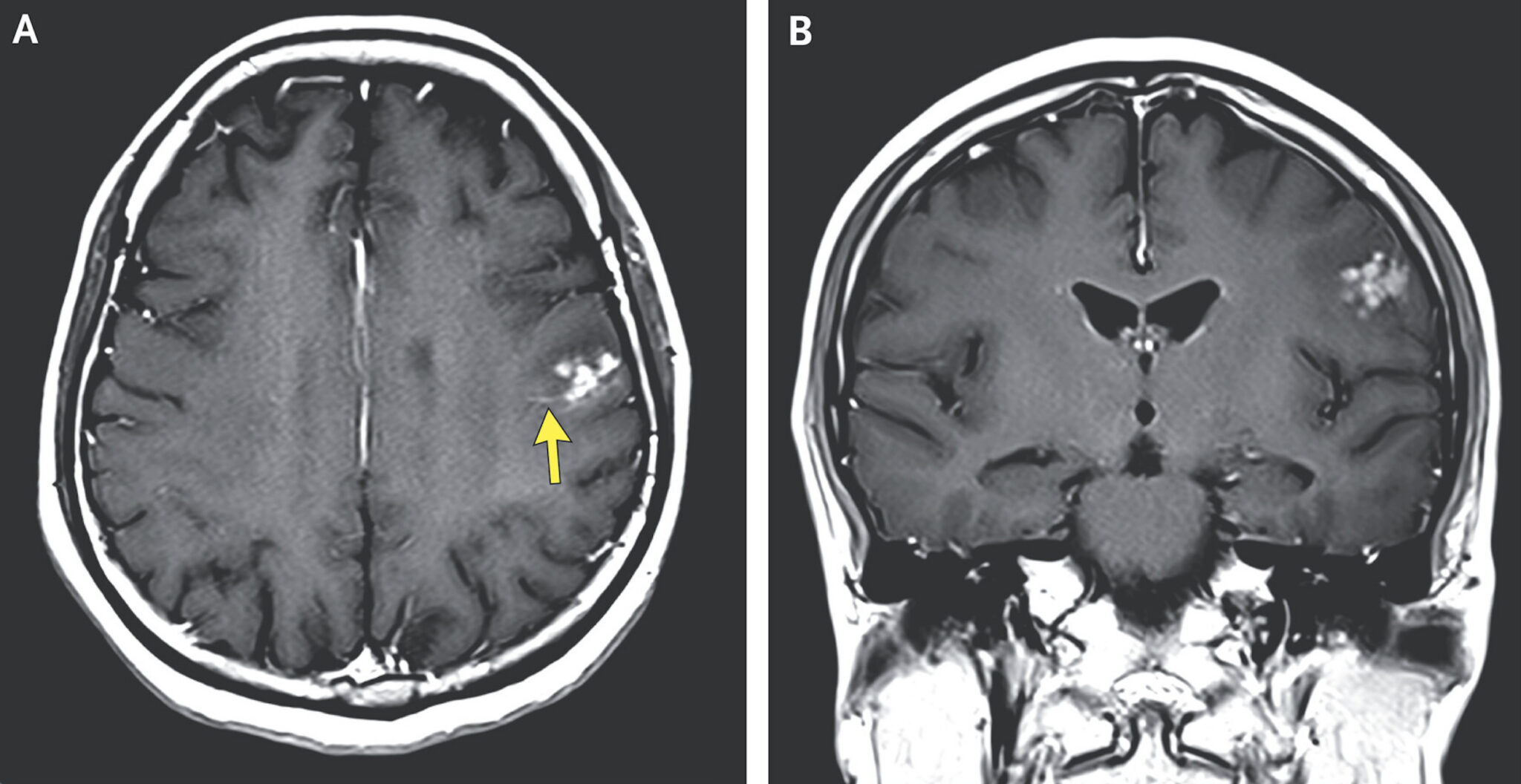
An MRI of the woman’s brain showing nodules. An MRI of the woman’s brain showing nodules. NEJM, 2026
Credit:
In a case report published in the latest issue of the New England Journal of Medicine, physicians describe their suspicion that the woman was suffering from neuroschistosomiasis—a rare complication of infection by a Schistosoma parasitic worm, commonly known as a blood fluke. In the Philippines, the predominant species is S. japonicum. The parasite is also present in China and parts of Indonesia; despite its name, it has been eradicated from Japan.
A Remarkable Parasite
S. japonicum, like its relatives, follows a remarkably complex life cycle that begins when its eggs are shed in the urine or feces of various animal hosts, including humans. Under favorable conditions, the eggs hatch into free-swimming larvae. These larvae seek out and penetrate specific species of aquatic snails, in which they undergo two developmental stages. Mature larvae then emerge, develop a forked tail, and swim outward in search of a definitive host. These tailed larvae, known as cercariae, can burrow directly through intact skin and travel through the vascular system—passing through the lungs, heart, and ultimately the liver, where they mature into adults.
The adult male and female worms live in permanent pairs, with the slender female nestled within a groove along the broader male. The paired worms typically migrate to large abdominal blood vessels connecting the liver to the intestines. There, they release vast numbers of eggs that are subsequently excreted in feces and urine, continuing the cycle.
Also Read
- Apple weighs its first server since the Xserve, and as always, Nvidia may hold the key
- Metal Detectorist Uncovers Vast Roman Silver Hoard from Era of Emperor Hadrian in Germany
- Rabbit Launches Standalone AI Agent That Runs Without R1 Hardware
- Ancient Peace Treaty Fragment Discovered in Turkish Excavation Links Past and Present