



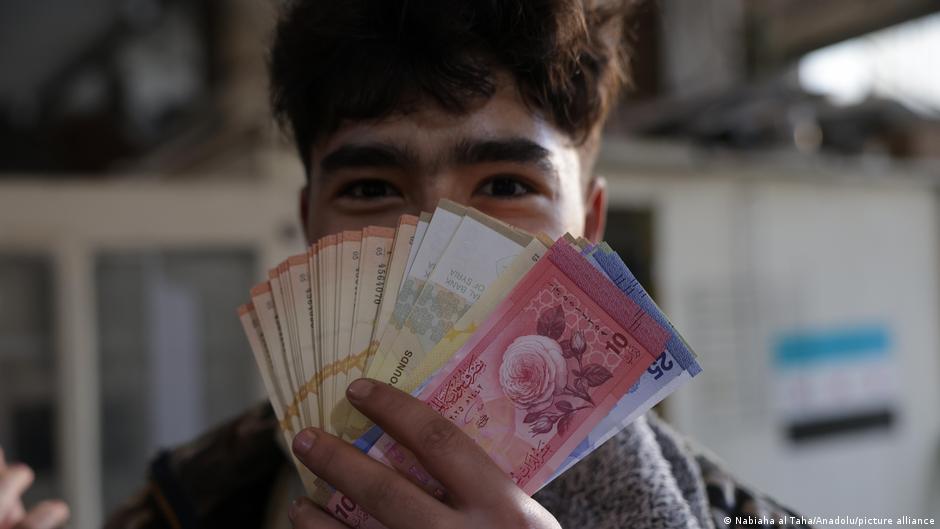
Kanan Abdullah has worked as a driver in the Syrian capital, Damascus, for roughly 12 years. Like many in his profession, he is now struggling to make ends meet following recent sharp increases in fuel prices across Syria.
“You’re left with almost nothing at the end of the day,” he told DW. “You have enough to buy another tank of gas, but how are you supposed to buy food? Or what if you need money set aside to repair the car?” he complained.
His potential passengers feel the same strain. “People are starting to worry about how they’re going to get to work and get home, because transport alone is costing them half their pay,” added Kamar Kasoum, a local mother of three.
In mid-September, the Syrian government raised the price of all kinds of fuel, including petrol and diesel. Diesel saw the biggest hike, rising by 40%. The energy ministry explained that such changes were necessary due to higher global fuel costs—Syria remains dependent on energy imports—as well as local supply shortages.
Widest Protests Since the Fall of the Assad Regime
The move triggered some of the most widespread protests Syria has seen since the dictatorial Assad regime was toppled in late 2024. While fuel prices are still comparable with other countries in the region, Syrians are struggling due to lower purchasing power, experts say. Demonstrators burned tires, blocked roads, and called for the dismissal of politicians they held responsible.
The protests subsided as the Syrian government walked back some of the changes and announced plans to subsidize diesel for heating, agriculture, and industry.
But higher fuel prices are only the latest factor adding inflationary pressure on ordinary Syrians. In its most recent bulletin on the consumer price index, the Syrian Center for Policy Research says prices increased by almost 25% between July 2025 and July 2026. Worryingly, the highest price increases—around 37%—were on “essential expenditure” such as housing, water, electricity, and gas.
“There is no sensible correlation between the income an individual earns in Syria and the prices they’re paying,” Alaa Sndyan, an architect in Damascus, told DW. “People are starting to feel the pinch; they feel that prices have gotten way too high.”
“And these protests and demonstrations didn’t just come out of nowhere,” Kamar Kasoum added. “We’re at the point where we can’t even say we’re just cutting back on non-priorities. It’s like, let’s just stick to eating and drinking. Nothing else.”
Economic Growth in Syria — But for Whom?
All this is happening despite what appears to be a lot of good news about the Syrian economy. There are regular reports of billion-dollar international investments and projects. Speaking at the Arab Media Summit in Dubai on Tuesday, Syrian President Ahmad al-Sharaa predicted Syria’s economy would be worth around $50 billion (approximately €44 billion) this year, up from around $20 billion in 2024.
But this much-celebrated prosperity doesn’t seem to be reaching ordinary Syrians, over two-thirds of whom still live in comparative poverty, according to the United Nations.
A New Syria for ‘the Rich’?
Damascus architect Sndyan said it was hard to tell who was benefitting from economic development. “With a lot of the projects being announced now, we don’t see anything happening on the ground; there’s no impact on the real world,” she argued. “And I always feel like these projects are aimed at a specific demographic: the affluent class. I’m not sure these projects are actually for the people.”
Sndyan added that she felt as if ordinary people who lost everything during Syria’s civil war were being forgotten in the midst of various grand plans. She said she would also like to see more transparency and better communication from the government regarding its plans.
She is not the only one. There has been plenty of criticism regarding the direction of Syria’s economic planning, as well as concerns that it may benefit the already-wealthy the most.
More extreme anti-government activists have pointed to the luxury watches some Syrian politicians appear to be wearing, making accusations of “crony capitalism” and suggesting the government is diverting funds into the military to secure its own power. None of those accusations are verified.
But criticism has also come from more moderate quarters. In an August story, the Syrian outlet Al Jumhuriya looked into the billion-dollar real estate projects announced around the country. These are mostly comprised of gated communities and luxury apartments, it said. In a country with a major housing crisis, “who will actually be able to live in these projects?” the publication asked.
‘Neo-Liberal’ Policies Not Suitable
There is concern that old patterns are being repeated. “As certain pre-existing forms of corruption and extraction change, new channels of privilege are emerging—albeit with new winners and losers,” the Syrian think tank Etana argued in an analysis this week.
Observers say the neo-liberal style reforms the Syrian government is currently committed to will only worsen this problem and, in the longer run, cause the same kinds of social problems that sparked Syria’s revolution in 2011.
When the new Syrian government first took control in late 2024, ordinary Syrians were willing to give them a chance. But monthly polling by the magazine Syria in Transition indicates patience is wearing thin. By April this year, “the most serious deterioration was in attitudes toward the economy … only 13% of respondents now believed the government was doing enough to tackle soaring energy and food prices, while 66% said its efforts were insufficient,” the magazine noted.
“The country’s new leaders have undertaken a shock therapy program of economic liberalization without, it seems, fully accounting for the acute vulnerability and poverty of most Syrians,” Sam Heller, an analyst with the New York-based think tank Century International, pointed out in Foreign Affairs magazine this week.
And that is not suitable, researcher Joseph Daher, an expert on Syria’s political economy, argued in an analysis for the online bilingual outlet Syria Untold. “In countries emerging from conflict, ‘success’ cannot be measured solely by fiscal surpluses or price stability,” he wrote. “True success is measured by the ability of fiscal policy to rebuild citizenship, justice, institutional capacity, and public trust.”
To do that, the Syrian government needs to change its policies, Karam Shaar, director of the Karam Shaar Advisory, a New Zealand-based consultancy for Syrian economic affairs, said during an online interview last week. Some of what the new authorities have done was necessary given the post-war situation, he conceded, but now more transparency, expertise, and better governance are needed.
“I think they are starting to realize that, and I continue to have a bit of hope that this will indeed happen,” Shaar concluded.
Edited by: Anne Thomas
Also Read
- Lucid Motors Enters Critical Turnaround Phase Following Operational Review
- At least 11 people killed in South Africa township shooting
- Israel Condemns Macron’s UN Remarks on West Bank as ‘Staggering Absurdity’
- GE HealthCare Appoints Finance Executive Pascal Desroches To Board; Boosts Q3 Cash Dividend