



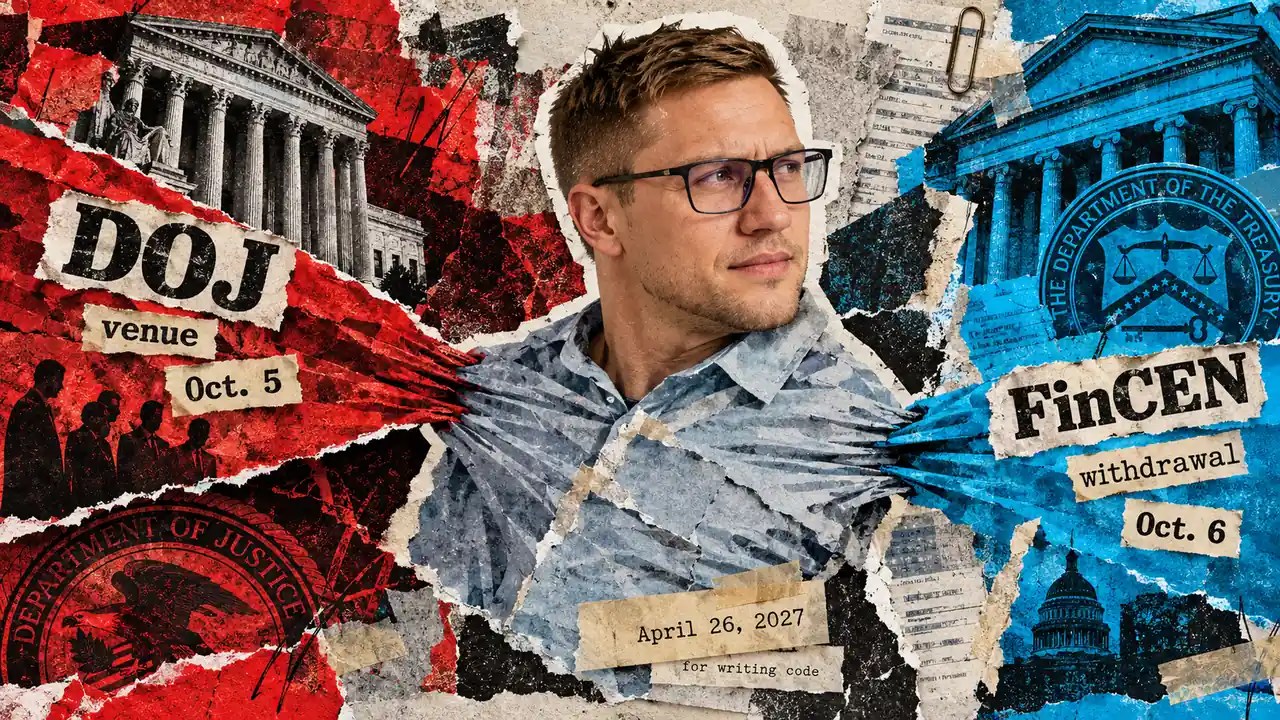
Federal prosecutors are leveraging a new Bitcoin Fog precedent to defend pursuing two money-laundering and money-transmission conspiracy charges against Roman Storm in New York. Their October 5 filing urges Judge Katherine Polk Failla to reject Storm’s challenge to the case’s venue in Manhattan. Storm, a co-founder of Tornado Cash—a cryptocurrency mixer that obscures transaction trails—faces allegations of participating in criminal activity.
The filing coincides with the Treasury Department’s decision to rescind its broader mixer-reporting proposal. While the prosecution’s case hinges on claims that Storm knowingly engaged in illegal conduct, the policy shift acknowledges lawful financial privacy and limits certain regulatory applications. The boundary between lawful development and criminal conduct remains contested.
Storm, active on X as @rstormsf, has characterized potential imprisonment as punishment “for writing code,” contrasting it with Treasury’s retreat from the proposed policy. His statements highlight the broader implications for privacy-focused developers navigating legal boundaries.
Storm currently faces an August 2025 conviction on one money-transmission conspiracy count, carrying a maximum sentence of five years. A court order set his retrial for April 26, 2027, pending his motion to dismiss and requested continuance.
Prosecutors cite the September 25 D.C. Circuit ruling in *United States v. Sterlingov*, involving another cryptocurrency mixer, as precedent for venue challenges. Their argument centers on Manhattan resident Shakeeb Ahmed, whose deposits allegedly expanded Tornado Cash’s anonymity pool, hindering fund traceability. Prosecutors assert that serving a customer in New York supports venue for the money-transmission charge.
Policy Shift Does Not Resolve Criminal Case
The Treasury’s Financial Crimes Enforcement Network (FinCEN) withdrew its 2023 proposal for enhanced reporting and recordkeeping requirements for international cryptocurrency mixing services. The October 5 notice, published October 6, cited concerns over a “chilling effect on legitimate activity” and regulatory burdens on financial institutions. FinCEN affirms protections for lawful financial privacy while maintaining oversight of money laundering and terrorist financing risks. This withdrawal reverses an administrative measure, not criminal statutes or pending litigation.
DOJ leadership mirrored this shift with a deputy attorney general memo dated April 7, 2025, directing prosecutors to limit mixer-related prosecutions against unwitting users or those violating only regulatory provisions. The memo excludes Section 1960(b)(1)(C)—which addresses funds known to originate from criminal activity or intended for unlawful purposes—from these restrictions.
In August 2025, DOJ official Matthew Galeotti clarified that software qualifying as truly decentralized, automating peer-to-peer transactions without custodial control, remains protected from new charges. However, existing convictions and charges involving alleged criminal intent may proceed. Storm’s current case predates these policy adjustments, leaving his legal status unchanged.
DOJ argues Storm facilitated criminal transactions through Tornado Cash despite awareness of unlawful use, including code development, maintenance, and enrichment of the service. Storm disputes treating developer activity as criminal conduct, contending such prosecution undermines innovation and legal liability boundaries.
Prosecutors emphasized their theory at a hearing on April 9, 2026, asserting that even legitimate deposits contributed to obscuring criminal funds. They distinguished between depositors who unknowingly used the service and developers accused of orchestrating the operation. Judge Failla questioned whether this theory sufficiently established willful participation, focusing on arguments that Storm and co-defendants actively maintained and expanded the mixer beyond passive operations.
Ulbricht Pardon Remains Distinct
Comparisons to Ross Ulbricht’s 2025 presidential pardon by Donald Trump underscore unique legal pathways. While Ulbricht received individual clemency for Silk Road-related convictions, this does not extend to Storm or establish precedent for crypto developers. Individual pardons remain exceptional and do not signal statutory changes or case-wide resolutions.
Upcoming judicial rulings on venue challenges, motions to dismiss, and further proceedings will determine the case’s trajectory. Regulatory and policy shifts toward crypto privacy have not conclusively resolved the contested criminal charges.