



The initiative is intended to protect Europe’s automobile industry from what the EU considers China’s unfair trade practices. The European Union’s Industrial Accelerator Act (IAA), proposed in March, seeks to strengthen European car factories and to offer public support only for vehicles produced in Europe.
Still, the EU’s “Made in Europe” approach is prompting deep concern among allied automotive nations, including Turkey, Morocco, Japan and South Korea, all of which are deeply embedded in European supply chains.
After months of deadlock over the IAA’s potential impact on their own vehicle production, Germany and France reached a key compromise earlier this month that would allow suppliers from non-EU countries such as the United Kingdom and Norway to qualify for “European origin” status.
The legacy car industry is in crisis. How can it move on?
To view this video please enable JavaScript, and consider upgrading to a web browser that supports HTML5 video
Close to Europe, but not close enough
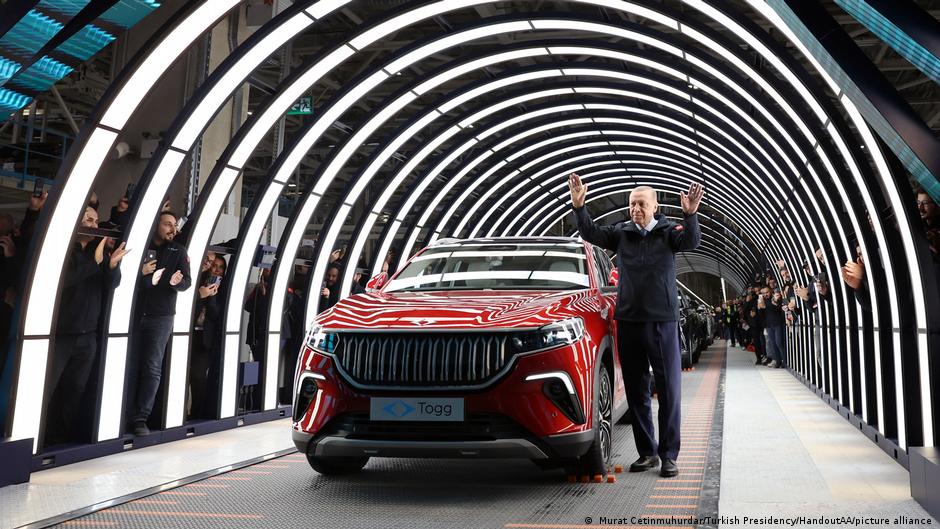
Other significant players in the automotive sector are expected to be excluded, including Turkey, which has enjoyed open access to the EU market since the mid-1990s.
Although the proposals still face major legislative hurdles in Brussels before becoming law, Ayhan Zeytinoglu, chairman of the Economic Development Foundation (IKV), said the Franco-German framework could seriously affect Turkey’s automotive sector.
“73% of Turkey’s total automotive exports go to the EU,” Zeytinoglu told DW. “If we encounter a ‘Made in Europe’ barrier in the EU market, this will cause serious damage to our trade with the EU and to our exports.”
Excluding Turkey would also harm European automakers rather than strengthen competitiveness against China, he added.
Turkey’s automotive exporters association, OIB, calculated that the country’s automotive exports to the EU totaled $30.1 billion (€26.8 billion) last year.
Protecting auto parts made in Europe
The IAA requires that 70% of a vehicle’s total components value, excluding the battery, come from Europe.
However, the initial proposal applied only to battery-electric vehicles, plug-in hybrids and fuel-cell models, which last year accounted for just 27% of all new EU car registrations.
Tommaso Pardi, director of the international automotive research network GERPISA and a senior researcher at the French National Center for Scientific Research (CNRS), said the 70% target was notably generous.
“If you take an average European-made electric car and remove the battery, you would find that around 83% of parts come from Europe,” Pardi told DW.
Under the revised German-French plan, some self-charging hybrids and petrol and diesel vehicles could still be sold after 2035 and would also be affected by the “Made in Europe” rules.
These vehicles contain a much lower proportion of European components. Most of Turkey’s nearly 800,000 vehicle exports to the EU last year would fall under this broader category.
Europe’s EV battery problem: Can it catch up with China?
To view this video please enable JavaScript, and consider upgrading to a web browser that supports HTML5 video
China seeks a side entrance
Another reason Turkey may be excluded is that Chinese automakers are expanding there, hoping to gain backdoor access to the EU market while facing major roadblocks.
They include SWM Motors, whose factory in the northwestern city of Eskisehir closed within a year because the vehicles produced did not meet EU safety standards.
BYD’s plans to open a $1 billion plant in Manisa, a large industrial hub near the Aegean coast, have been put on hold.
Morocco, meanwhile, has received Chinese investments worth more than €10 billion ($11 billion) since the COVID-19 pandemic, according to consultancy AlixPartners, much of it in batteries and auto parts.
For France, the North African nation plays a similar role to China for Germany’s auto sector: a low-cost production hub that helps French carmakers stay competitive. Budget-friendly French models would likely become more expensive if Morocco were excluded.
Japanese automakers, which build several models in European factories, could also lose out. Cars imported from Japan would not qualify for EU subsidies, while models built in France, Portugal and Eastern Europe would benefit only if enough of their parts come from Europe.
South Korean automakers could also be hurt. Hyundai and Kia build cars in the Czech Republic and Slovakia, but also ship models from Asia, which would not qualify. Korean battery plants in Poland and Hungary, however, would count as European.
Carmakers fight to keep cheap imports
Pardi noted how European car giants are actively lobbying to water down the IAA to protect their high profit margins.
“They want to limit the IAA to retain the largest possible scope to source from abroad, particularly from China,” he said.
EU-based automakers warn that higher parts costs would put them at an even greater disadvantage against Chinese rivals, while European battery supply is unlikely to meet demand anytime soon.
Ankara is also lobbying Brussels to be included in the “Made in Europe” program, while automakers are seeking a compromise that would allow Turkey to join at a later stage.
Pardi said this would be “only for European companies that are based there [Turkey and Morocco] … while excluding all recent investments involving Chinese capital [in those countries].”
EU to weaken combustion engine ban amid industry pressure
To view this video please enable JavaScript, and consider upgrading to a web browser that supports HTML5 video
‘Stop the bleeding’ say auto parts suppliers
European auto-parts suppliers, however, are on the opposite side of the argument, calling for further strengthening of the IAA. They warn that up to 650,000 auto jobs in the region could be lost by 2035 without better protection for their members.
“A lost industrial job is very hard to win back, and the damage reaches well beyond large suppliers,” Benjamin Krieger, Secretary General of the European Association of Automotive Suppliers (CLEPA), told DW.
Krieger believes the IAA helps European industry level the playing field against unfair competition from China, adding: “We must stop the bleeding.”
With broad public support for measures that ensure EU public funding benefits value creation in Europe, CLEPA’s Krieger thinks allies such as Turkey, Morocco, South Korea and Japan may not lose out if they meet the EU’s criteria.
“The EU should offer access to the IAA through an opt-in mechanism with objective criteria: regulatory alignment, social and environmental standards, no market distortion, respect for the rule of law and reciprocity, backed by anti-circumvention measures. Partners that meet them are welcome,” he said.
Also Read
- MSG just spun off the Knicks and Rangers. How one analyst sees them trading
- Saudi and Kuwaiti Foreign Ministers Meet in Riyadh to Discuss Regional Security and Bilateral Ties
- Turkey Urges Russia and Ukraine to Halt Black Sea Shipping Attacks as Tensions Escalate
- Spanish Copa del Rey Fixtures Cancelled After Central Spain Train Tragedy