




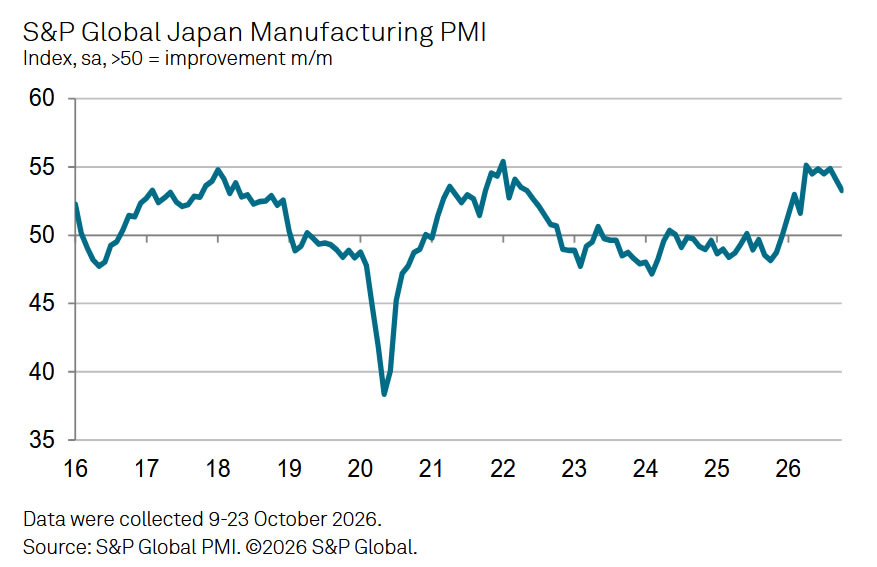
In October, Japan’s manufacturing sector saw its pace of expansion ease, with the S&P Global PMI falling to 53.3 from 54.1—the lowest level in seven months. Nonetheless, the index remained above its long‑term average of 50.6, signalling still solid growth in operating conditions. Output and new‑order gains slowed to their weakest since March, though production continued to rise for a tenth straight month. Semiconductor and AI‑related demand kept feeding new business, both domestically and overseas, even as overall sales momentum waned.
Capacity pressures remained evident even as growth slowed. Hiring stayed robust, approaching the strongest pace in eight‑and‑a‑half years, and work backlogs grew at an accelerated rate. Input costs began rising again for the first time in five months, driven by higher oil, raw‑material and component prices. Factory‑gate prices kept climbing at a historically strong rate, though the pace of increase slowed to a six‑month low. Anticipating further price rises, firms built up purchase stocks at the fastest rate in nearly four years.
The October data indicate that Japan’s manufacturing is slowing in expansion rather than losing underlying strength. Ongoing hiring, rising order backlogs and improving business confidence continue to support activity, despite weaker output and new‑order momentum. Expectations for future production hit an eight‑month high, reflecting manufacturers’ constructive outlook even as cost pressures mount and growth moderates.
Data Summary
Japan PMI Manufacturing — October 2026
Indicator
Sep
Oct
PMI Manufacturing
54.1
53.3
Components
Component
October Trend
Output
Slowest growth in seven months
New Orders
Slowest growth since Mar
Export Orders
Slowest growth since Mar
Employment
Strong hiring pace maintained
Backlogs
Solid, faster increase
Purchasing Activity
Slowest growth in six months
Stocks of Purchases
Fastest increase in almost four years
Input Prices
Inflation accelerated
Output Prices
Inflation eased to six-month low
Business Confidence
Eight-month high
Key Takeaways
- Manufacturing expansion moderated: PMI fell to 53.3 from 54.1, a seven‑month low, yet stayed above the long‑run average of 50.6, signalling solid improvement.
- Demand growth softened despite AI support: Output and new orders rose at their slowest pace in seven months, while semiconductor and AI demand continued to bolster domestic and export orders.
- Capacity pressures persisted: Robust hiring and rising backlogs indicated ongoing strain on operating capacity despite slower new‑business growth.
- Cost pressures intensified: Input inflation accelerated amid higher oil, raw‑material and component prices, prompting firms to boost purchase stocks at the fastest rate in nearly four years.
- Business confidence improved: Expectations for future output reached an eight‑month high, supporting a constructive view of manufacturing prospects.
Also Read
- Weekly Earnings Preview: Apple, AMD, Palantir, Arm, McDonald’s, and Uber to Report Key Results
- Cardano’s 2027 Budget Proposal Balances Institutional Stewardship with Direct Grant Access
- STOXX 600 Analysis: Shell, Sartorius Stedim and Verbund Lead as Banking Stocks Retreat
- Binance Sees $2.5 Billion in Outflows as Withdrawals Resume Following Security Breach