



Kosovo Woman Murdered After Repeatedly Seeking Police Protection Ignored
Arlinda Zekaj repeatedly urged the Kosovo police for protection, but authorities dismissed her claims as exaggeration.
On October 25, the 49-year-old filed police reports regarding her husband again. This time, he was arrested. However, Zekaj further requested additional protection—specifically, safeguarding against threats from her husband’s family. Her request went unanswered.
The police escorted Arlinda Zekaj home, where her assailant awaited. At 8:58 p.m., Zekaj exited the squad car. Shortly thereafter, officers received an emergency distress call. At 9:10 p.m., when they arrived at her residence, they discovered only her lifeless body.
The 49-year-old was fatally attacked in her bedroom with an axe. By then, the presumed killer—her brother-in-law Albert Sylaj—had fled the scene.
Protests across Kosovo
The killing, which occurred in the village of Vitomirica near Peja in western Kosovo, has ignited widespread public protests and demonstrations drawing thousands of participants nationwide.
This marks the eighth femicide in Kosovo this year—its most brutal to date.
More than any other femicide in recent years, Zekaj’s death revealed how the failure of police and prosecutors to heed the victim’s appeals enabled the murder to unfold.
Ministers refuse to resign
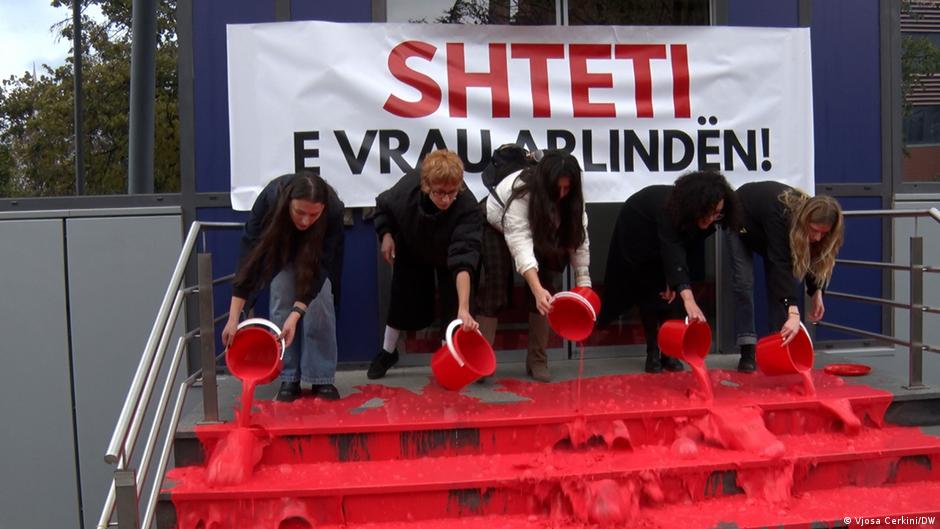
One of the first protests took place the following day, on October 26, when a group of feminists emptied buckets of red paint on steps outside the seat of Kosovo’s government in the capital, Pristina.
“The state killed Arlinda,” read a banner the activists hung at the entrance to the building.
In the days that followed and on November 1, public anger brought thousands of people onto streets across the country. Many carried photographs of murdered women. One slogan appeared again and again: “The government has blood on its hands.”
The protesters are demanding that charges be brought against the police officers and prosecutors responsible for handling the Zekaj case.
They are also calling for the resignation of Interior Minister Xhelal Svecla and Justice Minister Donika Gervalla, whom Kosovo Prime Minister Albin Kurti appointed national coordinator for protection against domestic violence in March.
Both Svecla and Gervalla have so far rejected calls to step down.
A murder foretold
In many ways, this was a murder foretold.
As far back as the summer, Arlinda Zekaj had reported her husband to the police for making threats against her. A court in Peja subsequently issued a protection order, granting her temporary custody of their son and giving her the right to remain in the family home.
The protection order allowed her husband to continue living in the same house, provided he did not come within two meters (about 6.5 feet) of her. Outside the home, he was required to keep a distance of at least 20 meters.
Zekaj had decided against moving to a women’s shelter because she wanted to continue living in her own home with her son.
Even after the protection order was issued, she repeatedly made complaints to the police, among other things about threats from her brother-in-law Albert Sylaj.
Three days before the killing, on October 22, Zekaj reported that members of her husband’s family, including Sylaj, were in her home against her wishes. According to her account, he threatened her with the words: “Leave or I’ll kill you.”
Nevertheless, Sylaj was questioned only as a witness in the case against Zekaj’s husband.
Police arrested him near Peja on October 27. He is now under investigation for murder.
‘A collapse of the state and society in relation to women’
Since 2010, 55 women in Kosovo have been killed by partners or family members, often after years of documented abuse and ignored complaints.
In recent years, successive Kosovo governments have adopted a number of laws and regulations aimed at better combating violence against women.
These measures include the possibility of life sentences for perpetrators in femicide cases.
Activists argue, however, that the authorities responsible for enforcing these measures—including police, social services, prosecutors and courts—have failed to implement them consistently and in a coordinated manner.
Writing in an article for the news portal Nacionale, lawyer Njomeza Zejnullahu said that “After every murder, we hear the same word: failure. ‘The institutions have failed.’ I disagree. Failure is when something happens once, when a system that normally works breaks down at one point. When the cases keep repeating themselves, when the victims are almost always women and each of them had previously knocked on the door of an institution, it is no longer a failure. It is a collapse of the state and society in relation to women in general.”
Also Read
- India Awards $5.7 Billion Corvette Contract to Domestic Shipyards GRSE and GSL
- UK PM Andy Burnham and Ed Miliband Perform Steel Drums in Antigua
- Record Number of Chinese-Descent Lawmakers Poised to Join U.S. Congress
- New York AG Letitia James Appoints Former Prosecutor to Lead Cornell Sexual Assault Investigation