



China aims to become a global leader in artificial intelligence, recognizing that advanced semiconductor technology is essential to achieve this ambition.
Vice Premier Ding Xuexiang, who chairs the Communist Party’s Commission on Science and Technology, has been appointed to boost China’s technological innovation capabilities, thereby enhancing its strategic competitiveness with the United States.
The Party is employing AI for citizen surveillance, developing advanced unmanned weapon systems, and driving economic transformation via robotics and industrial automation, among other applications.
However, the United States has remained at the forefront of chip manufacturing technology and design, and Washington has implemented a series of measures to preserve its dominance in this strategic sector.
As early as 2023, the Biden administration introduced restrictions on exporting advanced semiconductors and chip manufacturing equipment to China on national security grounds.
Beijing condemned the U.S. restrictions as unilateral and arbitrary.
Nevertheless, U.S. chipmakers have been attracted to China’s large and rapidly expanding market.
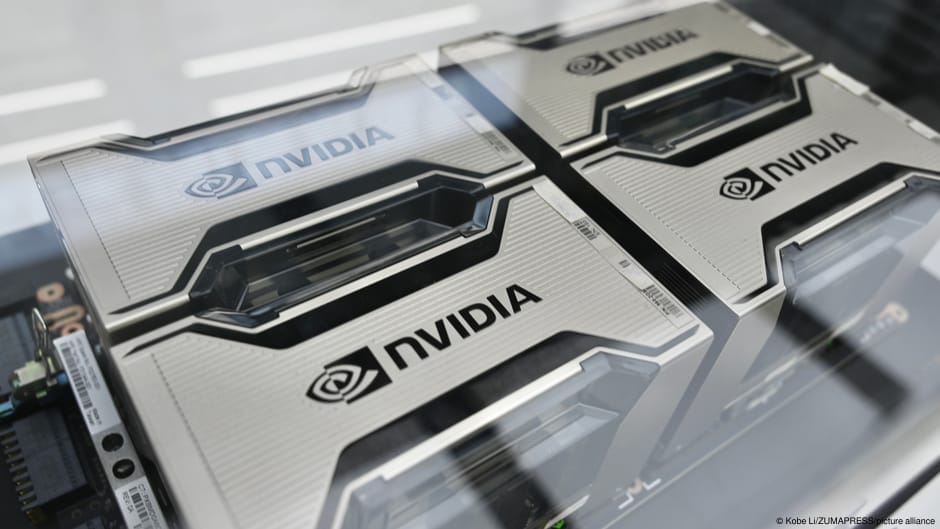
Jensen Huang, who stepped down as CEO of the U.S. AI chipmaker Nvidia last week, enjoyed iconic status in China. The 63‑year‑old, born in Taiwan, is regarded as a successful entrepreneur there.
Huang has become a key AI adviser to President Donald Trump during his second term and has advocated for more relaxed regulations and fewer restrictions on exporting AI chips to China.
In December, the Trump administration authorized Nvidia to ship its H200 chips to China, contingent on a 25 % share of sales being remitted to the United States.
Although the H200 is not part of Nvidia’s top‑tier product line, it is markedly more efficient than competing Chinese alternatives.
Each chip carries a price tag of $27,000 (€24,000), and Nvidia estimates Chinese demand at two million units, representing roughly $5.4 billion in sales.
US moves to restrict China’s access to chips
As early as 2023, the Biden administration introduced restrictions on exporting advanced semiconductors and chip manufacturing equipment to China on national security grounds.
Beijing condemned the U.S. restrictions as unilateral and arbitrary.
Nevertheless, U.S. chipmakers have been attracted to China’s large and rapidly expanding market.
Jensen Huang, who stepped down as CEO of the U.S. AI chipmaker Nvidia last week, enjoyed iconic status in China. The 63‑year‑old, born in Taiwan, is regarded as a successful entrepreneur there.
Huang has become a key AI adviser to President Donald Trump during his second term and has advocated for more relaxed regulations and fewer restrictions on exporting AI chips to China.
In December, the Trump administration authorized Nvidia to ship its H200 chips to China, contingent on a 25 % share of sales being remitted to the United States.
Although the H200 is not part of Nvidia’s top‑tier product line, it is markedly more efficient than competing Chinese alternatives.
Each chip carries a price tag of $27,000 (€24,000), and Nvidia estimates Chinese demand at two million units, representing roughly $5.4 billion in sales.
Nvidia affair and espionage allegations
The scandal sent shockwaves through the global AI and semiconductor sectors and sparked intense political debate in both China and the United States.
Washington, viewing its national security as threatened, is reportedly planning additional restrictions on China to close loopholes that enable Chinese firms to obtain advanced American semiconductors.
China, however, denied any attempt to involve Huang, characterizing the spying allegations as unsubstantiated and a smear campaign against Beijing.
Beijing also intensified its rhetoric ahead of the meeting between President Xi Jinping and former President Donald Trump at this week’s Asia‑Pacific Economic Cooperation (APEC) summit in Shenzhen, China.
‘China has consistently opposed the misuse of export‑control measures that threaten global industrial and supply‑chain stability, which is not in the interest of either party,’ Chinese Foreign Ministry spokesperson Mao Ning said on November 13.
Some Chinese media outlets have also criticized the reporting on this issue.
‘Jensen Huang cheated on his wife. What does that have to do with China?’ China’s state‑run Global Times newspaper asked in an editorial.
It accused U.S. media of turning the affair into a Hollywood thriller without presenting concrete evidence to substantiate the central allegations.
Many Chinese users have taken to the microblogging platform Weibo to comment on the controversy.
One user wrote that Huang’s downfall amounted to ‘political maneuvering within the United States,’ while another questioned, ‘Could a love affair really cause Mr. Huang to resign? Isn’t this plot a little too melodramatic?’
Underlying the verbal sparring is an economic calculation.
Is China buying more US chips?
Vice Premier Ding must decide whether China should continue relying on U.S. chips or support its domestic industry in the hope of achieving a breakthrough that would allow it to surpass American competitors.
For example, around 600,000 Nvidia H200 chips are currently stored in Hong Kong, awaiting Chinese import approval.
The White House has already granted its approval, but Beijing has yet to authorize the imports.
Karson Elmgren, research manager at the Institute for AI Policy and Strategy in Washington, finds this puzzling, noting that it suggests China does not consider short‑term gains decisive and is confident it can replace U.S. chips in the medium term.
Chinese AI products are increasingly employing domestically produced “Made in China” chips.
‘This effectively mitigates the risk of cyberattacks by foreign actors,’ wrote Tiantian Wang of the Harbin Institute of Technology in a recent study on China’s semiconductor strategy.
This applies not only to civilian sectors. ‘Against the backdrop of today’s complex geopolitical situation, strengthening autonomy and control over national defense and critical infrastructure has become a core element of the national security strategy,’ Wang explained.
According to her, for example, the radar systems on China’s fifth‑generation Chengdu J‑20 fighter jet and on the Dongfeng‑41 intercontinental ballistic missile are equipped exclusively with Chinese chips.
Wang underscored that China is increasingly focused on autonomous AI chip platforms developed domestically.
‘This has created a closed ecosystem encompassing data, algorithms, computing power, and chips, thereby reducing systemic dependence on foreign chips such as Nvidia,’ she added.
Will AI-powered autonomous weapons obey the laws of war?
To view this video please enable JavaScript, and consider upgrading to a web browser that supports HTML5 video
Nevertheless, China still lacks the production equipment required for cutting‑edge chips.
Chip manufacturing relies on lithography systems that expose raw silicon to ultraviolet light.
Bowing to pressure from Washington, Dutch lithography equipment maker ASML has halted exports of its most advanced machines to China.
The ban helps preserve the United States’ technological lead in AI chips, according to the Center for Technology & Statecraft, a Washington‑based think tank. If China were to import additional ASML systems, as it did in 2024 and 2025, its annual production could be enough to erode much of the U.S. lead and, in certain scenarios, even surpass it.
According to consulting firm Deloitte, China is planning extensive further investments, focusing on long‑term capital support and research incentives to foster sustainable innovation in key technologies.
Policymakers aim to stabilize the supply chain, expand self‑sufficiency, and actively manage risks, the study noted. ‘The focus is shifting from supporting individual companies to fostering synergies within the supply chain, establishing quality systems, and ensuring secure management of critical resources to promote a more resilient industrial structure.’
Also Read
- US Applauds Jennifer Warren’s Election to ITU Radio Regulations Board
- Yazidi Survivors Testify at Berlin Truth Commission on Genocide Atrocities
- After a Year of Going Nowhere, Kraft Heinz May Be Poised for a Turnaround
- Homs Children’s Book Fair Encourages Reading and Cultivates Young Literary Voices