




With Anthropic going public at a valuation above $1.4 trillion, a great many people in San Francisco are about to confront a choice they have never had to make before—and many are wrestling with the familiar sting of wishing they had invested more, and earlier.
So let’s run a thought experiment for the “everyday millionaire” in San Francisco. You get to choose one option, and only one:
Option 1: A fully remodeled, 4,500-square-foot, five-bedroom, five-bathroom single-family home on a generous lot with views in San Francisco, worth $7.5 million. Owned free and clear, with the keys handed over tomorrow.
Option 2: $8.5 million in Anthropic stock at whatever it prices at, subject to a six-month lockup.
My first aim is to set the line the way a bookmaker would, splitting readers as close to 50/50 as I can. My second aim is to get you thinking about what the money is really for. Trace it backward: you take the job for the equity and hope for enormous upside; you want the windfall so you can buy a house; and you want the house because that’s where your family lives.
Option 1 hands you the end of that chain today—no lockup, no tax bill, no waiting. That is the entire debate.
Why The Stock Number Is Bigger Than The House Number
You may have noticed that Option 2 is worth more on paper. That is not a thumb on the scale—it is the tax code.
A house and a share of stock are not the same currency. One is an after-tax asset that yields shelter every single day; the other is a pre-tax asset that yields nothing at all.

To turn Anthropic stock into a $7.5 million house in California, you need roughly $11.92 million in shares at long-term capital gains rates: 20% federal, plus the 3.8% net investment income tax, plus 13.3% to California—a 37.1% haircut.
And that is the generous version. If your shares are RSUs that vest at the IPO, they are taxed as ordinary income, and now you need $15.84 million in stock to buy the same house.
A quick note for early employees: qualified small business stock could erase a sizable portion of that federal bill. But Anthropic blew past the $50 million gross-assets test years ago, so this benefit reaches only the small group who acquired shares in 2021.
In other words, a $7.5 million house is worth about $11.9 million of Anthropic stock today. I set the line at $8.5 million because the stock also gets four years to grow, while the house appreciates far more slowly.
The Case For The Luxury House Over Anthropic Stock
I have long believed that company equity is a kind of funny money. Its value rests on growth and profit assumptions stretching years into the future. A stock provides no utility; its price can collapse overnight, as we have seen recently with NVIDIA and many other tech names. You can watch it on a screen, and that is about all.
It only becomes real once you sell it and buy something—and the moment you sell, the government takes a third or more.
A house is different. It pays you every single day in the form of shelter you never have to rent. The whole point of getting rich from stock is to buy the dream house—not the reverse.

Owning that $7.5 million home outright costs $117,750 a year, and property taxes are nearly the whole story at $87,750. Utilities, gardening, and services add another $15,000; maintenance on a freshly remodeled house runs about $10,000; and insurance is $5,000. So even “free and clear” costs $9,812 a month before you buy a single grocery.
Yet renting the same house in San Francisco costs about $25,000 a month—a 4% gross yield. Owning it therefore beats renting it by $182,250 a year, and that gap widens over time. During the six-month lockup alone, that is $91,125 handed to a landlord while you wait for permission to sell.
Then there are the tax advantages:
Proposition 13. Your assessment is locked at your purchase price and can rise only 2% a year. If the house doubles in value, your tax bill does not. Your stock’s tax bill, by contrast, grows right alongside the gain.
The $500,000 exclusion. A married couple can shield $500,000 of gain when selling a primary residence. Anthropic stock gets no such exclusion.
You can borrow against it without triggering a taxable event. Now try securing a line of credit against locked-up, pre-IPO shares.
And then there is the part that never shows up in a spreadsheet. Your kids get bedrooms. You might get a rare enclosed front yard, or the sunset over the ocean at 7 p.m. You cannot raise a family inside a brokerage account.
The Case For The Anthropic Stock Over The Dream House
Now let me argue against myself, because the bull case is far from foolish.
Anthropic’s 2026 annualized revenue run rate is about $80 billion, up from roughly $47 billion in May and about $9 billion at the end of 2025. The company also posted its first positive adjusted operating income, reversing a loss of roughly $5.6 billion in 2024.

Here is my pro forma, and I am deliberately staying within the company’s own guidance. I have the run rate reaching $90 billion by December 2026, $150 billion by December 2027, and $200 billion by December 2028. Growth decelerates from 67% to 33%—still extraordinary for a business of that scale.
If those numbers materialize—and I think they will, since companies tend to lowball their first guidance—the multiple does the work for you. Whatever Anthropic prices at, that figure is roughly cut in half by the end of 2027 and halved again by the end of 2028. The company simply grows into its price.
A house will not do that. It will sit there and appreciate at an optimistic 10% a year—more likely closer to 5%—all while asking you for a new roof.
The Four-Year Math
Suppose you take the $8.5 million in Anthropic stock, ride out the lockup, and plan to buy your dream house with an enclosed front yard in four years.
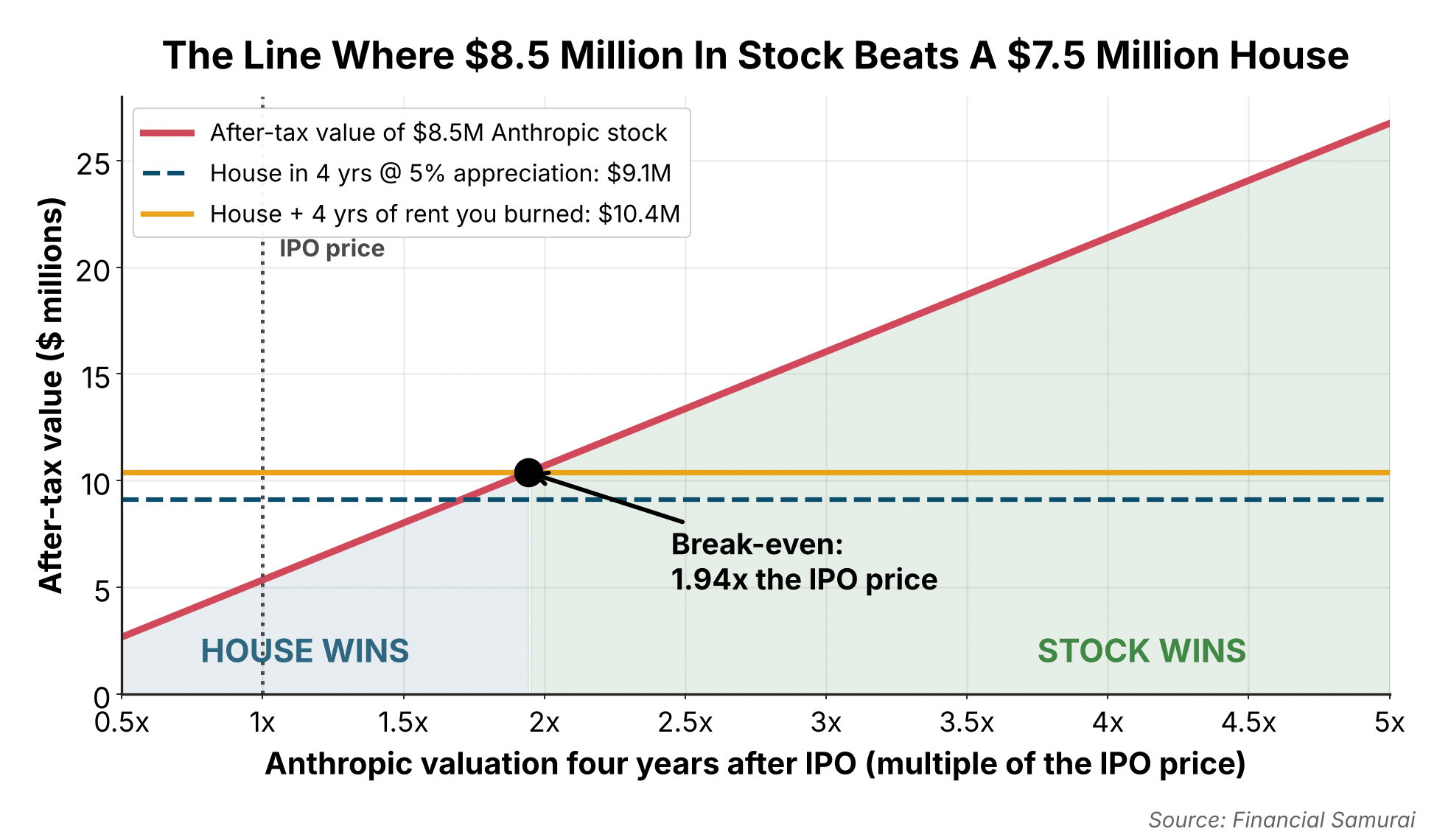
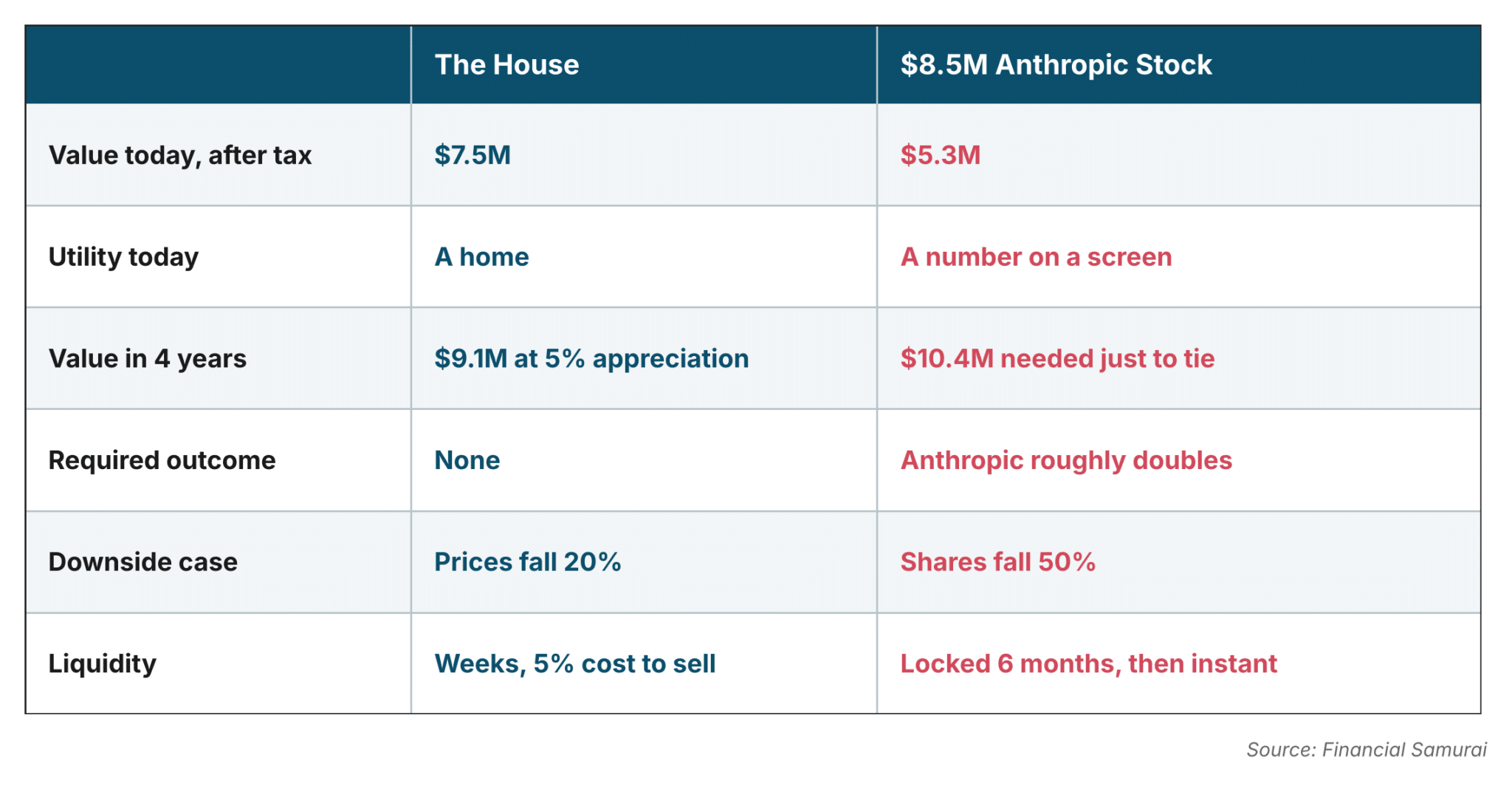
The house is not going to wait for you. At 5% appreciation, $7.5 million becomes $9.1 million. And while you wait, you are renting at $25,000 a month, which burns roughly $1.27 million over four years.
So the stock has to produce $10.4 million after tax just to break even. Pre-tax, that means your $8.5 million in stock must grow to $16.5 million, with the extra $6.1 million going to the government.
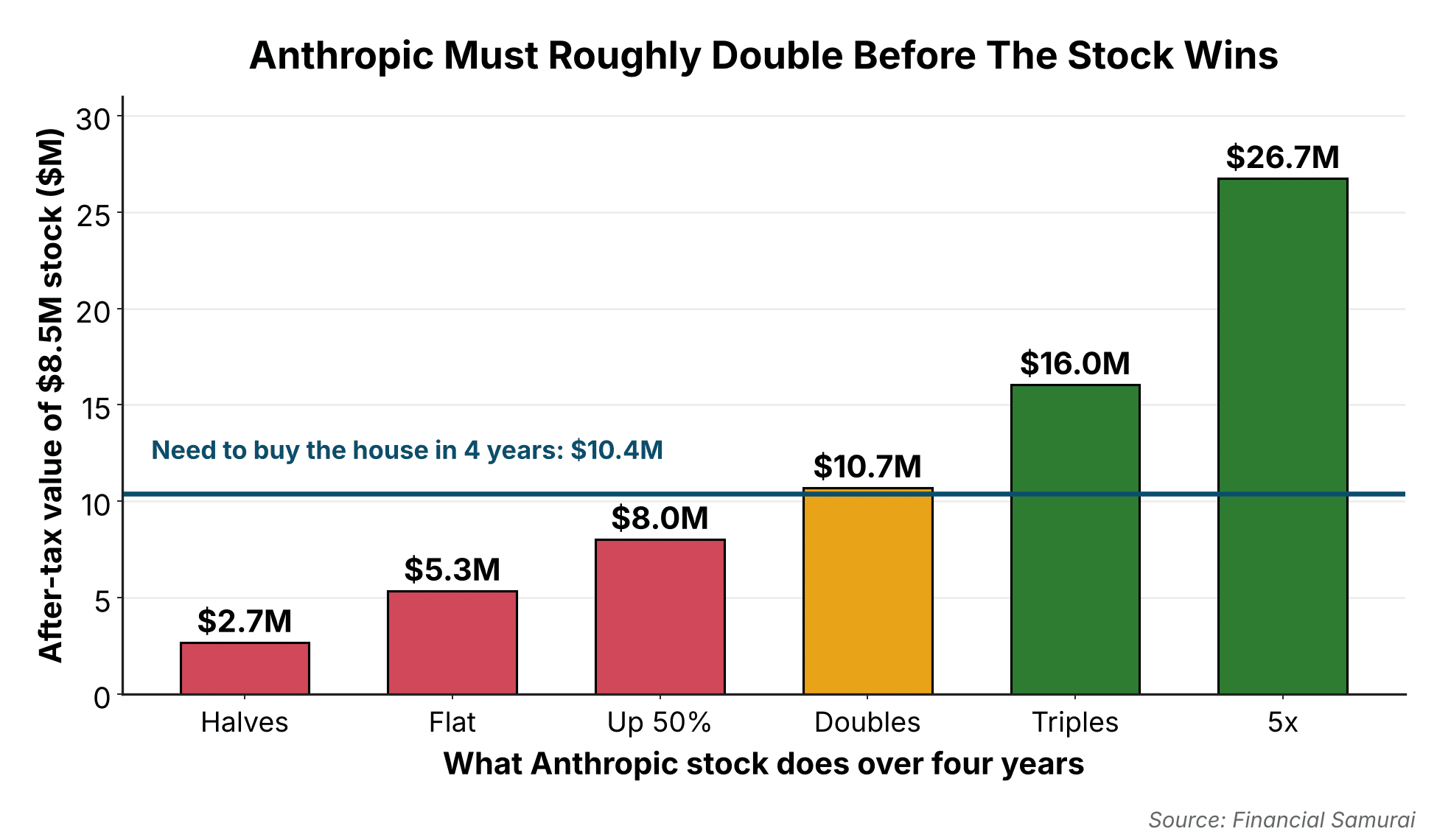
Anthropic has to appreciate 1.94 times—call it a double—from wherever it prices, all within four years. That equates to an 18.1% compound annual return.
If it prices at $1.4 trillion, you need $2.7 trillion; if it prices at $1.5 trillion, you need $2.9 trillion. The dollar figure moves; the requirement does not. The house costs what it costs, rent costs what it costs, and California takes what it takes—none of which cares what Goldman and Morgan Stanley settle on tonight.
A 50% gain is not enough. Up 50% leaves you with about $8 million after tax—more than a million short of the asking price alone, and $2.4 million short once you count the rent you burned along the way.
Anthropic’s Valuation Compared To Comps
If growth keeps decelerating—from 33% in 2028 to 25% in 2029 to 20% in 2030—the run rate reaches roughly $300 billion by the time the four years are up.
So the real question is what multiple of that $300 billion the market has to pay for you to break even.
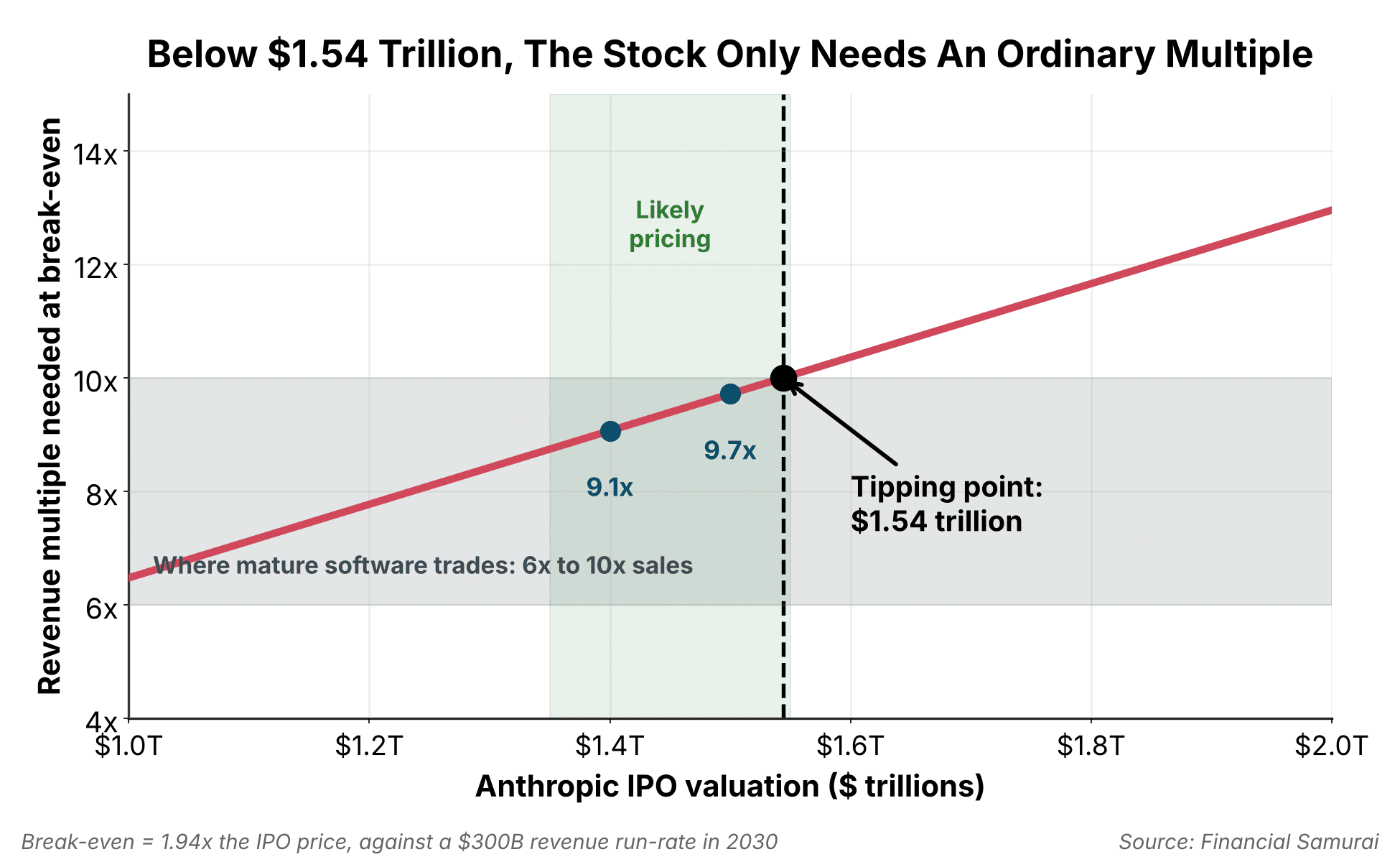
Mature software companies trade at 6 to 10 times sales. Run the numbers across that range and a clean dividing line emerges at about $1.54 trillion.
Price below that, and breaking even requires only an ordinary multiple. At $1.4 trillion, you need the market to pay 9.1 times 2030 sales; at $1.5 trillion, 9.7 times. Both fall within the normal band. The stock wins even if Anthropic is re-rated down to a perfectly ordinary software company.
Price above $1.54 trillion, and breaking even requires a premium multiple that must still hold four years from now. That is a different bet entirely, since it depends on sentiment rather than execution.
For perspective, back in September, when Anthropic was floating a $2 trillion valuation, breaking even required 13 times sales.
The SpaceX Warning
SpaceX went public in June at around $1.75 trillion. It surged past $2 trillion, then pulled back. It has been a volatile stock from the start, and Anthropic may trade the same way.
That is the catch with a six-month lockup: you do not get to sell into the euphoria. You get to watch it, and then find out what is left when everyone else’s lockup expires on the very same day as yours.
Meanwhile, The House Is Not Sitting Still
The other half of this trade is that San Francisco real estate is in a melt-up, driven by precisely the wealth we are discussing.
Between January and late June 2026, 136 single-family homes closed at or above $5 million—more than double the 67 transactions in the same period a year earlier. In June alone, 44 homes sold for at least $1 million over asking. At the very top, even all-cash offers of $25 million and up have been outbid.
This remodeled Victorian on Castro Street sold in September for $7,650,000 against a $5,495,000 list price—39% over asking, or $2.15 million more than the sellers had hoped for, for 3,416 square feet on a 2,622-square-foot lot. That is smaller than the house in our scenario. This is what the money actually buys here.
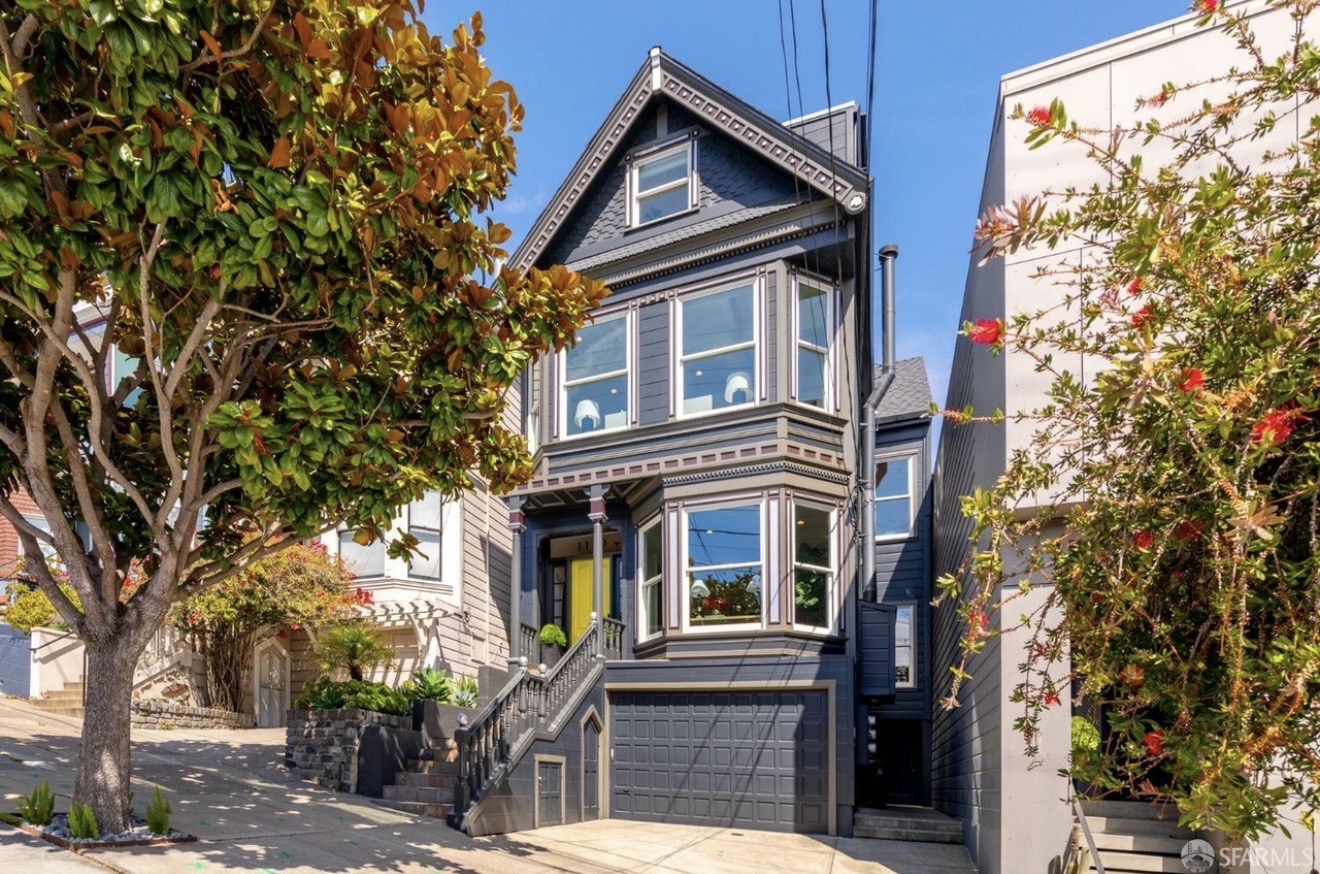
A 4,500-square-foot remodeled home on a large lot with views is a unicorn property; maybe five trade in a given year. If you wait four years to buy it with your stock proceeds, you are not bidding against today’s buyers. You are bidding against every other newly liquid Anthropic and OpenAI employee who made the same plan you did.
Rather than that $7.5 million house being worth $9.1 million in four years, it could easily be worth well north of $10 million.
That is the trap: everyone’s exit strategy points to the same handful of houses.
Taking The Money And Relocating Is Harder Than It Looks
Some of you are already typing that the answer is to take the stock and move somewhere a mansion costs $2 million. Two problems.
First, the job that created the windfall is in San Francisco, so leaving means leaving the equity behind. And because California taxes equity compensation based on where you worked while it vested, moving afterward does not get you out of the bill you are trying to avoid.
Second, would you really walk away from a job like that when there are so many more millions to be made? Only if you are a FIRE devotee who values time and freedom above money.
As for the mansion itself, I toured a number of them in Honolulu last summer and came away thinking that buying a mansion in paradise might be backwards. Then again, owning one in a beautiful city like San Francisco is a remarkable combination.
What Real Wealth Actually Is
Real wealth is not the number. Real wealth is the gap between what you own and what you can actually enjoy.
You can spend the next four years watching a ticker and eating at home to preserve optionality, and finish with $10.4 million and four years of your kids’ childhoods spent in a subpar rental you never loved. Or you can spend those four years in the dream house, providing for your family and making memories, and finish with $9.1 million or more in home equity plus four years you actually lived.
That said, I believe Anthropic could reach a $3 trillion market cap by the end of 2027 and $5 trillion by the end of 2028. Against anything in tonight’s IPO range, that is a healthy amount of upside. If I am right, the stock wins this debate within about thirteen months, and it is not even a contest.
I drew the fair line myself, and I am still leaning toward the house. Watching names like Google and Nvidia fall 30% to 40% in a matter of months is a reminder of how fickle stocks can be. And not having to fight a bidding war over a unicorn property would spare my wife and me a great deal of heartache.
At 49 with two young children, time is too precious to put my life on hold for money I will not use. I might well finish with far more money holding Anthropic stock. But by the time I sell and pay the capital gains, I doubt I could secure the dream house at a reasonable price.
Because if I have $20 million in Anthropic stock in four years, so do thousands of other employees and investors. Bidding against a single buyer is hard enough; bidding against dozens for the same unicorn property is impossible to win. And what good is money you cannot convert into the very thing you wanted it for?
So I take the bird in hand. I have watched enough people optimize their way through a decade only to reach the finish line wealthy and vaguely disappointed. Money is a means to an end, and one of those ends is living in the nicest house you can comfortably afford.
Readers, which would you take: the $7.5 million dream house, or $8.5 million in Anthropic stock with a six-month lockup? And why?