[Aerosol Pollutants Linked to Elevated Risks of Glaucoma and Cataracts]
Aging is one of the biggest risk factors for developing glaucoma or cataracts — but as scientists look more closely at what happens to the eyes over a lifetime, they are finding that people’s exposure to air pollution also plays a role in whether they develop these eye conditions.
Glaucoma, which affects about 80 million people worldwide, is a group of diseases that damage the optic nerve, which carries visual information from the eye to the brain. It can lead to permanent vision loss, usually affecting peripheral vision at first and later central vision. Cataracts are even more common, affecting more than 94 million people globally; the condition occurs when the eye’s lens becomes cloudy, causing blurred vision and, eventually, blindness.
Aging raises the risk of both diseases, as do certain medical conditions, such as diabetes. However, a review of 41 studies suggests that people who are exposed to higher levels of air pollution may also face a greater risk of these diseases. The research, presented in September at the 44th Congress of the European Society of Cataract and Refractive Surgeons in London, brought together evidence from dozens of studies collectively involving millions of people across East Asia and the U.K.
A review of pollution metrics within residential and community settings helped establish exposure baselines through a combination of governmental monitoring, satellite systems, and computational models. Some investigations focused on brief exposure windows linked to acute events like sudden angle-closure glaucoma. Leveraging this extensive dataset, the team cross-referenced pollution levels against the frequencies of glaucoma, cataracts, and age-related macular degeneration (AMD), noting that PM2.5—microscopic particles two-and-a-half micrometers or smaller—demonstrated the clearest statistical connections with disease incidence.
This relationship is illustrated in recent visual documentation showing urban particulate contamination.
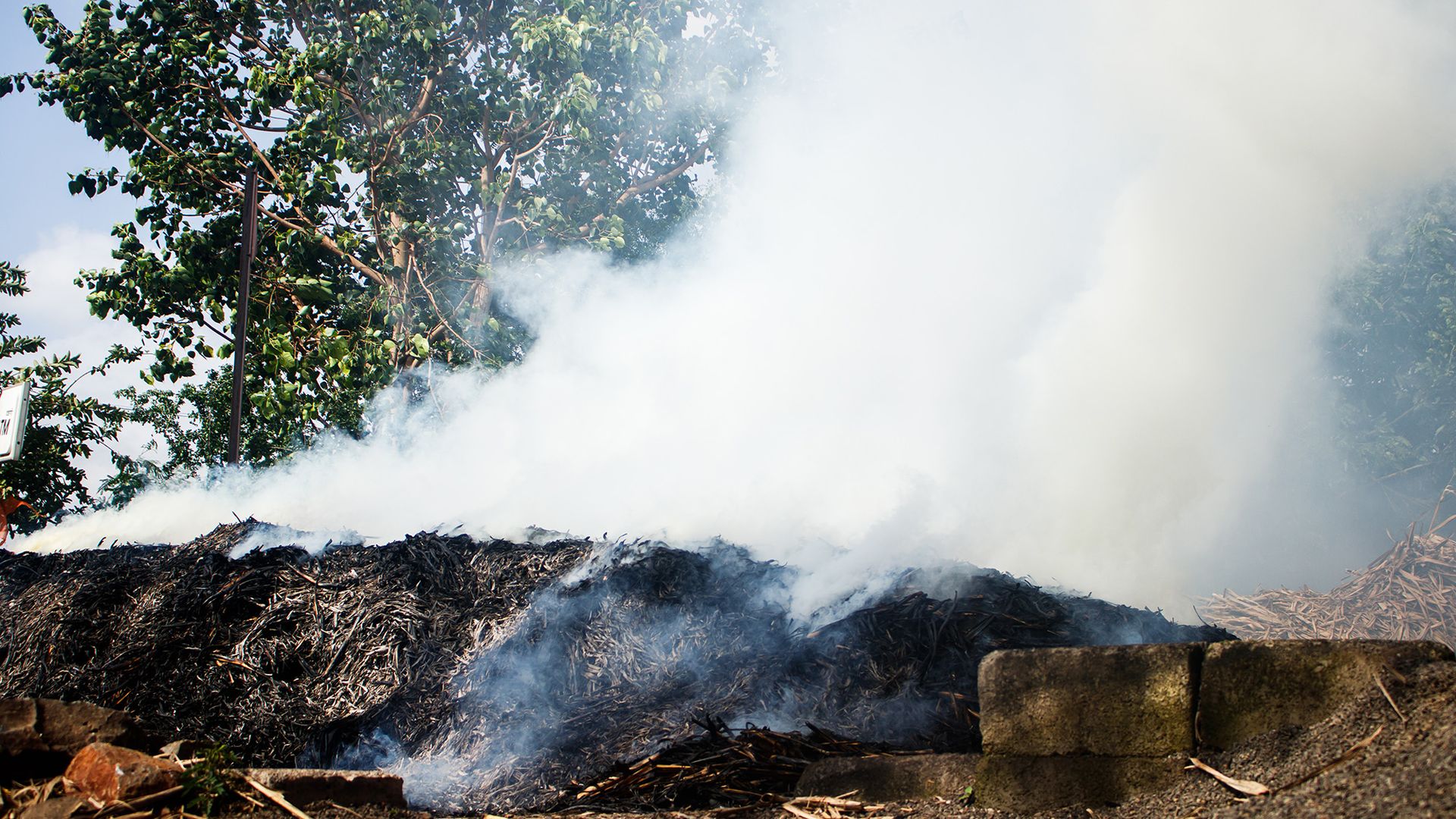
Smoke from burning agricultural residue contains fine particulate matter. In a review of 41 studies, higher PM2.5 exposure showed a strong association with glaucoma and cataract.
(Image credit: Sanket Jain)
Most studies adjusted for long-term exposure using data derived from neighborhood-level monitoring, satellite observations, and predictive computational models. A subset of research examined short-term spikes and their potential link to rapid-onset eye issues, specifically acute angle-closure glaucoma. Utilizing this broad corpus, researchers correlated specific pollutant levels with clinical outcomes, identifying PM2.5 as the most consistently implicated agent. Data indicated that individuals with the highest levels of PM2.5 exposure experienced a 70% greater probability of contracting glaucoma compared to those with minimal exposure. Furthermore, shifting exposure levels equivalent to moving between the 25th and 75th percentile benchmarks corresponded to an 8% heightened risk for glaucoma and a 4% elevation in cataract hazard.
PM2.5 Shows the Clearest Links
The researchers evaluated exposure to various pollutants, including diverse particle sizes—specifically fine PM2.5 and larger PM10 units. Additional analytes probed included nitrogen dioxide, sulfur dioxide, ozone, and carbon monoxide.
You may like
“
Most trials assembled in the review quantified long-term exposure based on local environmental readings. Diverse methodologies—such as municipal monitoring stations, orbital satellite feeds, and algorithmic estimation tools—were employed to map community-wide atmospheric conditions. Certain cohorts isolated immediate exposure timelines connected to acute ocular emergencies, including sudden angle-closure episodes triggered by refractive stress.
Cross-referencing pollution metrics against glaucoma, cataract, and age-related macular degeneration rates allowed the team to assess prevalence trends. PM2.5—particles measuring 2.5 micrometers or less in diameter—reported the most robust correlations with both glaucoma and cataract onset. Statistics revealed that subjects facing the greatest PM2.5 exposure experienced a 70% increased likelihood of glaucoma, whereas increments equating to differences in 25th-to-75th percentile exposure bands yielded an 8% rise in glaucoma and a 4% uptick in cataract occurrence.
Smoke from burning agricultural residue contains fine particulate matter. In a review of 41 studies, higher PM2.5 exposure showed a strong association with glaucoma and cataract.
(Image credit: Sanket Jain)
The empirical evidence proved less consistent regarding air pollution and age-related macular degeneration, which targets the central retina responsible for sharp vision. Unlike the pronounced link seen with PM2.5, secondary pollutants displayed weaker ties to ocular pathology. Specifically, nitrogen dioxide failed to show a significant correlation with macular degeneration, while ozone-linked associations with cataracts were absent. Neither pollutant established a meaningful link to glaucoma. Sulfur dioxide and PM10 similarly revealed no statistically significant relationships with any of the target conditions.
The specificity of the PM2.5-glaucoma link aligns with broader mechanistic insights. The microscopic size of these particulates permits absorption deep into systemic circulation. This facilitation triggers oxidative stress—where aggressive free radicals overwhelm homeostatic defenses—alongside chronic, low-grade inflammation sustaining prolonged immune activation. Consequently, lens transparency suffers as crystalline cells lose structural integrity and misfold. Similarly, in the optic nerve, identical biochemical cascades threaten retinal ganglion cells, which function as crucial relays transmitting visual data to the brain independently of conventional blood-pressure pressures. As Dr. Ahmed Alnabihi emphasized, the retina’s inherent lack of protective barriers offers a direct conduit through which ambient pollutants can induce harm.
“Unlike the lungs or gastrointestinal tract, its [the eye’s] surface maintains continuous, direct interaction with outdoor air; consequently, pollutants possess a uniquely direct pathway capable of causing injury,” Alnabihi concluded.
Establishing definitive causality remains preliminary given the observational nature of current datasets. Clinical evidence supports an association rather than proving that PM2.5 directly initiates pathological change within the ocular structures.
What Explains the Increased Risk?
The precise physiological pathways under girdle remain incompletely understood, yet Alnabihi suggested that extremely small particles enable passage through biological barriers. Their presence provokes oxidative stress and sustained inflammatory states. RegARDING the lens, these responses compromise crystallin proteins required to maintain transparency, leading to opacity characteristic of cataracts. The optic nerve faces parallel threats wherein the aforementioned cellular insults endanger the specialized neural networks handling visual processing.
“Beyond typical vascular pressures, the link continues to involve damaged retinal ganglion cells, introducing a unique ocular risk independent of standard cardiopulmonary markers,” Alnabihi clarified. Recent corroborative work also hints at these mechanisms in vivo. Studies exposing rodent subjects to chronic ambient PM2.5 detected elevated intraocular pressure and biochemical indicators of nitrative stress within aqueous drainage pathways, mirroring human clinical presentations.
A parallel surge was observed in biobank cohorts comprising over 480,000 individuals; higher PM2.5 concentrations correlated with diminished long-term glaucoma prognosis. Additionally, stem-cell-derived retinal tissue culture experiments confirmed that PM2.5 ingestion disrupts developmental trajectories of retinal cells, including ganglion precursors, while simultaneously accelerating cellular apoptosis—a hallmark of cytotoxicity.
While collective biological data elucidate plausible routes, synthesizing these pathways into coherent clinical narratives requires further longitudinal investigation.
This article is for informational purposes only and is not meant to offer medical advice.