







Aave’s proposed USDG rollover mechanism would allow borrowers to migrate stablecoin debt into a new fixed-yield USDG position, but the replacement collateral currently yields less than most quoted borrowing rates on the platform. This dynamic leaves leverage and separately administered incentives as the primary determinants of whether extending the trade remains financially viable.
The proposal centers on Pendle principal tokens (PTs) on the X Layer network: holders of the token maturing October 29 would transition into a replacement instrument maturing February 25, 2027. In an October 8 assessment, risk provider LlamaRisk determined that the February token’s on-chain yield alone fell short of USDT0, USDC, and USDG variable borrowing costs. GHO was the sole exception, offering a cheaper funding rate in the assessment’s October 7 snapshot.
TokenLogic’s proposal would facilitate the transition via a flash-loan transaction that temporarily repays debt, swaps the legacy PT collateral for the new series, reborrows, and repays the flash loan. OKX would develop the integration separately. Both the Aave listing and the OKX integration must be implemented for the rollover to function.
An October 10 data refresh confirms the persistent spread. Pendle’s market API reported a February PT implied annual percentage yield of approximately 2.98%, with data timestamped 21:09 UTC. Aave’s X Layer market display, retrieved at 21:11 UTC, showed variable borrowing APYs of 4.12% for USDT0, 5.87% for USDC, and 3.75% for USDG.
The readings underscore that transaction convenience and investment profitability are distinct considerations: a rollover can preserve borrowing access while resetting the collateral’s yield at the new purchase price.
A Pendle PT represents a discounted claim on an accounting asset at maturity. For this USDG market, LlamaRisk describes redemption as a one-to-one exchange of one PT for one USDG. The purchase discount determines the return from holding to maturity, while ordinary PT holders forfeit the underlying variable yield and points to the corresponding yield token (YT) under Pendle’s mechanics.
Borrowing to acquire additional PTs increases exposure to that discount. The strategy generates positive incremental carry when the acquired PT return exceeds its financing cost. When borrowing costs surpass the asset’s return, each additional borrowed increment erodes the position’s return before rewards and fees.
This relationship appeared more favorable in LlamaRisk’s August review. Using August 18 data for the October maturity, it cited a 3.19% PT yield against borrowing rates of 0.45% for GHO, 1.37% for USDT0, and 2.69% for USDG, describing the environment as offering positive carry.
The October 7 snapshot for the February replacement quoted a 2.79% PT yield against 4.48% for USDT0, 4.10% for USDC, and 3.67% for USDG. GHO, at 0.93%, still borrowed below the PT yield. These comparisons span different maturities; existing October PT holders retain their original purchase yield.

There is also a distinction between a quoted funding comparison and an permitted borrowing route. LlamaRisk’s recommended new Aave borrowing category, E-Mode 9, lists USDT0, GHO, and USDC as borrowable assets. USDG is absent from that proposed list, so its rate serves as a cost comparison rather than proof of eligibility for the February configuration.
How Leverage and Rewards Alter Returns
The 2.98% annualized PT yield corresponds to roughly 1.11% gross appreciation over the approximately 137.1 days from the October 10 snapshot to February 25. The annual figure should not be conflated with the cash return available over that shorter holding period.
A standalone PT-and-debt illustration demonstrates how leverage changes the outcome. It holds the displayed borrowing APYs constant through maturity, excludes rewards, transaction costs, and retained YT, and assumes no rebalancing. Two-times exposure implies assets equal twice starting equity with debt matching that equity; five-times exposure implies debt equals four times starting equity.
Using the APY convention in Pendle’s calculation documentation, the illustration converts each annualized rate into a return over the identical holding period, then subtracts the debt’s interest cost from the PT position’s appreciation.
| Funding Comparison | Borrow APY, Oct. 10 | Return on Equity at 2x Exposure | Return on Equity at 5x Exposure |
|---|---|---|---|
| USDT0 | 4.12% | +0.69% | -0.56% |
| USDC | 5.87% | +0.05% | -3.11% |
| USDG (comparator only) | 3.75% | +0.83% | -0.02% |
The table shows illustrative total returns through February 25. Without borrowing, the same PT position earns approximately 1.11% before costs. At two-times exposure, the return on the investor’s own capital can still offset the negative spread on the borrowed portion. At five-times exposure, financing costs consume more than the gross PT gain in all three scenarios.
Actual borrowing rates may fluctuate throughout the holding period. Effective PT yield is also determined by actual purchase prices, and the October 8 assessment noted 0.05% taker fees for the February pool’s AMM and order book. Slippage, network fees, and any applicable flash-loan charges further impact the transaction; a thin positive result can vanish after execution costs.
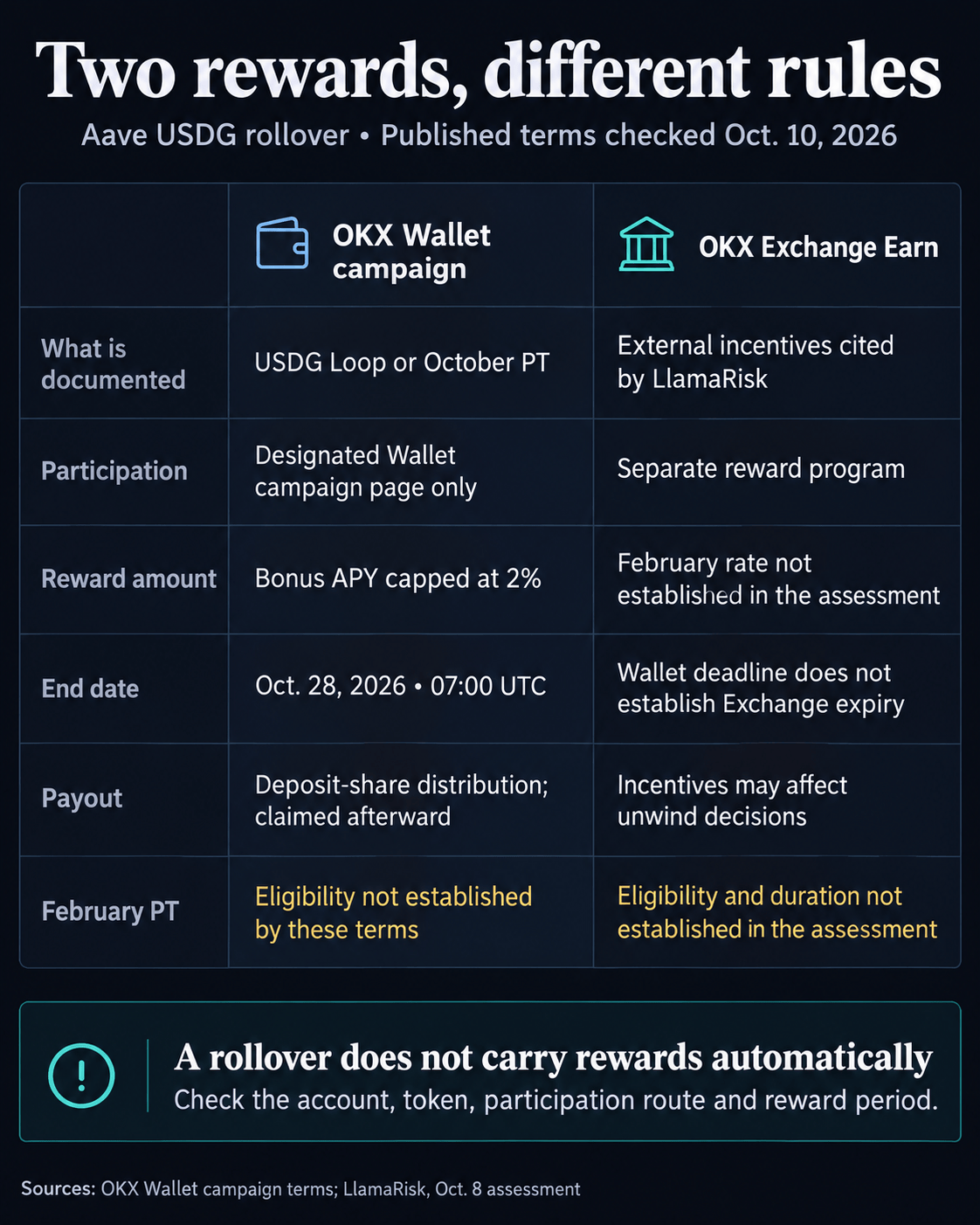
LlamaRisk attributes participating loop users’ profitability to external OKX Exchange Earn incentives, noting that an end to those incentives would likely prompt users to unwind positions.
The public OKX Wallet bonus announcement describes a separate program. It specifies USDG Loop or PT-USDG-29OCT2026 supplied to Aave through the designated Wallet campaign page, with a bonus APY capped at 2%. Transactions executed through Aave or other third-party websites do not qualify.
The Wallet campaign concludes October 28 at 15:00 UTC+8 (07:00 UTC), with rewards claimable afterward. Distribution depends on eligible participants’ deposit shares, and the actual payout may fall below the announced 490,000 USDT reward pool.
Those terms govern the October token. February reward eligibility and the separate Exchange Earn expiry require their own terms.
The standalone illustration also differs from the actual OKX Wallet product. Its Loop FAQ states that PT Loop can leave YT separately in the user’s wallet, outside the displayed Loop position value. Those retained tokens, product rewards, and execution costs must be included when assessing the wallet’s total return.
OKX Wallet’s FAQ further clarifies that a PT position does not automatically redeem, unwind, renew, or roll over at maturity. PT promotional rewards cease at that point under Wallet rules, and a new-term subscription depends on product availability.
Rollover Limits and the October Exit
LlamaRisk’s October 8 recommendation diverges from the initial plan. It calls for a new E-Mode 9, with a 91.48% loan-to-value limit, a 93.48% liquidation threshold, and a 35 million PT supply cap. The existing E-Mode 7 threshold cited in the assessment stands at 94.66%. A position carried into the replacement configuration would therefore need to conform to the recommended borrowing and liquidation limits if those parameters are adopted.
LlamaRisk reported 66.03 million October PT units supplied as collateral in its October 8 review. The Aave display retrieved October 10 showed 59.79 million October PT units supplied and $61.12 million of borrowing across the entire X Layer market. The borrowing figure covers the full market, while the collateral figures isolate October PTs.
A September 9 borrower review reported 55.1 million USDT0 debt, representing 98.7% of the reviewed PT cohort’s debt, and a median health factor of 1.03 among top suppliers. That snapshot illustrates how heavily the reviewed cohort relied on USDT0 and how little buffer its top suppliers maintained before liquidation.
The February pool held approximately $1.42 million of reported liquidity. A migration’s executable size depends on available quotes and acceptable slippage.
The proposed reduction of the October PT loan-to-value ratio to zero after maturity concerns borrowing headroom. Under Aave’s liquidation mechanics, eligibility hinges on the health factor falling below one, with collateral value, debt, and liquidation thresholds determining that factor.
The choice at the October maturity is consequently both economic and operational. A borrower can preserve debt exposure through a supported migration only if the configuration and integration are live. Whether extending the position pays depends on the new entry price, actual funding costs, leverage, and reward eligibility—rather than the mere ability to move collateral in a single transaction.
Also Read
- Bitcoin Whale Accumulated Before March 2020 Crash Moves $378M to New Addresses
- Bitcoin and Ether Rebound from Liquidation Waves; Correction Status Remains Unclear
- Forex Signals October 13: UNH, JPMorgan, Goldman Sachs, JNJ, Domino’s Earnings Preview – FXLeaders
- Australian NAB Business Confidence Drops to -13 Amid Ongoing Capacity Strain


