






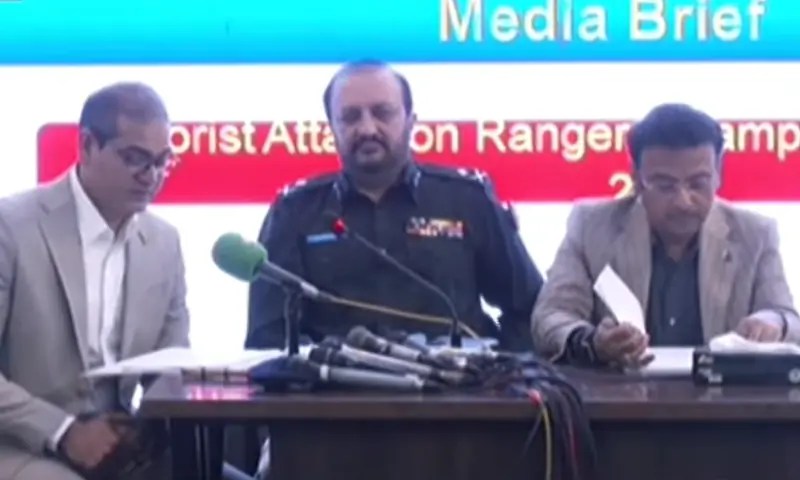
Police officials have confirmed that the recent assault on a Rangers base in Karachi’s Gulistan-i-Jauhar district on June 27 reportedly involved coordination with Afghanistan-based extremists for planning and logistical execution.
This operation resulted in the deaths of three Rangers personnel, while four others sustained injuries, according to briefings by the Inter-Services Public Relations (ISPR). Authorities disclosed that the attack was launched by insurgents affiliated with the Indian proxy group Jamaatul Ahrar (JuA). Following the strike, security forces eliminated three attackers, and a fourth suspect—identified as an Afghan national—was detained alive.
During a press conference held with Home Minister Ziaul Hassan Lanjar, Karachi’s Senior Superintendent of Police Irfan Bahadur emphasized the involvement of Afghan nationals in both the premeditation and execution phases. The officials stated that tactical guidance and training were sustained through a network operating from Kabul.
A law enforcement spokesperson detailed a multi-stage process behind the attack: training of operatives in Afghanistan, physical infiltration of four Afghan militants into Karachi, and continuous operational directives issued remotely from Afghan territory. LEAs also claimed to have dismantled a facilitator group linked to procurement and strategic coordination within the city.
SSP Bahadur noted the operatives’ precise timing of the assault, weaponry distribution, and deployment of explosive devices. He underscored the involvement of four named attackers: three deceased terrorists and one apprehended invader. The deceased individuals were identified as Umer Farooq from Kunar, Bilal alias Hadi (born in Bajaur but linked to Kandahar), and a third unnamed suspect. The captured perpetrator, Usman Sher Mohammad, hailed from Nangarhar, Afghanistan.
A video documenting the aftermath of the operation has been released to nationals and international channels for transparency. Law enforcement agencies continue their probe into broader cross-border networks enabling such incursions.

Ongoing investigations aim to prevent future attacks by tracing wider transnational collaborations in the region.
More to follow
Also Read
- Hong Kong Woman Sentenced to 10 Years for Role in Extortion and Assault Gang’s Crimes
- EU Imposes Gold Import Ban on Sudan to Strangle Conflict Financing
- Country’s overall situation, AJK comes under discussion as Dar meets Bilawal
- Decades of Discipline: Why Warren Buffett’s Strategy for Market Volatility Remains Unrivaled


