



Nigeria is little more than two months away from going to the polls, with incumbent President Bola Tinubu campaigning on a platform centered on tackling persistent insecurity and resolving the country’s economic crisis. He is contesting against former Vice President Atiku Abubakar and prominent opposition figure Peter Obi.
The Independent National Electoral Commission (INEC) recently published its preliminary voter register, which is reportedly marred by images suspected to have been generated with artificial intelligence (AI).
Indicators of AI use included exaggerated facial features and irregularities in the register, such as duplicate names and entries for people who had died since the previous election.
The revelations have intensified concerns about INEC’s readiness for the country’s forthcoming 2027 general elections. Rather than enhancing transparency by opening its procedures to scrutiny, INEC has faced criticism amid wider debates over the growing role of AI in elections across the continent.
Is Nigeria becoming a one-party state?
To view this video please enable JavaScript, and consider upgrading to a web browser that supports HTML5 video
Fake news: Nothing new in Nigeria
Joash Amupitan, chairman of the commission, said the body is investigating the matter, with attention on discrepancies that may have been produced by AI.
He announced the creation of a dedicated unit to monitor AI-related threats, identify deepfakes and reinforce the integrity of the electoral process, warning that otherwise the credibility of the coming elections could be compromised.
Yet even before AI became widespread across Africa and the world, Nigeria had already had to contend with fabricated images, manipulated audio and fake videos circulating online. Ahead of the 2023 elections, deepfakes falsely linking candidates to terrorism-related activities spread across social media.
Such content is often designed to promote particular candidates or discredit opponents in order to shape public perception; with AI, it could now fuel disinformation campaigns on an entirely new scale.
AI’s Varied Effects on Voter Behavior
Lois Ugbede, assistant editor at the fact-checking platform DUBAWA, told DW that “based on our monitoring so far, AI-driven disinformation is serious and is becoming commonplace.”
“This could influence political discourse and voter behavior ahead of 2027 because we are already seeing parties using inflated crowds to show that they have a large followership or support,” she added.
At the same time, rather than swaying votes in favor of any particular candidate, “the deeper danger is that people may begin to doubt authentic information simply because they know convincing AI generated fakes are possible,” said Akintunde Babatunde, executive director of the Abuja-based Center for Journalism, Innovation and Development (CJID).
“We often focus on the risk of people believing an AI-generated falsehood, but there is another problem where genuine evidence can be dismissed as AI generated,” he noted, citing instances of a lawmaker who recently made inflammatory remarks during a campaign rally — but then claimed the clips were manipulated.
Have some elections become an empty ritual?
To view this video please enable JavaScript, and consider upgrading to a web browser that supports HTML5 video
Additional Risks from Weak AI Safeguards
Chibuike Mgbeahuruike, an election consultant at the Centre for Democracy and Development (CDD-West Africa), told DW that beyond the spread of synthetic content online, AI intrusion into INEC’s portal could also “undermine its institutional credibility, especially with the low level of confidence that we are already witnessing.”
He added that AI itself is not inherently a threat to electoral integrity; the real danger lies in “the absence of effective accountability for its deployment,” as technological innovations increasingly appear to infiltrate governments and democratic processes.
“Voters must have confidence … that the technology is also transparent, accountable and independently scrutinized, and ultimately subject to human and institutional oversight,” Mgbeahuruike said.
The Director-General of Voice of Nigeria (VON), Mallam Jibrin Baba Ndace, agreed, urging journalists at a recent conference not to fall into the trap of believing reports that later turn out to be false because of AI manipulation.
He stressed the importance of protective measures and due diligence in the news media, especially as public institutions such as INEC become less able to provide impartial information owing to the use and influence of AI and other election-related technologies.
Nigeria’s Troubled Relationship With Election Technology
Beyond AI, Nigeria’s electoral processes have undergone various technological changes over the years in hopes of improving transparency and efficiency.
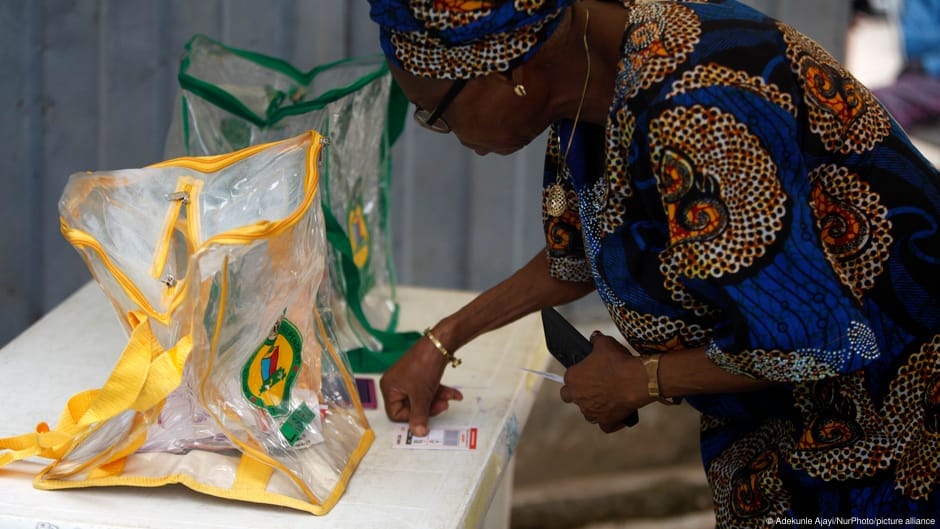
Electoral authorities first deployed electronic assistance in 2011, when Direct Data Capture Machines were introduced; the devices collect voters’ biometrics by scanning fingerprints or capturing facial recognition data with webcams to prevent voters from submitting multiple ballots.
Ten years later, a new system called the Bimodal Voter Accreditation System (BVAS) was introduced as the new standard, designed to combine fingerprints with facial recognition; however, during the 2023 general elections, this voting process was marred by system failures of BVAS, as poor cell signal delayed these voter accreditation procedures.
Still, with INEC reporting more than 103 million Nigerians registered to take part in the coming poll, disinformation, fake news and technological challenges are only a few of the concerns facing Nigeria’s democracy:
Voter apathy has become a particular concern, especially among the country’s youth; the 2023 elections recorded the lowest voter turnout since the country’s return to democratic rule in 1999, with merely 27 percent of registered voters going to the polls.