



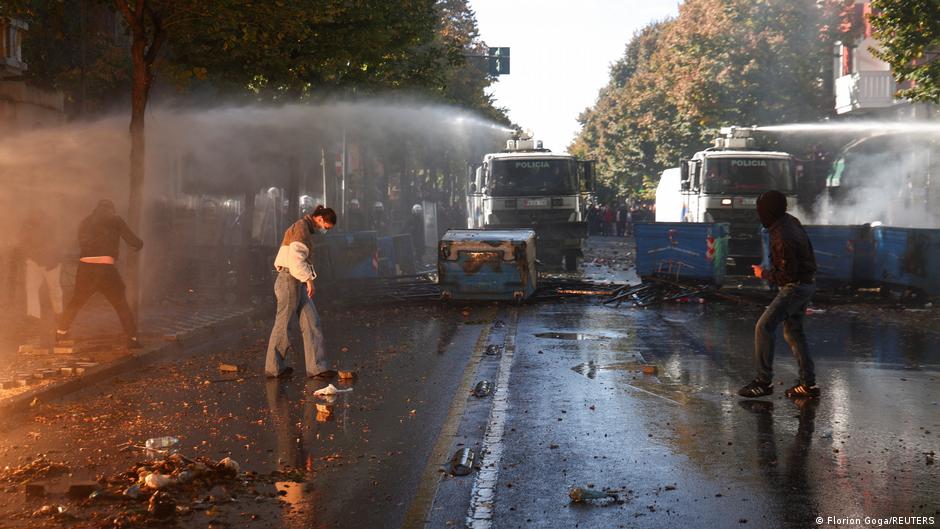
On Wednesday, the Education Ministry was engulfed in fire during a second stage of student demonstrations targeting corruption and higher‑education reforms.
A bank adjacent to the ministry also suffered a blaze, according to witnesses.
What happened in Tirana’s student protests?
Authorities deployed riot police, using tear‑gas canisters and water cannons to disperse large crowds in central Tirana.
Thousands assembled outside the ministry on Wednesday, many covering their faces; some hurled bricks, breached fence barriers, and knocked over waste containers.
A banking facility neighboring the ministry experienced a fire, reported by the Reuters agency based on eyewitness testimony.
The demonstrations began peacefully on Tuesday with several hundred participants on the square, yet tensions quickly escalated into violence.
Police recorded roughly forty detainees and thirteen injuries—including six officers—during the clashes. The unrest persisted well beyond the initial confrontation.
Government says demonstrations degenerated into “orchestrated violence”
Deputy Prime Minister Albana Kociu shared a video on Facebook lamenting how the climate of protest had turned into “orchestrated violence,” describing the ensuing attacks on institutions and police as “unacceptable for emerging leaders.” She emphasized that the rampant demolition of public property did not reflect the true aspirations of the youth.
“It is heartbreaking to see the spirit of protest degrade into manufactured aggression,” Kociu declared.
Blockquote class=”fb-post embed” data-facebook=”true” data-href=”https://www.facebook.com/61550901522643/videos/1412595037665707″>
[](link-not-used-embedding)
In a subsequent post, Kociu appealed to students who uphold the right to protest, urging them to distance themselves from “violence and vandalism.”
Student organizers state that the backbone of the mobilization centers on university conditions, high tuition costs, lack of financial aid, and uncertain job prospects after graduation.
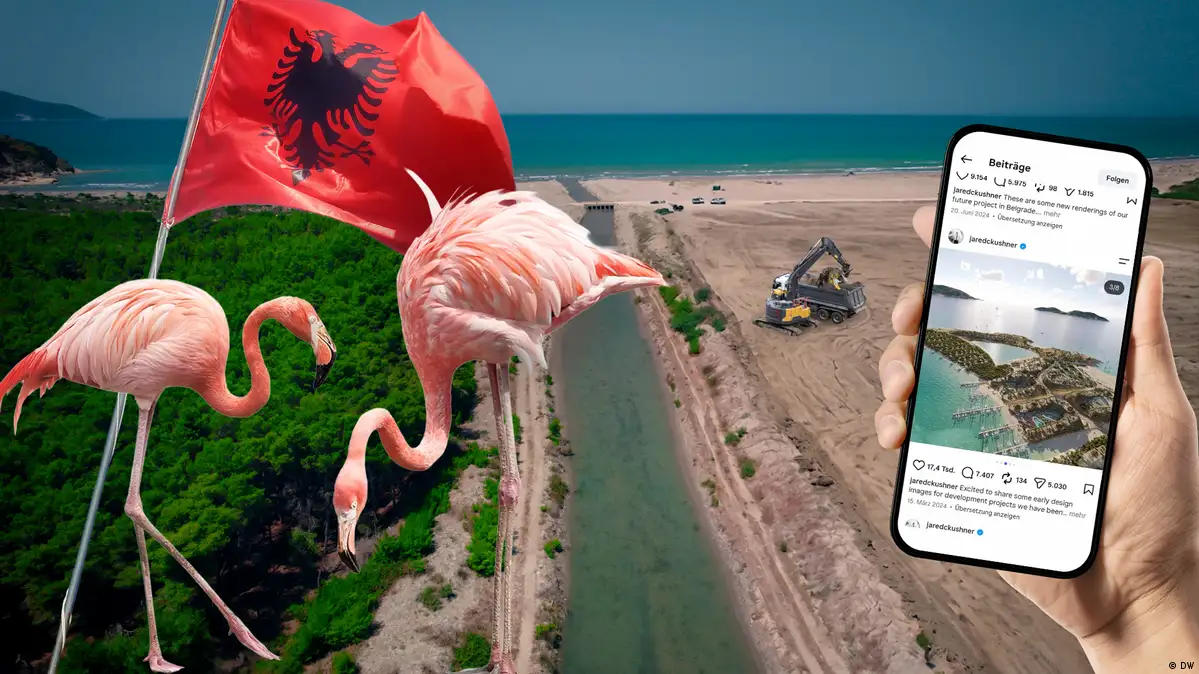
Wider context reveals a series of mass showbreads across the country this spring often dubbed the “Flamingo Revolution,” sparked by a contentious coastal construction project affecting a protected habitat for flamingos. While this environmental dispute contributed impetus, the broader movement has crystallized around sustained disillusionment with the steady dominance of Albania’s traditional political parties.
The coalition dominated by Prime Minister Edi Rama’s Socialists and opposition leader Sali Barisha’s right‑wing Democrats has tussled for power intermittently for over thirty years, a pattern rooted in the tumultuous post‑Cold War democratic transition.
To view this video please enable JavaScript, and consider upgrading to a web browser that supports HTML5 video
The timing aligns with heightened international attention on similar unrest in France, fueling a wave of comparable demonstrations.**Edited by: Wesley Dockery
If you rely on our team for trusted reporting, please take a moment to select us as your Preferred Source on Google, so you’ll always see our verified news first.