



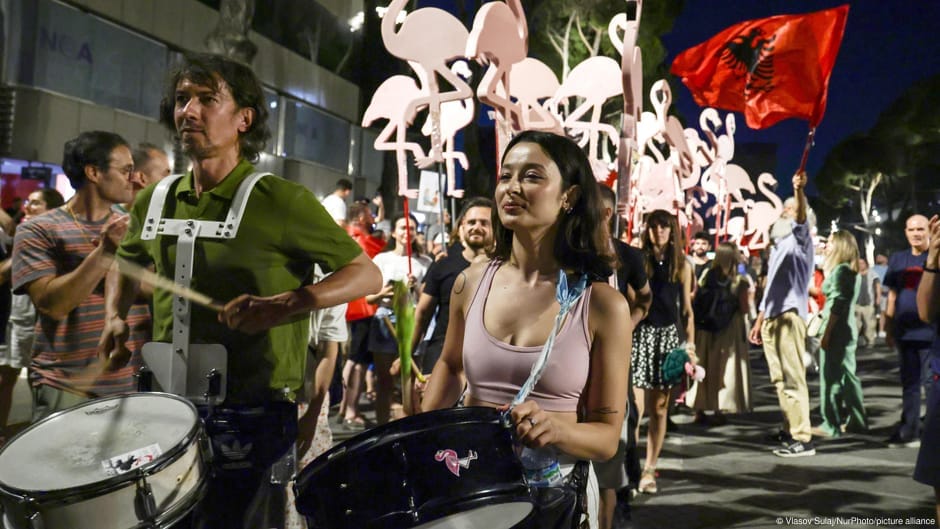
In mid-October, students in the Albanian capital, Tirana, set a suitcase on fire and threw it into the courtyard of the Education Ministry. The gesture carried a clear political message. According to the 2023 census, Albania’s population had shrunk by about 420,000 people between 2011 and 2023—nearly 15%—mainly because of emigration.
For a generation of young Albanians, that decline was a response to a system that gave them little voice. Now young people say they want to stay, and protesters argue that the system must change.
Known as the “Flamingo Revolution,” the movement began in May with demonstrations against a luxury resort in a coastal reserve involving President Donald Trump’s daughter Ivanka Trump and her husband, Jared Kushner. It quickly grew into broader criticism of corruption, Prime Minister Edi Rama’s government, the Socialist Party, and Albania’s political class.
Thousands marched almost every evening for four months in largely peaceful protests. But on October 13, a student protest escalated into clashes with police. Since then, the unrest has continued, with police using tear gas, water cannons and rubber bullets. There have been hundreds of arrests, many injuries, and damage to public and private property.
Support for the ‘Flamingo Revolution’ Broadens
Protesters have called for Rama’s resignation, a transitional government, electoral reform and fresh elections. The movement, which has no single leader, has drawn support across the political spectrum. While the prime minister blamed “foreign hands,” there appears little evidence that external actors are orchestrating the protests, though they may have tried to exploit the unrest online.
The protesters say they do not feel represented by Albania’s democracy. Their demands are driven by domestic issues including corruption, high living costs and low wages. This is not entirely new, but several factors have converged recently: high-level corruption charges, including against ministers and two of Rama’s former deputies; rising prices; and a new generation being compared against EU standards.
In some areas, Rama has transformed Albania since taking office in 2013, and the government points to significant economic growth and booming tourism. But critics say prosperity is unevenly distributed. They accuse the government of directing too much taxpayer money toward a small number of well-connected companies through prestige projects and public-private partnerships, and sometimes through corrupt deals, at the expense of healthcare, education and broader economic prospects.
Rama has rejected calls for his resignation and invited protesters to engage in dialogue, which they have so far refused.
Political Alignment and the Fight for Electoral Change
In 2008, Rama and Sali Berisha, then the long-time chairman of the opposition Democratic Party, worked on a reform to Albania’s constitution and electoral law, which parliament approved. Since then, party leaders have largely determined who enters parliament, weakening ties between lawmakers and constituents.
It has also become much harder for new parties to win seats. In 2025, a new party received about 64,000 votes but won only one seat. The Socialists, by contrast, won about one seat for every 10,000 votes.
Rama has led the Socialists since 2005, while Berisha became chairman of the Democratic Party in 1991. For 21 years, Albania’s prime minister has been either Rama or Berisha. Freedom House, a US nongovernmental organization, classifies Albania as “partly free” and describes political parties as often organized around leading personalities.
Protesters have said they want both men jailed. Rama has argued that governments should be replaced at the ballot box, not in the streets.
Although the Organization for Security and Co-operation in Europe acknowledged that Albania’s 2025 parliamentary elections were “competitive and professionally managed,” it said they took place “in a highly polarized environment and contestants did not enjoy a level playing field.” It added that there were “reports of intimidation, misuse of public resources and pressure on public employees, which undermined equal opportunities.”
The Democratic Party also raised allegations of election fraud and intimidation. Turnout was below 45%.
Corruption and the High Cost of Living
Many protesters allege that business decisions often depend on proximity to those in power. They criticize the public procurement, public auction and concessions system, which they say led to the sale of state-owned land, including coastal and protected areas, to private investors.
Ordinary Albanians are feeling the financial pressure. According to the Albanian Institute of Statistics, half of all employees earn less than 60,000 lek (roughly €620 or $680) per month after taxes. According to Eurostat, food prices are slightly above the EU average, while real estate prices in Tirana have nearly doubled since 2018, with rents rising almost as quickly.
For years, young Albanians dissatisfied with the system chose to leave. The number of Albanian citizens in Germany more than doubled between 2018 and 2024, reaching almost 120,000.
Though it is still too early to say whether fewer Albanians are leaving today, staying has become a political statement for many protesters.
Albanians and the European Union
Rama has argued that his resignation would jeopardize Albania’s bid to join the European Union by 2030, but most Albanians are pro-European, including protesters and opposition figures. From the protesters’ perspective, it is the government led by Rama that remains the real obstacle to EU membership.
Although protests have swept across Europe, the most obvious comparison is Serbia, where a student-led movement recently forced a long-time ruler from office. Whether Albania will follow this path depends on whether young people, who have traditionally been less engaged in politics, can turn protests into votes.
What is certain is that for three decades, Albania’s leaders relied on citizens’ suitcases. Now the country’s students have burned that very luggage.
Why Albania’s political crisis is deepening
To view this video please enable JavaScript, and consider upgrading to a web browser that supports HTML5 video
Also Read
- Indonesia pays high price to keep fuel cheap under Prabowo’s blanket subsidy
- Banff Authorities Issue Urgent Ice Safety Warning After Fatal Lake Louise Incident
- Bangladesh Garment Workers Clash With Police After Wage Increase Falls Short
- Ford Chief Discusses Le Mans, Upcoming Electric Pickup, and Trade Negotiations