






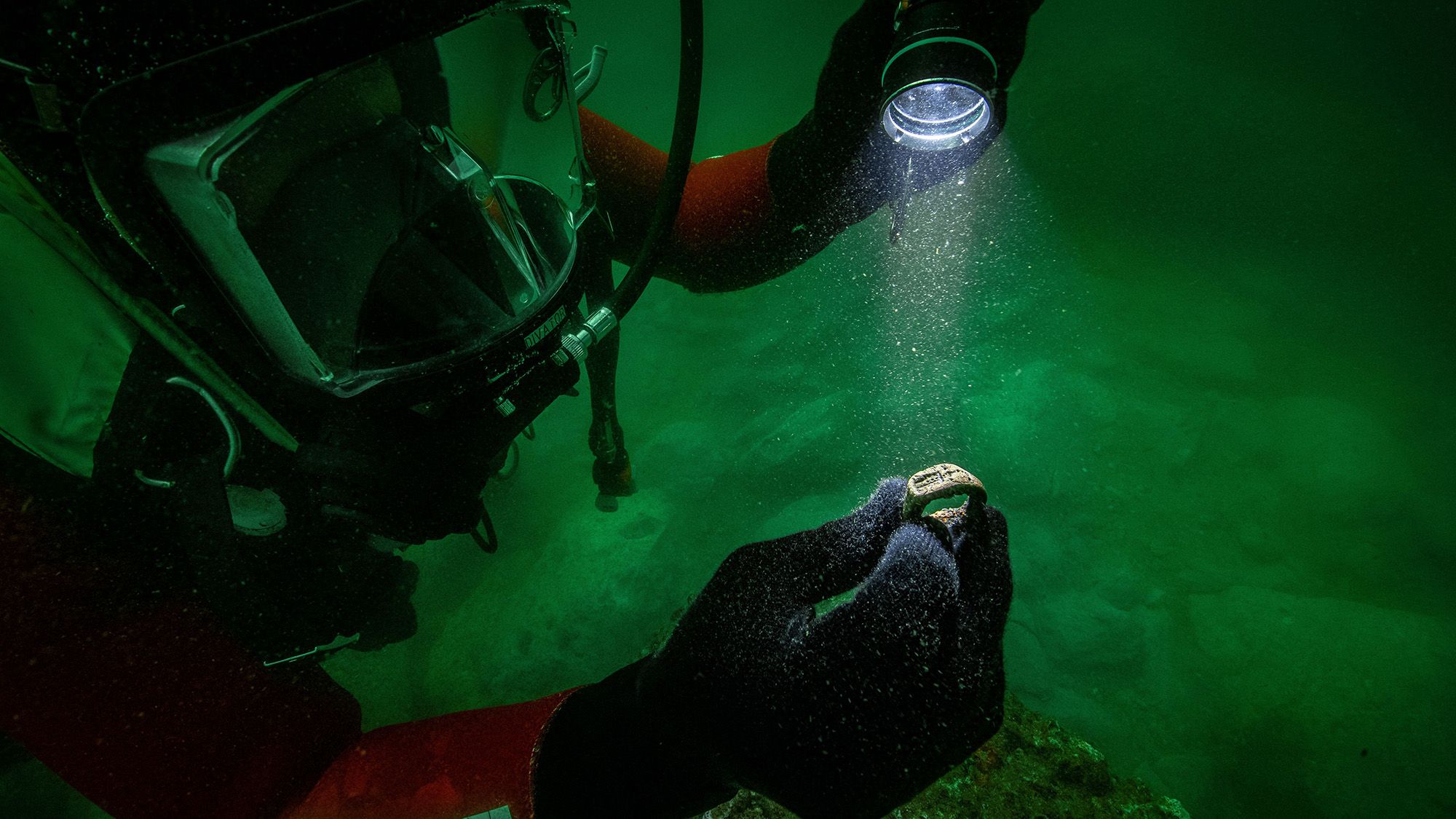
A bronze signet ring depicting the Lighthouse of Alexandria, one of the Seven Wonders of the Ancient World, has been discovered underwater in the Mediterranean Sea off the coast of Alexandria, Egypt.
A collaborative team from the European Institute for Underwater Archaeology (IEASM) and the Egyptian Ministry of Tourism and Antiquities recovered the artifact from the ruins of a palace on the now-submerged island of Antirhodos. This groundbreaking discovery marks the first time a signet ring featuring the image of the ancient lighthouse has ever been found, according to a statement from the IEASM team.
The engraving on the ring closely resembles depictions of the lighthouse previously found on coins dating back to the second century, representatives of the IEASM noted.
“The discovery of the ring-signet is even more important as it has been excavated in the legendary palace of the Island of Antirhodos, which once served as a center of power,” Franck Goddio, president of the IEASM, stated in the announcement.
The palace was utilized by Egyptian pharaohs during the Ptolemaic period (304 to 30 B.C.), a dynasty descended from one of Alexander the Great’s generals. Built on the island of Pharos around 280 B.C., the lighthouse stood over 328 feet (100 meters) tall. Ancient writers, such as Pliny the Elder, regarded it as one of the wonders of the world. It continued to function into the Middle Ages before earthquakes and erosion ultimately led to its destruction and submersion beneath the sea.
Over the centuries, the lighthouse underwent modifications, but it is believed to have featured a statue, possibly of Zeus, at its summit holding an oil lamp to guide mariners.


The wearer of a signet ring would have used it to stamp impressions onto soft materials like clay or wax to seal documents or goods. The discovery of this ring within the palace ruins at Antirhodos suggests the site played an administrative role connected to the lighthouse, IEASM representatives explained.
Despite some wear on the engraving, experts believe it depicts the lighthouse. Doris Behrens-Abouseif, a professor emeritus of history of art and archaeology at the University of London who has written about the lighthouse but was not involved in the research, shared her assessment.
“There are thousands of coins from Alexandria showing a similar depiction of the lighthouse,” she communicated via email, noting that these coins date to either the Ptolemaic or Roman periods (29 B.C. to A.D. 395).
Behrens-Abouseif added that she is not sufficiently familiar with ancient rings from Alexandria to determine if this is the only known ring bearing this specific image.
Other scholars have expressed their agreement that the ring depicts the lighthouse, with two researchers pointing out that the design may show smoke rising from a lamp at the peak.
“The most interesting thing about the new signet ring engraved gem is an asymmetrical feature at its peak,” which “may depict a plume of smoke from the oil lamp in the hand of the crowning statue,” Andrew Chugg, an independent researcher and author of “The Pharos Lighthouse in Alexandria: Second Sun and Seventh Wonder of Antiquity” (Routledge, 2024), noted in an email.
Margaret Miles, a professor emeritus of art history and classics at the University of California, Irvine, also observed the possible plume of smoke. In an email, she suggested that the “ring could have been used as a signet ring by a merchant from Alexandria who used the profile of the [lighthouse] to signal his location in Alexandria. The lighthouse was famous, so it became a symbol of the city.”
Recent underwater research off the coast of Alexandria—including the recovery of 22 massive blocks—has provided unprecedented insights into the lighthouse’s exact appearance. This new data is assisting researchers in their efforts to digitally reconstruct the ancient marvel.


