



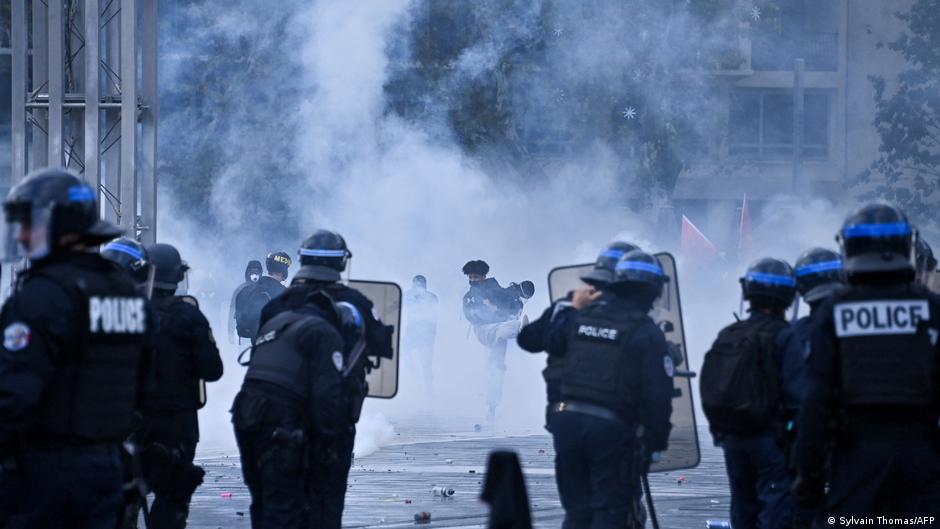
As protests sweep France, videos purportedly showing police violence have surged on social media. One clip appears to capture officers beating a man and dragging him unconscious; another shows an officer seizing a young man from behind and dragging him by the neck; a third depicts a teenage girl being pulled away with a twisted arm while she screams in pain. None of these recordings have been independently verified.
Rights groups have renewed their condemnation of French police tactics, focusing on the use of stun grenades and rubber bullets. France maintains one of the most heavily armed police forces on the continent. Over recent weeks, student demonstrations have resulted in severe injuries: a teenager lost a hand, another was blinded in one eye, and a third suffered a shattered jaw.
France’s protests grow
More than half a million demonstrators assembled in French cities on Saturday, the majority marching peacefully to denounce public‑sector cutbacks, the rising cost of living and to demand better school conditions for students. The event also saw violent episodes: rioters set buildings ablaze, looted shops and hurled projectiles at officers, creating a hazardous environment for law‑enforcement and emergency crews.
The weekend unrest follows a wave of actions by high‑school pupils who have occupied school buildings to protest teacher shortages and deteriorating infrastructure. Authorities have announced further demonstrations this weekend and indicated they may deploy military personnel to help maintain order.
Weapons made for war?
French police are equipped with a more extensive arsenal than most European counterparts. They employ the LBD‑40, a firearm designed to discharge rubber bullets. Many nations, including the United Kingdom and Germany, largely prohibit rubber‑bullet use during protests, while Spain permits it under stricter conditions and reports fewer injuries.
“It is not a French specificity. But there are guidelines. There must be a certain distance,” Anastassia Tsoukala, an associate professor of criminology at the University of Paris‑Sud, told DW. “Even if you try to respect the guidelines, people may move and then all of a sudden they may lose one eye. So it’s extremely dangerous.”
Tear gas is routinely deployed by French officers, a practice shared by numerous European forces. In armed conflict, its use is prohibited by treaties such as the Chemical Weapons Convention. A further distinguishing feature of the French police is their use of stun grenades.
“These grenades contain a high level of explosive substances. So from this point of view, France is unique,” Tsoukala noted.
Interior Minister Laurent Nunez maintains that police weapons are “non‑lethal.” Nonetheless, certain equipment is classified under French security law as “war material.”
France: Why students are taking to the streets
To view this video please enable JavaScript, and consider upgrading to a web browser that supports HTML5 video
French police: the ‘most brutal’ in the EU?
The deployment of these weapons has provoked fresh criticism after causing severe injuries during the protests. A teenager who lost eyesight is believed to have been struck at close range by a rubber bullet fired from an LBD‑40.
“When we look at crowd control, it is clear that if we measure police brutality by the number of deaths amongst demonstrators or members of the crowd, and if we also measure it by the number of cases of maiming, the French police are the most brutal in the whole of the European Union,” says Roche.
He underscores the political backdrop that shapes police equipment and its current application.
“The political authorities are free to decide on the police’s equipment,” the expert remarked. “When LBDs were introduced into the French police force, they were intended for units like anti‑organized crime squads. This is the same weapon that is today used for crowd control. It gives an idea of how the way in which politicians in France think we can or should deal with political protest has evolved.”
Confrontation vs. de‑escalation
A further divergence between French police and other European forces lies in their operational approach. German officers, for instance, are instructed to avoid escalation.
Roche contrasted the handling of demonstrators in Lützerath, Germany, in 2023 with the more aggressive tactics employed in Sainte‑Soline, France, that same year, both of which were environmental protests.
“In Lützerath, dogs were used, there were some injuries but far fewer seriously injured people on both sides. In Sainte‑Soline, the military police was sent in and used LBDs and grenades intensively. There were serious injuries amongst both police officers and demonstrators. Two protestors were left in a coma.”
When can police officers use force?
United Nations standards dictate that law‑enforcement officers may use force only in exceptional circumstances, such as preventing crime or effecting a lawful arrest. Any application of force must adhere to the principle of proportionality, employing no more than is necessary to achieve its objective.
French Interior Minister Nunez has asserted in radio interviews that officers have largely respected this principle—also embedded in French law—during the ongoing demonstrations.
Amnesty International, however, describes the police response to the current protests as “disproportionate” and urges French authorities to uphold their human‑rights obligations.
The French branch of the League of Human Rights condemns the “violent repression” of the high‑school protest movement.
DW reached out to two police unions and the Interior Ministry for comment, but none responded before publication.
“It was very complicated to contain all the different groups,” Nunez said in Marseille on Tuesday. “The police did a great job and there were a great number of crimes that were prevented thanks to their commitment.”
Experts, however, voice criticism of the police conduct.
“Public order is subordinated to human life and safety,” Tsoukala observed. “As a jurist I should say that this is a non‑negotiable value.”
Less oversight than in the UK and Denmark
The French police operate without an independent watchdog; oversight rests with the internal General Inspectorate of the National Police (IGPN), which can investigate incidents when they arise. The IGPN reports that at least 40 probes have been opened since the start of the recent protests.
In contrast, countries such as the United Kingdom and Denmark employ independent bodies to examine police conduct. Tsoukala points to a broader European trend of leniency and insufficient transparency in police‑related cases.
“They are acquitted or they receive extremely light penalties,” she said. “And I’m afraid this is the standard method to deal with police brutality cases across Europe.”
Edited by: Carla Bleiker
Also Read
- Boring Money Moves Still Win: Why Traditional Strategies Beat Crypto Speculation, Says Bestselling Author
- Tommy Robinson References Photos of Journalists’ Homes in Harassment Trial
- Clavicular Pleads Not Guilty Amid Alleged Rape Allegations
- UK Ministers Urge Public to Brace for Cyber and Climate-Driven Supply Chain Disruptions