







For astronauts on long-duration spaceflight, prolonged microgravity is one of the most serious health risks, affecting the eyes, bones, muscles and many other systems in the body.
A possible remedy is artificial gravity: a way to produce forces similar to Earth’s inside a spacecraft, much like the rotating ring in Stanley Kubrick’s 1968 film “2001: A Space Odyssey.”
But can that technology become real, or will it remain a fixture of science fiction?
“There really is no reason it couldn’t happen,” said Torin Clark, an associate professor of aerospace engineering at the University of Colorado Boulder. “From a technical standpoint, this is something that could be achieved in the very near future.”
Artificial gravity has already come close to reaching space. The Centrifuge Accommodation Module was planned as an 8.2-foot-wide (2.5-meter) centrifuge for the International Space Station, but the project was canceled in 2005 because of budget constraints.
“[Artificial gravity] is one of those things — like all of a sudden, it becomes very popular, and then all the scientists at NASA and everybody have funding to figure out how to implement it, and then it just dies,” said Ana Diaz Artiles, an associate professor of aerospace engineering at Texas A&M University. “And then it comes back, and dies, and comes back. I have been through a couple of these cycles in the time I have been doing this.”
Beyond budget concerns, there are unresolved questions about how artificial gravity could be implemented.
“Everybody agrees it is a good thing to do. The problem is that we do not know how to implement it,” Diaz Artiles said. “How much gravity do you need? How big does the device have to be? How long does it need to be? And how long do you need to use it? Should we provide continuous gravity, or use a short-radius centrifuge where you go in and out?”
Researchers are considering three main approaches. The first is the familiar science-fiction design: a large ring that rotates so passengers live and work under forces similar to Earth’s gravity.
“You have a relatively long radius, which means you do not have to spin very fast to create gravity,” Diaz Artiles said. “But this is massive. You cannot launch all the parts in the same spacecraft — you need multiple spacecraft and have to assemble everything. So, of course, you can see what a large endeavor this would be.”
A short-radius centrifuge is a more practical option. It is essentially a tube about 6 to 10 feet (1.8 to 3 meters) in radius that spins to simulate gravity. A person would sit or stand inside, with the head closest to the center of rotation, so the spin produces the strongest force toward the feet.

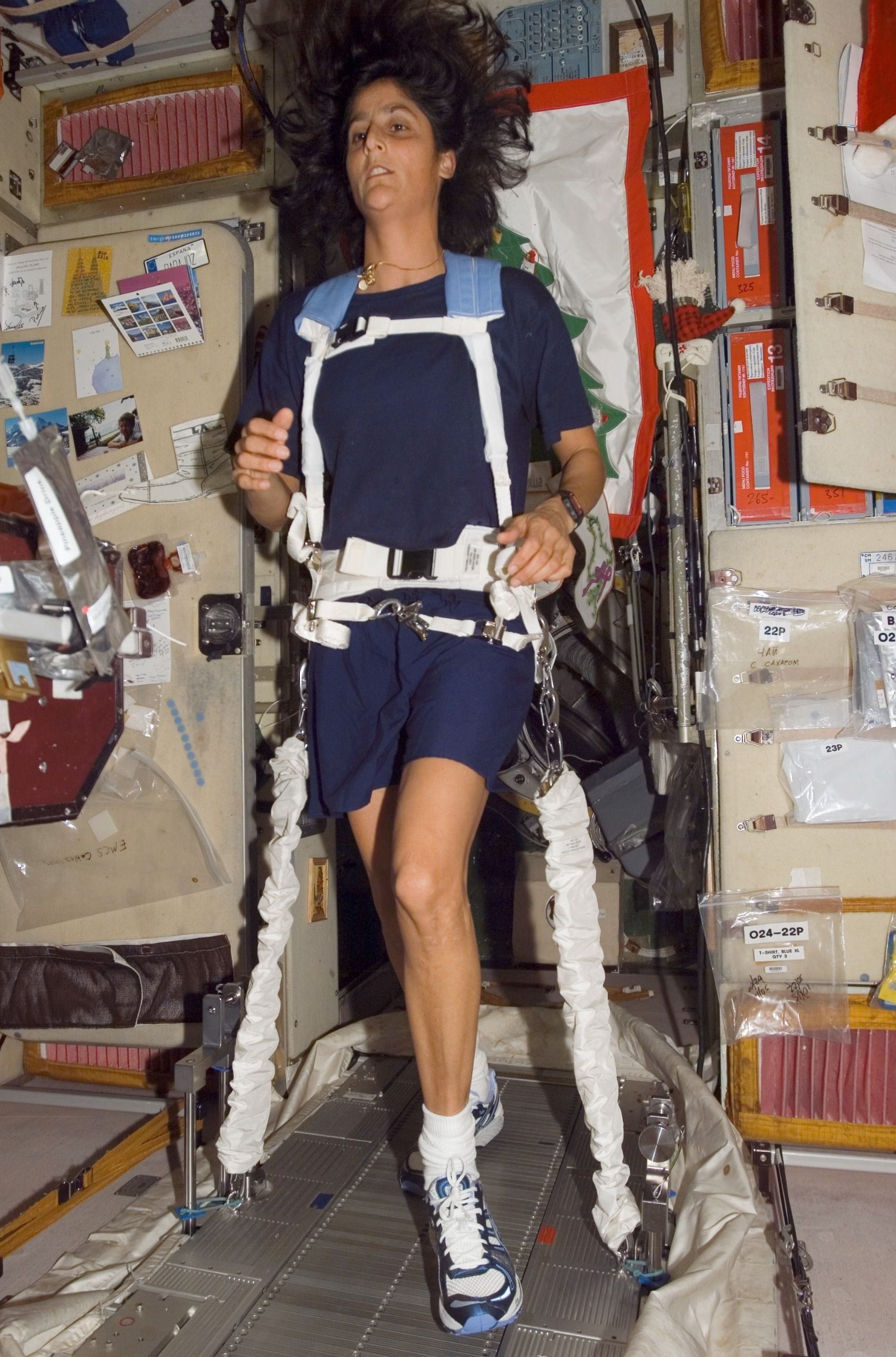
Instead of allowing passengers to live continuously in artificial gravity, this smaller device could be used in short daily sessions. “It is kind of like an exercise device,” Diaz Artiles said. “In the ISS, you have a treadmill and this resistive exercise machine, so you go there for 30 minutes to do your exercise, and then you get out.”
The third option is to create gravity through linear acceleration. This works in much the same way that an accelerating car pushes passengers back into their seats, except the spacecraft would be oriented so that an astronaut’s feet are pressed toward the floor. To slow down, the spacecraft would turn around and fire its thrusters in the opposite direction, decelerating smoothly while maintaining roughly similar artificial gravity for its occupants.
“But then you need something like an engine that is able to accelerate all the time,” Diaz Artiles said. “And propulsion-wise, I think we are not there yet.”
Although a short-radius centrifuge appears to be the most feasible option in terms of cost and engineering, it has drawbacks. Its fast spin can produce the Coriolis cross-coupled illusion — a sensation of tilting or tumbling that occurs when a person tilts their head off-axis while rotating.
This is the effect that can cause motion sickness, Clark said.
However, Clark and his team have found that people can build tolerance to the sensation through training, simply by spending time in a slowly spinning centrifuge and gradually increasing the speed once the sensation fades.
“If you very slowly, incrementally increase the spin rate, and do that not just over one session but over multiple sessions across multiple days, as far as we could tell, anyone can be made to incrementally acclimate to the rotating environment of up to 20 to 30 rotations per minute,” Clark said.
Would artificial gravity prevent harmful effects on the body?
Researchers still do not know how fast a centrifuge would need to rotate, or how long a person would need to spend inside it, in order to receive a health benefit. Long periods in microgravity can lead to bone and muscle loss, reduced aerobic fitness, blood clots, and visual problems caused by fluid shifts in the eyes. The hope is that artificial gravity could help prevent these effects, but the amount of gravity required remains an open question.
Studies using head-down tilt bed rest — the standard research method for simulating spaceflight deconditioning — have found that 30 minutes a day in a centrifuge prevented some loss of muscle function.
“Thirty minutes a day may not be enough,” Clark said. “Maybe an hour or even two hours a day, and maybe at higher G levels, would be beneficial.”
These studies are also expensive and time-consuming. “It is very difficult,” Diaz Artiles said. “I think people are interested in this concept, but we just do not have a good answer.”
In the end, the main barrier is not whether the technology is possible; it is determining the best way to use it and securing the funding to do so.
“We know how to do this. As humans, we have done more difficult things,” Diaz Artiles said. “We need the money, but we also need to better understand the need.”


