








For years, Southeast Asia’s battery ambitions have centered on potential. Indonesia possesses vast nickel reserves; Malaysia offers semiconductor and advanced materials expertise; Singapore contributes research depth and capital networks; Thailand and Vietnam are developing EV supply chains; and the Philippines is working to strengthen its own EV ecosystem.
At the fourth ASEAN Battery Technology Conference (ABTC) in Malaysia this week, the conversation shifted to a more challenging question: whether these disparate strengths can be woven into an integrated regional industry.
Held from August 19 to 21 at the Mövenpick Hotel & Convention Centre KLIA in Sepang, ABTC 2026 convened policymakers, manufacturers, researchers, investors, and industry groups from across the region. Hosted by NanoMalaysia Berhad, the conference carried the theme “Industrialising Battery Technologies: Strengthening ASEAN’s Battery Value Chain for Global Competitiveness.”
The theme signals a pivotal shift. The region has moved beyond discussions of research collaboration or EV adoption targets to confront the industrial backbone of the energy transition: battery materials, cell development, safety testing, certification, manufacturing scale-up, recycling, and market deployment.
Opening the conference, Malaysia’s Minister of Science, Technology and Innovation, Chang Lih Kang, urged ASEAN to move “from discussion to industrialisation.”
“ASEAN’s strength lies in our ability to complement one another through research, manufacturing, standards development, investment, and market integration,” he said. “By working together, we can build a resilient regional value chain that benefits all our economies.”
The challenge is formidable: battery manufacturing is capital-intensive, technically demanding, and highly scale-sensitive. China dominates the global supply chain from processing to cell production, while South Korea and Japan lead in advanced technologies. The US and Europe are leveraging industrial policy to localize segments of the chain. ASEAN’s opportunity is real, but realizing it requires coordination across ten fragmented markets rather than duplicated efforts.
Malaysia positions itself as a battery industrialisation hub
Malaysia’s hosting role reflects its own push to bridge battery research and commercial production.
Through initiatives such as the NanoMalaysia Energy Storage Technology Initiative and the Hydrogen–EV–Battery Centre, the country has developed capabilities in research, prototyping, testing, validation, and pilot-scale manufacturing. Recent developments—including the establishment of GigaFactory Malaysia Sdn Bhd and advances in graphene-enhanced lithium-ion battery technology—demonstrate an effort to translate laboratory work into industrial capacity.
For Southeast Asia, this matters because the battery economy cannot be built on raw materials alone. While Indonesia’s nickel reserves have drawn global attention, the broader value chain encompasses cathode materials, cell design, battery management systems, pack assembly, safety certification, second-life applications, and recycling. Nations that secure multiple positions along this chain stand a better chance of retaining value domestically.
NMB Group CEO Prof. (Adj.) Dr. Rezal Khairi Ahmad noted that while the region possesses technical capabilities, it lacks clear pathways to scale.
“Malaysia has been building infrastructure to move technologies from research into pilot and industrial application, but no single market can build the battery economy alone,” he said. “ABTC provides a platform to connect capabilities across ASEAN, develop stronger cross-border pathways, and collectively build a globally competitive industry.”
This captures the region’s central tension: ASEAN has the ingredients for a battery ecosystem, but ingredients do not automatically constitute an industry. Investors require predictable demand, common standards, skilled talent, bankable offtake agreements, and manufacturing discipline. Governments must align EV policies, grid storage plans, and industrial incentives without triggering a subsidy race.
Malaysia-Indonesia pouch cell points to regional complementarity
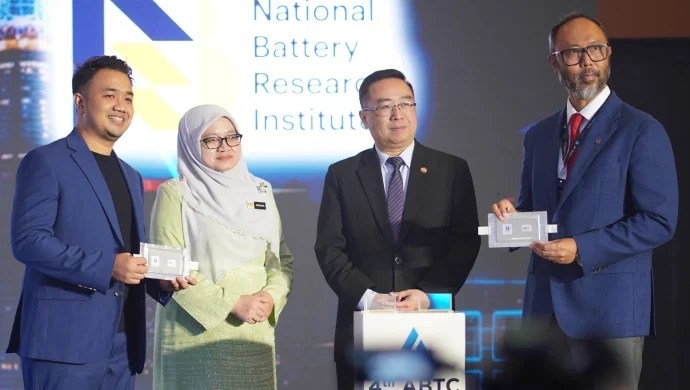
One of the most concrete announcements on the opening day was the launch of a Malaysia-Indonesia NMC-graphene lithium-ion pouch cell, developed through collaboration between NanoMalaysia Berhad and Indonesia’s National Battery Research Institute.
NMC refers to a lithium-ion cathode chemistry combining nickel, manganese, and cobalt. Widely used in EVs and energy storage for its relatively high energy density, it also presents challenges regarding cost, raw material sourcing, and safety management. Graphene—a highly conductive carbon-based material—is being explored globally to enhance battery performance, durability, and charging characteristics.
The pouch cell builds on a memorandum of understanding signed by NMB and NBRI during ABTC 2025, covering technology transfer, joint research and innovation, testing and standardization, education, and industrial training.
In practice, the initiative combines Indonesia’s NMC active material production with Malaysia’s battery formulation, graphene technology, and cell development capabilities. It offers a modest but instructive example of how the region might divide labor: no single country needs to own the entire stack if cross-border collaboration enables materials, research, testing, and commercialization to connect efficiently.
For Indonesia, such collaborations could shift its battery strategy beyond mineral extraction. For Malaysia, they provide a pathway to integrate its materials science, electronics, and manufacturing expertise into a regional supply chain. For ASEAN as a whole, these projects test whether regional cooperation can withstand the commercial realities of intellectual property, ownership, standards, and market access.
Partnerships signal interest, but execution will decide impact
ABTC 2026 also featured several partnership announcements spanning battery storage, manufacturing, AI-enabled operations, and commercialization.
GigaFactory Malaysia and Milan Utama signed a supply agreement to prototype compact battery energy storage systems. Infien Energy and Ampace announced a strategic collaboration to explore battery technology opportunities. Green Tenaga and Go Rental Singapore partnered on sustainable energy solutions, while Neoron Energy Network, Aryva Energy, Nano Commerce, and GigaFactory Malaysia formed a consortium to develop and commercialize battery and energy storage solutions.
GigaFactory Malaysia also unveiled separate initiatives with Axium Industries and Montavista Energy Technologies Corporation. The Axium partnership aims to leverage AI and digital tools to enhance battery manufacturing, operational efficiency, and supply chain management. The Montavista collaboration focuses on high-energy-density battery innovation, recycling, manufacturing capabilities, equipment facilitation, and market development.
While such agreements are common at industry conferences—and not all will materialize into factories, revenue, or exportable products—they signal the direction of the region’s battery discourse. Energy storage is gaining parity with EVs in importance, especially as Southeast Asian nations integrate more solar and renewable power into their grids. Battery energy storage systems can mitigate intermittency, stabilize grids, and support decentralized energy models for factories, commercial buildings, and remote communities.
Safety and certification will grow in importance as batteries transition from pilot projects into homes, vehicles, factories, and grid infrastructure. Opening sessions addressed battery safety, manufacturing scale-up, circularity, and emerging technologies, featuring speakers from Argonne National Laboratory, the University of Chicago, SEDA, MARii, Pertamina, A*STAR, and the Electric Vehicle Association of the Philippines.
From conference circuit to industrial policy
ABTC has evolved rapidly since its inaugural edition in Bali in 2023. Subsequent editions were held in Singapore and Phuket, with the 2026 event in Malaysia and the 2027 edition slated for the Philippines, hosted by the Electric Vehicle Association of the Philippines. Along the way, the platform has fostered regional industry coordination, including an ASEAN battery associations memorandum in 2023 and the ASEAN Battery Safety Network in 2025.
The handover to the Philippines is symbolic, but the real test lies beyond the conference hall. Southeast Asia’s battery ambitions hinge on whether countries can coordinate standards, train engineers and technicians, attract long-term capital, support recycling, and generate sufficient domestic demand to justify manufacturing investment.
The global battery race is accelerating. ASEAN need not replicate China’s scale to be relevant, but it must identify where it can compete—whether in selected materials, specialized manufacturing, pack assembly, battery management systems, energy storage deployment, testing and certification, or recycling.
The shift from dialogue to industrialization is less a slogan than a deadline. If Southeast Asia aims to capture more value from the EV and energy storage boom, the next phase will be measured not by memoranda signed, but by plants built, products certified, and batteries deployed in real markets.


