




TL;DR: The AUD/NZD pair surged past the 1.2489‑1.2493 resistance after two policy moves 30 minutes apart: a higher‑than‑expected Australian CPI reinforced expectations for a November RBA rate hike, while the RBNZ unexpectedly kept its Official Cash Rate at 2.75% in a 4‑3 vote. The move is driven primarily by NZD weakness, pushing the cross toward 1.2624 and potentially 1.2845.
Why This Matters
Today’s sharp AUD/NZD breakout reflects a rapid policy divergence between Australia and New Zealand. Australia’s September CPI rose to 4.3% year‑on‑year, beating forecasts and lifting the odds of a November 3 RBA increase to around 79%. In contrast, the RBNZ surprised markets by holding the OCR at 2.75% after a narrow committee vote, though all members signaled that further tightening could be needed depending on inflation data. The cross cleared the 1.2489‑1.2493 barrier, briefly hitting 1.2600, underscoring that the move is a response to New Zealand’s relative policy pause rather than a surge in Australian dollar strength.
Australian Inflation Reinforces November RBA Hike Expectations
Australia’s September CPI accelerated to 4.3% year‑on‑year from 4.0% previously, outpacing the 4.2% forecast. Quarterly headline inflation rose 1.3%, while trimmed‑mean inflation posted a 1.0% quarter‑on‑quarter increase, exceeding the RBA’s August projection of 0.8%. Core components showed mixed signals:
- Services inflation rose to 4.1% from 3.7%.
- Automotive fuel jumped 9.4% month‑on‑month after a 14.8% surge in August.
- New dwelling inflation moderated to 4.7% from 5.4%.
The data reinforced concerns that underlying price pressures remain persistent, pushing OIS‑implied probability of a November 3 RBA hike from about 60% to 79%.
RBNZ Surprise Delays Tightening, but Breman Keeps Hawkish Risks Alive
The Reserve Bank of New Zealand surprised markets by holding the Official Cash Rate at 2.75% in a narrow 4‑3 vote, contrary to widespread expectations for a 25‑basis‑point increase. The majority opted to gauge the impact of previous tightening, citing softer Q3 inflation and subdued demand. All seven committee members, however, affirmed that additional hikes would likely be required if inflation remained entrenched. Governor Anna Breman emphasized that the pause should not be read as an end to the tightening cycle, warning that “further tightening will be needed, even into restrictive territory,” if domestic inflation proves persistent. She also noted that September’s CPI release fell after the pre‑decision blackout period, complicating the policy assessment.
AUD/NZD Reprices the Policy Timing Gap
The immediate divergence is now evident: the RBA stands at 4.60% with a November increase heavily priced, while the RBNZ remains at 2.75% with its next decision scheduled for December 9. This timing mismatch underpins the AUD/NZD breakout. Importantly, the divergence is about the calendar rather than ultimate policy direction, as both banks remain vigilant on inflation.
Further re‑pricing is constrained by market expectations. The RBA’s November move is largely anticipated, and stronger New Zealand data could revive December hike speculation. Breman’s comments suggest the pause is conditional, limiting how far the cross can drift without supportive New Zealand data.
Today’s high‑impact events, notably the FOMC rate decision, may add short‑term volatility, but the underlying AUD/NZD policy gap remains unchanged.
ActionForex’s Technical View: AUD/NZD Targets 1.2624, Then 1.2845
After breaking through the 1.2489‑1.2493 resistance, AUD/NZD resumed its uptrend. The next key projection is the 61.8% Fibonacci extension of the 1.1910‑1.2489 move, arriving at 1.2624. A decisive close above this level could set up a run to the 100% projection at 1.2845.
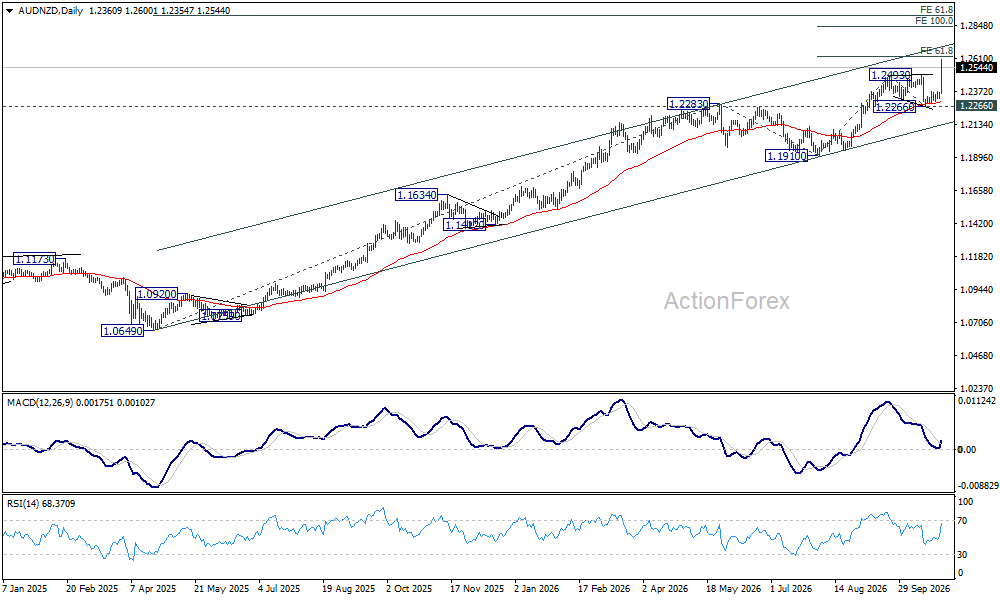
Immediate focus will be on whether the 1.2266 support holds; a breach would increase near‑term jitter, especially with the FOMC decision pending. Even if a pullback occurs, the bullish bias persists as long as 1.2266 remains intact.
For the medium term, the pair may target the 61.8% extension of the 1.0649‑1.2283 swing, aiming for 1.2920, with the 1.3000 psychological barrier also in view, provided the rising channel ceiling supports further upside.
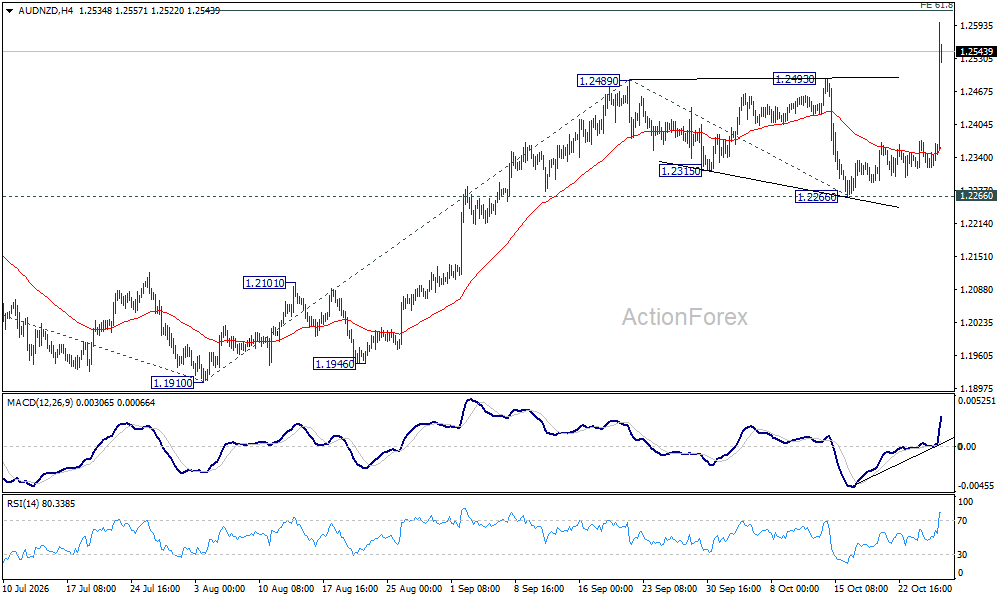
Overall, the technical breakout mirrors the sharp repricing of near‑term RBA‑RBNZ policy timing. However, Breman’s signals that the pause is conditional indicate that the divergence may not extend indefinitely without supportive New Zealand data.
Key Takeaways
- AUD/NZD’s breakout through 1.2489‑1.2493 is driven largely by NZD weakness; NZD/USD fell ~1.30% while AUD/USD rose only 0.12% on the day.
- September CPI in Australia rose to 4.3% y/y, exceeding the 4.2% forecast and pushing November RBA hike odds from 60% to 79%.
- The RBNZ’s surprise hold at 2.75% was not a dovish pivot—all committee members still see further tightening as likely, and Governor Breman highlighted the possibility of moving into “restrictive territory.”
- The divergence is timed, not directional: the RBA’s November move is already priced, while stronger NZ data could revive December hike expectations.
- Technicals point to next targets of 1.2624 and 1.2845, with the bullish outlook intact as long as 1.2266 support holds, even amid FOMC‑related volatility.