







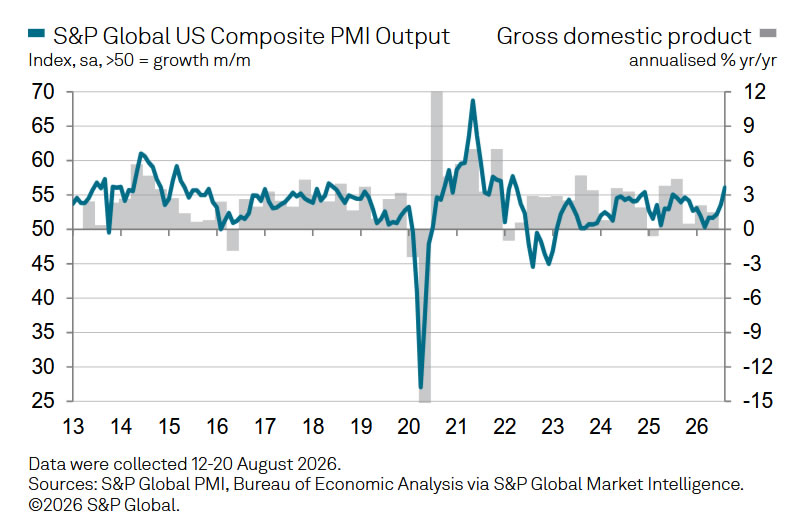
Private‑sector activity in the United States intensified in August, with the composite PMI output climbing to 56.0 from 54.5—the highest level recorded in over four years. The services PMI rose to 56.8 from 54.6, marking a 20‑month peak and serving as the primary engine of growth. Meanwhile, manufacturing PMI slipped to 53.2 from 53.9, and manufacturing output fell to 51.9, the lowest reading in 13 months.
S&P Global observed that Q3 survey data suggest annualized growth could reach roughly 3.0%, up from 1.5% in the previous quarter. Employment continued to strengthen as business confidence improved. Manufacturing, however, lost steam as inventory building receded and supply bottlenecks limited output. These bottlenecks remained among the most severe observed in the past four years, with Middle East tensions and energy prices still posing significant risks.
Inflation pressure has moderated slightly but remains elevated, leaving the Federal Reserve with a mixed yet still firm backdrop. Robust services activity and renewed hiring signal resilient demand, whereas weaker factory output indicates that expansion increasingly relies on consumer and financial services. With price pressures still susceptible to another energy shock, the August PMI data do little to bolster the case for a swift policy easing.

Data Summary
Component
Current
Previous
Trend
PMI Composite Output
56.0
54.5
52-month high
PMI Services Business Activity
56.8
54.6
20-month high
PMI Manufacturing
53.2
53.9
5-month low
PMI Manufacturing Output
51.9
53.9
13-month low
Q3 GDP Signal
~3.0% annualized
1.5% Q2
Stronger
Employment
—
—
Growth revived
Business Confidence
—
—
Improved
Input / Price Pressures
—
—
Easing but still elevated
Supply Delays
—
—
Among worst in four years
Key Takeaways
- US PMI Composite Output rose from 54.5 to 56.0 in August, reaching its strongest level in more than four years.
- PMI Services Business Activity accelerated from 54.6 to 56.8, a 20-month high and clear driver of overall growth.
- PMI Manufacturing eased from 53.9 to 53.2, while PMI Manufacturing Output fell more sharply from 53.9 to 51.9.
- S&P Global said Q3 survey data point to annualized GDP growth approaching 3.0%, up from 1.5% in Q2.
- Employment growth revived as business confidence improved.
- Manufacturing lost momentum as precautionary stock building faded and supply delays constrained production.
- Supply-chain disruption remained severe, with Middle East conflict and energy prices still key risks.
- Price pressures eased but stayed elevated, leaving inflation vulnerable to another energy shock.
- For Fed, data point to resilient demand and stronger services activity, limiting scope for a rapid shift toward easier policy.
Also Read
- Justin Sun’s Legal Battle Over World Liberty’s $4B Stablecoin Bank Intensifies Ahead of Final OCC Approval
- Whale Retains 5 Trillion SHIB Tokens for Over Four Years Amid Market Volatility
- Hyperliquid Targets US Market Compliance with $200B On-Chain Liquidity as Trump Advances Crypto Regulation
- Silver Surges Toward $70 Amid Ongoing USD Weakness


