







Separate seizure permissions
Base’s Cobalt upgrade, set for launch on mainnet on September 30, 2026, at 18:00 UTC, gives B20 token issuers the ability to configure balance seizures independently of regular transfer restrictions. This means a holder may retain full transfer rights while still being subject to administrative reassignment.
B20 is Base’s native ERC‑20‑compatible token standard, available in both Asset and Stablecoin variants. It already provides administrators with granular control over roles and policies that dictate how balances may be moved. The Cobalt upgrade now extends this control to encompass separate administrative powers over those balances.
Role assignments define which addresses may exercise a given power, whereas policy settings specify which accounts are subject to an operation. Modifying a token’s rules and carrying out a balance operation each require their own set of permission checks, ensuring a clear separation of concerns.
The new administrative operation, named seizeWithMemo, transfers a defined amount from a holder to a designated address. This operation keeps the overall token supply unchanged and sidesteps normal transfer policies and holder allowances.
Issuers must pre‑define which accounts are excluded from seizure; the SEIZE_EXEMPT_POLICY setting defaults to exempting all addresses when unconfigured. Even with eligibility set, execution also needs the SEIZE_ROLE, an active (unpaused) seizure function, a permitted recipient address, and an adequate balance to transfer.

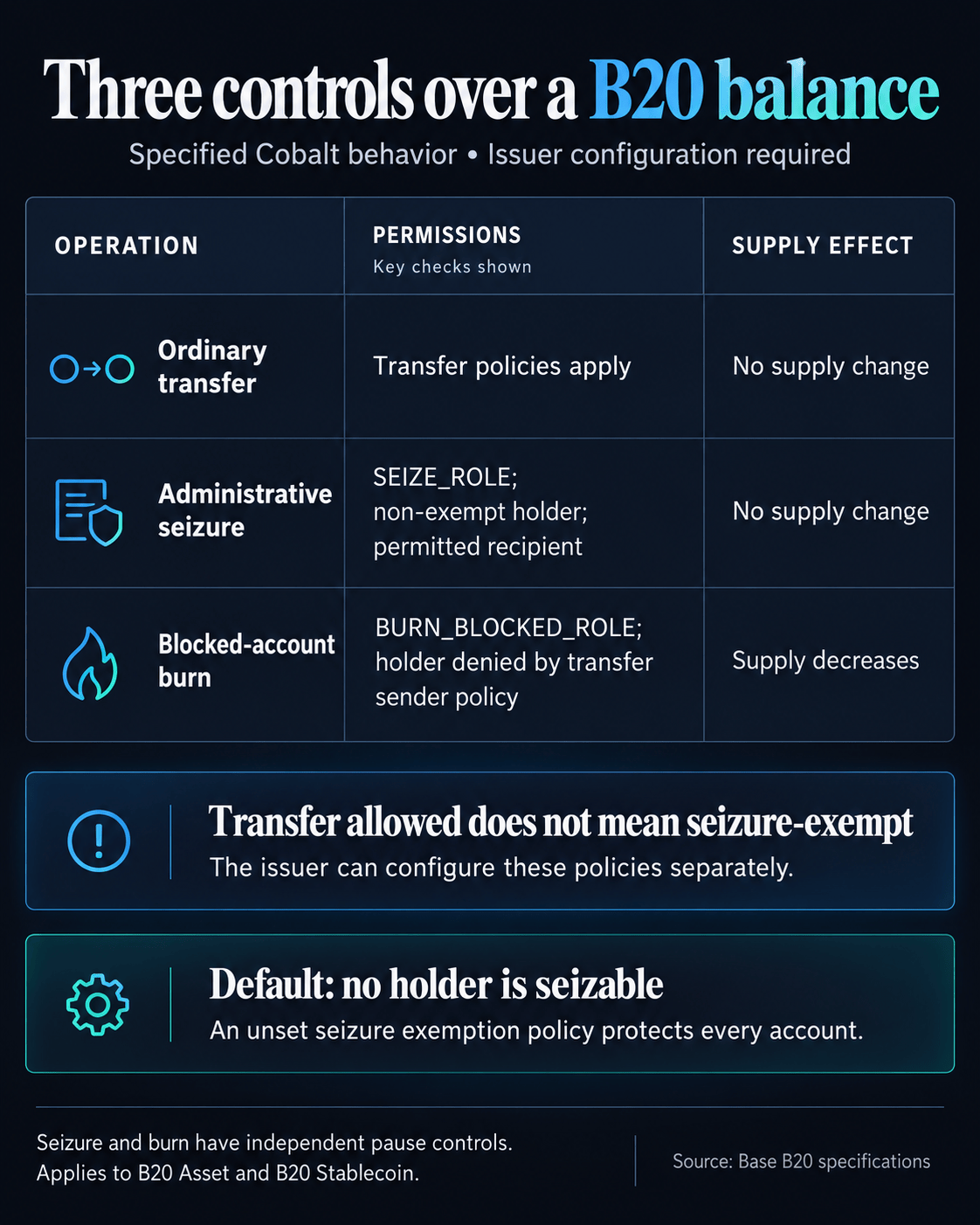
A separate recipient policy governs the destination of seized tokens; if left unconfigured, any otherwise valid address can receive them. A holder’s permission to perform ordinary transfers is independent of these seizure‑policy checks.
B20’s existing transfer policies evaluate the sender, receiver, and executor for certain transfers initiated on another account’s behalf. Administrators may modify these policies at will. Granting approval to a spender does not waive the checks that apply to the eventual transfer; ordinary transfer permissions remain separate from Cobalt’s seizure rules.
B20 also includes a burnBlocked function that allows an authorized caller to destroy tokens held by an account blocked by the transfer sender policy. Cobalt designates this function as deprecated but retains its existing callability.
This provides issuers with multiple mechanisms for removing a holder’s balance. Reassignment transfers the tokens to another address while keeping them in circulation, whereas eliminating the seized supply requires an additional burn operation. Seizure and burning functions each have distinct administrative roles and pause controls.
Base’s status page confirms the mainnet rollout, scheduled for a maintenance window from 18:00 to 20:00 UTC on September 30. The Sepolia testnet went live on September 23, and mainnet activation is set to ship on September 30.
Version 1.4.2 introduces Cobalt mainnet support and directs node operators to apply the upgrade no later than September 30, 18:00 UTC.
Also Read
- EU Regulators Scrutinize Binance’s Use of Reverse‑Solicitation Exemption: Report
- UK Manufacturing PMI Edges Up to 51.9 in September Amid Slowing Output and Rising Cost Pressures
- EUR/USD Hits New Lows Amid Rising US Yields and Inflation Concerns
- MetaMask Halts Ethereum Staking Operations Following Security Breach, User Funds Unaffected


