




A camera trap in the ancient Białowieża Primeval Forest captured an exceptionally rare encounter: wolves attempting to prey on a European bison herd that included a newborn calf. The footage, recorded on September 15, 2025, shows five wolves entering the scene, followed closely by three adult bison cows and the vulnerable calf.
Initially, the cows chase the wolves away, leaving the calf exposed. The wolves surround the youngster, bite its neck, and try to drag it off. Two cows intervene, rescuing the calf, but the wolves return for a second attempt. This time the entire herd assembles, forming a protective circle that drives the predators off and ends the attack.
The video was taken in Białowieża Primeval Forest, the largest and most intact temperate lowland forest in Europe and home to the continent’s biggest European bison population. The forest spans about 350,600 acres (141,900 hectares) along the Poland‑Belarus border, supporting more than 870 bison in Poland and roughly 730 on the Belarusian side.
Often called “the king of the forest,” the European bison has traditionally been viewed as a non‑prey species, with humans being its only natural predators. This footage challenges that perception.
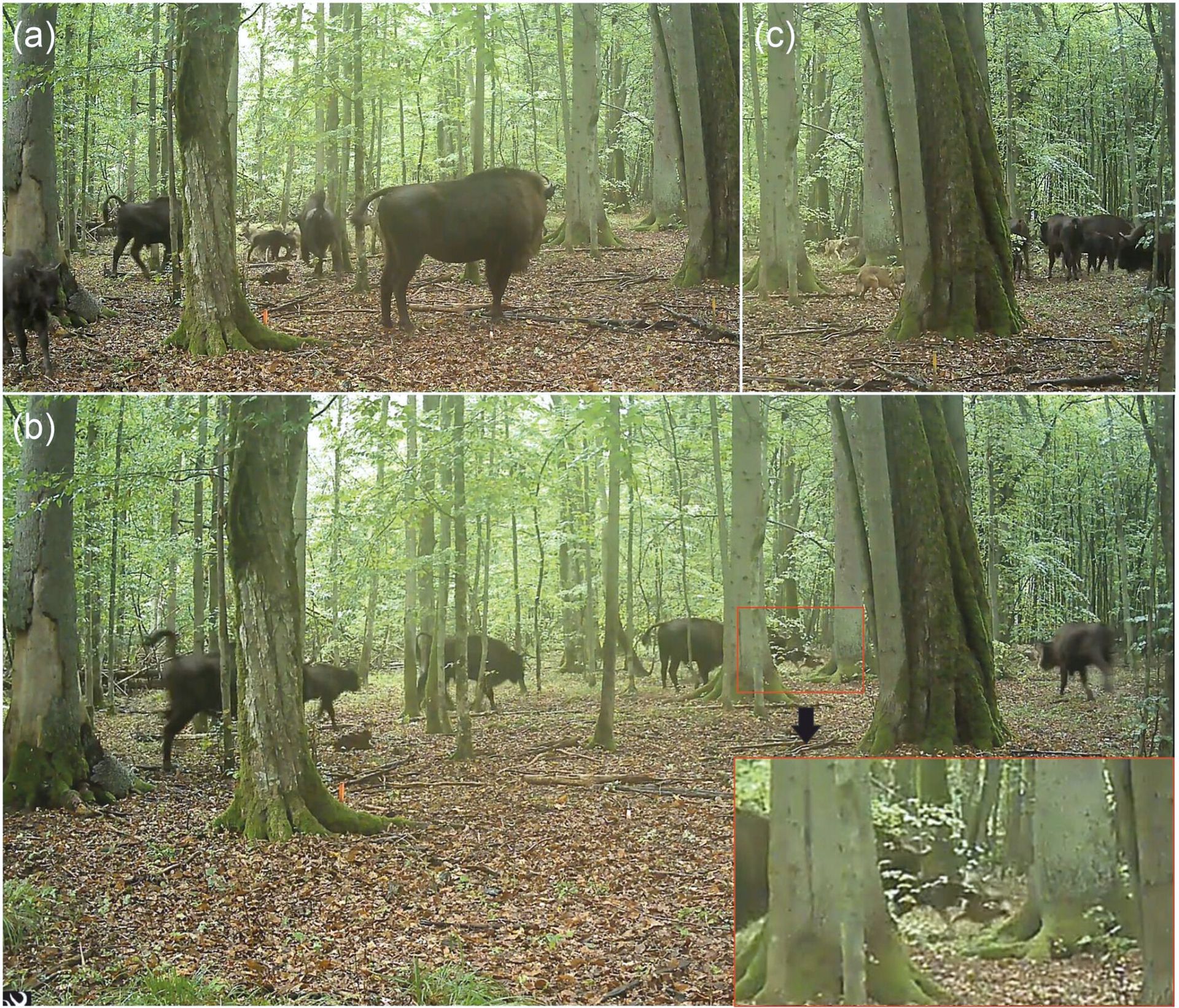
Frames from the video show (a) wolves grabbing the newborn calf, (b) a second attempt to seize the calf, and (c) the bison herd forming a defensive circle around the calf.
Researchers reported that this is the first video‑recorded evidence of wolves attacking a European bison herd in Białowieża. Although the footage does not capture a lethal strike, it suggests that successful attacks on bison, while rare, are possible.
Historical records indicate that wolf attacks on bison were more common in the 19th century, with about eight kills per year documented between 1840 and 1849. European bison vanished from the wild in 1919 and were re‑introduced to Białowieża in 1952. Since the mid‑1990s, wolves have largely preyed on smaller ungulates such as roe deer, red deer, and wild boar, which are easier to hunt.
The new observation therefore raises questions about the bison’s status as a non‑prey species and the potential implications for its conservation and management.
Wolves in the forest are forming larger packs, possibly due to hunting bans introduced in the late 1980s. Larger packs could increase the likelihood of successful predation on bison, especially younger individuals.
If wolf predation on young bison proves more frequent than previously thought, wolves might play a modest yet significant role in naturally regulating bison populations, which could help mitigate human‑bison conflicts.
Wijnands, R. R., & Borowik, T. (2026). The King in the Crosshairs: Evidence of a predation attempt on European bison by Wolves. Ecology and Evolution, 16(6), e73752.