






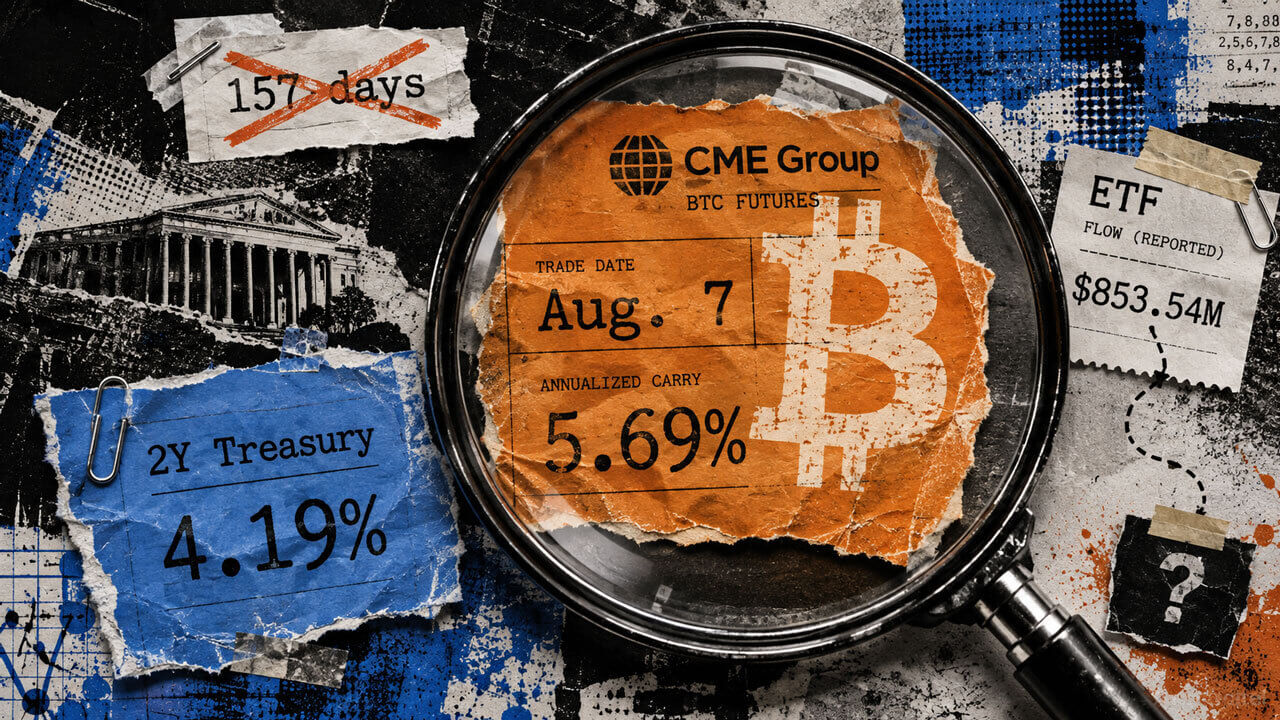
Synchronized CME and Treasury observations from August 7 put Bitcoin futures carry above government debt, undercutting a comparison that circulates across the cryptocurrency markets. Analyst Marc Baumann placed the annualized Bitcoin futures basis near 3% and the two-year Treasury yield at 3.8%, noting that the crypto spread had trailed the government benchmark for 157 consecutive days. The official Treasury curve recorded the two-year par yield at 4.19% on August 7 and 4.25% on August 10.
A matched-date calculation based on the Aug. 7 CME settlement bulletin and the 4 p.m. ET New York Bitcoin benchmark of $64,880 generated three gross annualized readings above the same day’s 4.19% Treasury yield. The December contract registered the smallest reading at 5.69% on that basis.
August 7 falls within the proposed 157-day window, breaking a streak calculated from comparable CME and BRRNY inputs. A different venue, tenor, roll convention, or net-cost methodology may produce another figure; Baumann’s thread did not disclose those parameters.
How Bitcoin Futures Carry Works
A Bitcoin cash-and-carry position typically pairs a spot purchase with a short futures contract, aiming to capture the premium of futures over spot as they converge, while the annualized figure depends on the contract and time remaining to expiry.
CME’s BasisWatch methodology applies a 60-second spot time-weighted average from 3:59 p.m. to 4 p.m. ET and the nearest monthly futures contract at 4 p.m., with a stated roll convention. The table applies similar matched-date arithmetic to the August contract and extends it across the September and December term structure, which falls beyond BasisWatch’s nearest-contract scope.
The August 2026 contract produced the highest gross annualized basis at 7.89%, with September at 6.25% and December at 5.69%.


The Treasury rate supplies a same-date opportunity-cost benchmark. Monthly futures sit on different horizons, and each trading desk faces its own financing rate. An investable calculation would also account for the cost of financing the spot leg, margin, fees, and execution on both sides.
Calling the trade “riskless” obscures those paths. A Bank for International Settlements study of crypto carry found that one-month CME Bitcoin carry exceeded 20% at points in 2021 while documenting financing, leverage, margin, and liquidation risks that could interrupt a position before convergence.
For an arbitrage desk, the relevant Bitcoin futures carry is the premium left after funding, balance-sheet and execution costs. A small net spread can push that capital elsewhere even as institutions continue buying Bitcoin for other reasons.
Also Read
- 5 Best Solana Tools for Tracking Smart Money and Wallet Activity in 2026
- U.S. Dollar Gains as Oil Markets Rally: Comprehensive Analysis for EUR/USD, GBP/USD, USD/CAD, and USD/JPY
- Dollar-Yen Pauses Near 155 Ahead of FOMC Decision as Markets Remain Cautious
- U.S. Justice Seeks Forfeiture of $61 Million Tied to Sanctioned Iranian Oil Proceeds Laundered Through Binance Accounts


