






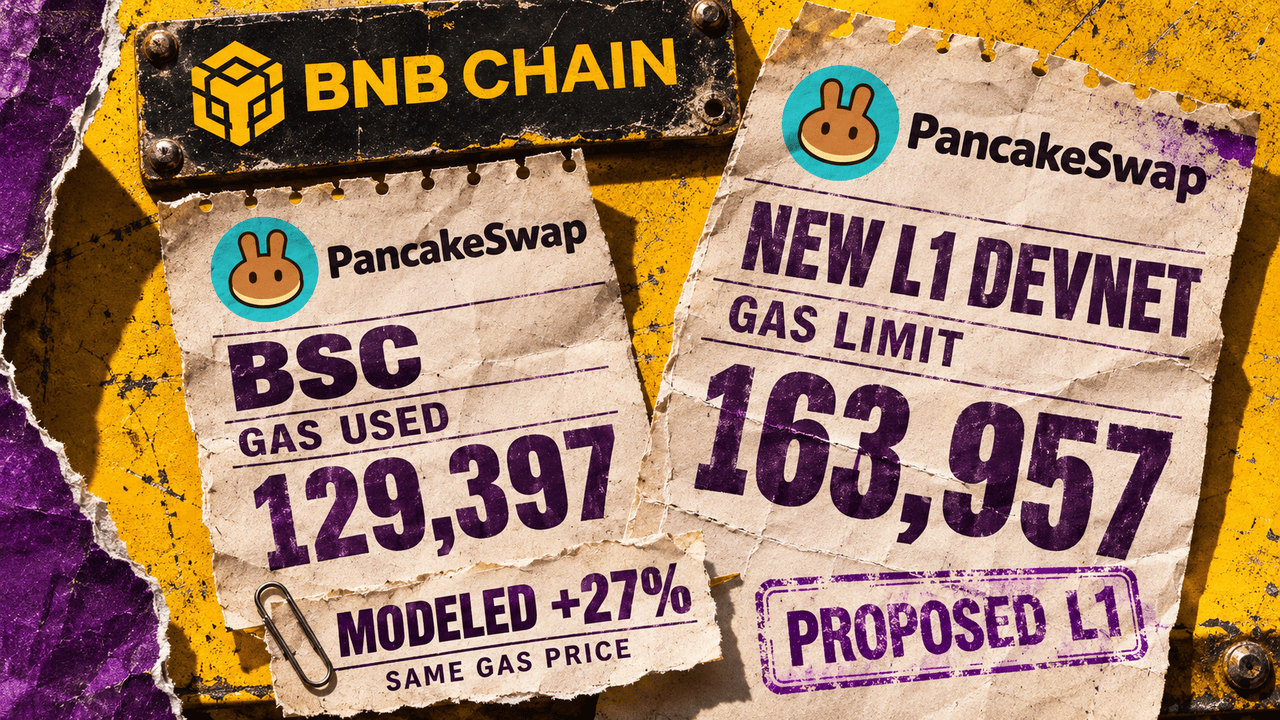
On BNB Chain’s proposed network, traders would pay for all computing capacity a swap reserves. Applying this rule to a PancakeSwap trade on BNB Smart Chain would increase the network fee by approximately 27% at the same gas price.
BNB Chain published its new layer-1 litepaper on November 26, detailing a separate network under development alongside BNB Smart Chain (BSC). The design retains BNB as the gas token, with a public testnet in preparation.
For trading applications, the proposal pairs early feedback on transaction placement with reserved capacity for eligible activity. The devnet charges ordinary transactions for the block space they request.
Comparing Swap Costs on the Proposed BNB Chain Network
A gas limit represents the maximum computational work a transaction can consume. On BNB Smart Chain, the network fee for an ordinary transaction reflects the gas actually used.
The new devnet orders transactions prior to execution, using the declared limit to allocate block space. An ordinary transaction with a valid sequence number and sufficient funds pays for the full declared amount, even if it completes with gas remaining.
On June 26, a successful swap via PancakeSwap’s v3 router consumed 129,397 gas at 0.05 gwei per unit, costing 0.00000646985 BNB.
At the same gas price and a 163,957-gas limit, the new devnet rule would charge 0.00000819785 BNB. The 34,560 units of unused capacity would add 0.000001728 BNB to the swap’s fee.
With a 150,000-gas limit, the modeled fee would be 0.0000075 BNB, roughly 16% above the observed BSC fee. At 200,000 gas, the fee would reach 0.00001 BNB, approximately 55% higher. A router that lowers its limit can reduce costs on transactions that fit, though it risks running out of gas if a route requires more computation than anticipated.
The observed swap’s full gas limitThe swap declared 163,957 gas. It used 129,397 gas and left 34,560 gas unused. The proposed rule would charge for both pieces.THE SWAP’S 163,957-GAS LIMIT129,397 used34,560 unusedBilled on BSCAlso billed under new rule
The observed swap’s full gas limitThe swap declared 163,957 gas. It used 129,397 gas and left 34,560 gas unused. The proposed rule would charge for both pieces.THE SWAP’S 163,957-GAS LIMIT129,397 used34,560 unusedBilled on BSCAlso billed under new rule
Modeled gas limit
Modeled gas limit163,957 gas150,000 gas200,000 gas
The swap’s recorded limit becomes the billed amount in the model.
Gas billed for one historical BSC swapAt the same 0.05 gwei gas price, the BSC receipt bills 129,397 gas and the proposed rule would bill 163,957 gas, an increase of approximately 27 percent.SAME GAS PRICE · 0.05 GWEI27%higher modeled feeBNB Smart Chain0.00000646985 BNB129,397 gas billedNew L1 model0.00000819785 BNB163,957 gas billed+34,560 charged gasJune 26, 2026 · One BSC swapScale: 200,000 gas
Gas billed for one historical BSC swapAt the same 0.05 gwei gas price, the BSC receipt bills 129,397 gas and the proposed rule would bill 163,957 gas, an increase of approximately 27 percent.SAME GAS PRICE · 0.05 GWEI27%higher modeled feeBNB Smart Chain0.00000646985 BNB129,397 gas billedNew L1 model0.00000819785 BNB163,957 gas billed+34,560 charged gasJune 26, 2026 · One BSC swapScale: 200,000 gas
Illustrative lower limit, with the original swap’s gas price held constant.
Gas billed for one historical BSC swapAt the same 0.05 gwei gas price, the BSC receipt bills 129,397 gas and the proposed rule would bill 150,000 gas, an increase of approximately 16 percent.SAME GAS PRICE · 0.05 GWEI16%higher modeled feeBNB Smart Chain0.00000646985 BNB129,397 gas billedNew L1 model0.0000075 BNB150,000 gas billed+20,603 charged gasJune 26, 2026 · One BSC swapScale: 200,000 gas
Gas billed for one historical BSC swapAt the same 0.05 gwei gas price, the BSC receipt bills 129,397 gas and the proposed rule would bill 150,000 gas, an increase of approximately 16 percent.SAME GAS PRICE · 0.05 GWEI16%higher modeled feeBNB Smart Chain0.00000646985 BNB129,397 gas billedNew L1 model0.0000075 BNB150,000 gas billed+20,603 charged gasJune 26, 2026 · One BSC swapScale: 200,000 gas
Illustrative higher limit, with the original swap’s gas price held constant.
Gas billed for one historical BSC swapAt the same 0.05 gwei gas price, the BSC receipt bills 129,397 gas and the proposed rule would bill 200,000 gas, an increase of approximately 55 percent.SAME GAS PRICE · 0.05 GWEI55%higher modeled feeBNB Smart Chain0.00000646985 BNB129,397 gas billedNew L1 model0.00001 BNB200,000 gas billed+70,603 charged gasJune 26, 2026 · One BSC swapScale: 200,000 gas
Gas billed for one historical BSC swapAt the same 0.05 gwei gas price, the BSC receipt bills 129,397 gas and the proposed rule would bill 200,000 gas, an increase of approximately 55 percent.SAME GAS PRICE · 0.05 GWEI55%higher modeled feeBNB Smart Chain0.00000646985 BNB129,397 gas billedNew L1 model0.00001 BNB200,000 gas billed+70,603 charged gasJune 26, 2026 · One BSC swapScale: 200,000 gas
The proposed rule bills unused gas, so increasing the limit raises the fee even when the swap uses the same amount of gas.
One historical swap. The model holds the effective gas price fixed and applies devnet billing to three declared limits. The alternatives do not establish future network prices or successful execution at those limits.
An included transaction meeting these conditions still pays the full limit if it reverts or runs out of gas under the devnet fee rules. At execution, an invalid transaction sequence number incurs no gas charge, while insufficient funds may limit the network’s collection.
When the Additional Fee Could Be Justified
A market maker might delay a quote update upon seeing that a swap likely to change its reference price has provisional placement.
If the signal prevents costly stale quotes frequently enough, those savings can offset the recurring charge for unused gas. If the signal is withdrawn, the market maker must reassess. A router requiring a swap outcome before its next move must still wait for execution.
BNB Smart Chain recorded $484.13 million in 24-hour decentralized exchange volume in DefiLlama’s November 27 snapshot.
For any of that activity to migrate, the proposed network must make economic sense for traders at real gas prices. Public testing will reveal which lanes are available, how often placement signals are withdrawn, and how much spare gas different routes require.
Also Read
- Comprehensive Technical Analysis of I’LL inc. (3854/JPY) by Traders Union
- Binance withdrawals are back after October’s hack and here’s why yours might still be blocked
- Ogaki Kyoritsu Bank Ltd. 8361: JPY Daily Price Movements & Market Overview
- Ripple CTO Highlights: XRP Ledger Operates Without Coercive Consensus Mechanisms


