







Canadian Highlights
- Despite weekly gains, equity markets and oil prices remain well below November highs.
- Governor Macklem highlighted in a Tuesday address that lingering inflationary pressures are set to filter through to consumer prices, supporting the argument for a rate increase in December.
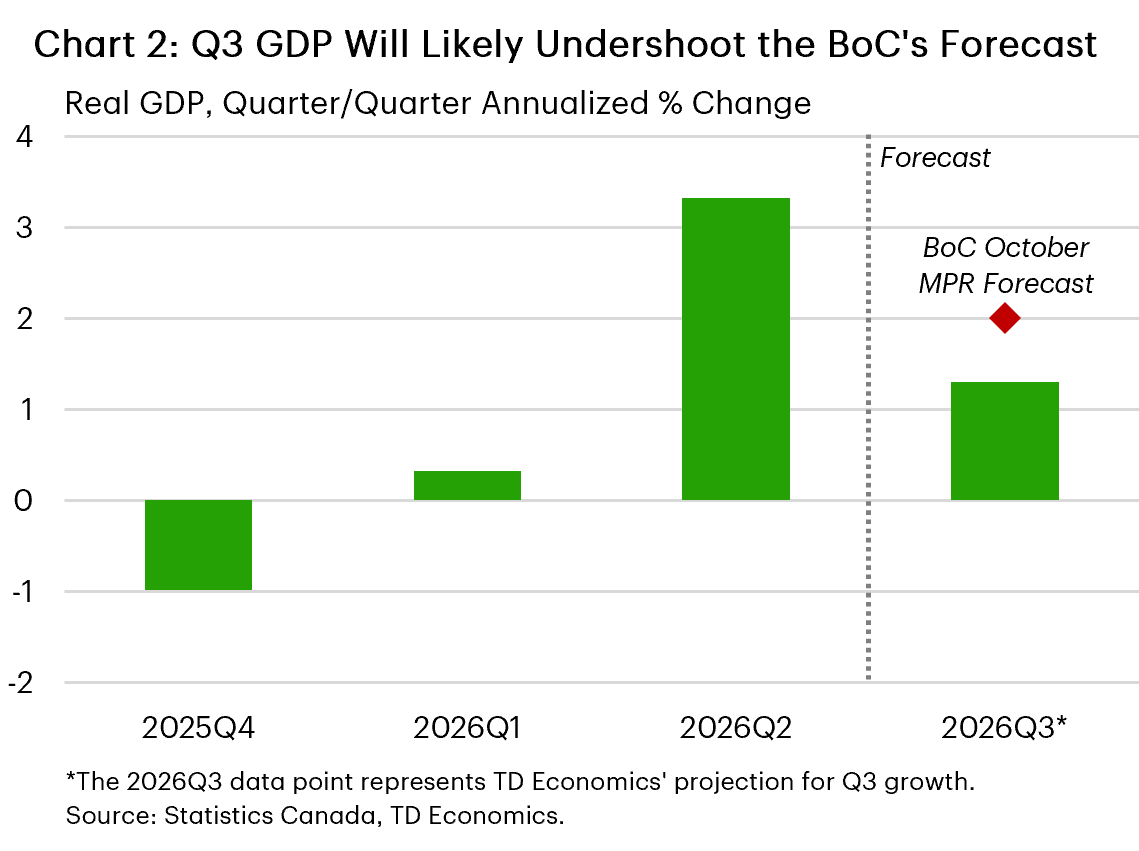
- Q3 GDP data arrives next week, with forecasts pointing to a modest 1.3% annualized increase, consistent with the view that limited monetary tightening will be needed to keep inflation in check.
U.S. Highlights
- AI valuation jitters and tariff uncertainty drove market volatility, though the S&P 500 and Nasdaq finished the shortened holiday week in positive territory.
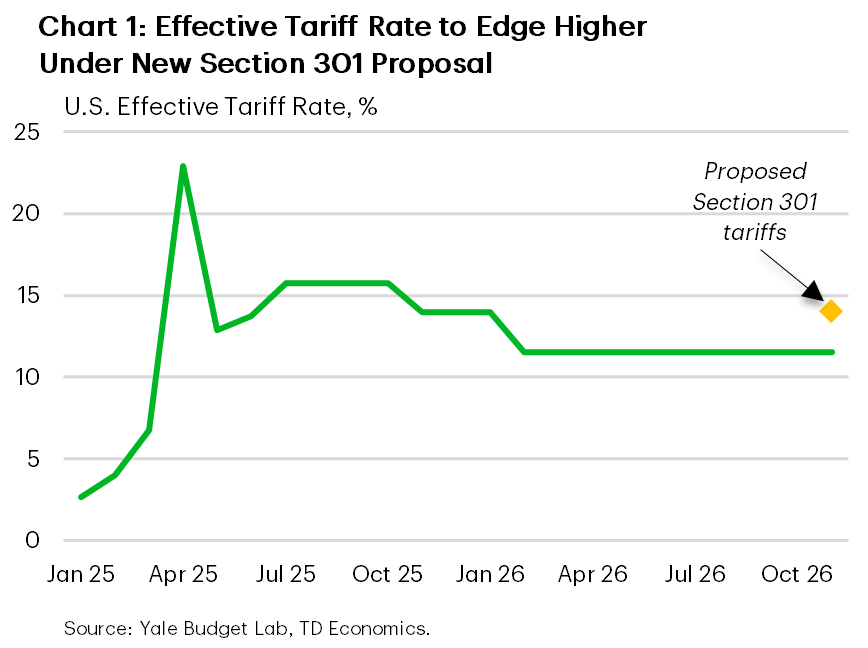
- The proposed tariffs aim to replace or supplement existing rates, modestly elevating the effective U.S. tariff burden while constraining incremental growth and inflation effects.
- With resilient demand and persistently elevated inflation, further Fed tightening remains in focus, and next week’s employment report will serve as a crucial test of labor-market durability.
Canada – The Banker’s Speech
Financial markets exhibited mixed momentum this week. Equities partially recovered last week’s notable losses, driven by a partial AI sector reversal. Nevertheless, the TSX lingered roughly 5% below recent peaks. Despite equity inflows that typically push bond yields higher, government yields declined, suggesting persistent concern over the AI sector’s sustained trajectory.
The standout event for Canadian observers was Bank of Canada Governor Macklem’s remarks on the quinquennial monetary policy framework review. Macklem stressed that the Bank targets headline inflation, with core measures serving as supplementary guideposts toward maintaining 2% stability. The Bank announced it will prioritize CPI-trim and CPIX, and will release an inflation dashboard featuring a breadth of metrics.
Macklem’s speech reinforced the Bank’s view that inflationary pressures have accrued over several months, with historical data and business surveys pointing to greater pass-through of rising energy costs to consumers. The Bank’s research indicates that delaying rate hikes during a supply-driven inflation shock is more costly than overshooting and correcting later. This positioning, coupled with broader messaging, suggests a December 9th rate hike is likely, with markets assigning over 80% probability.
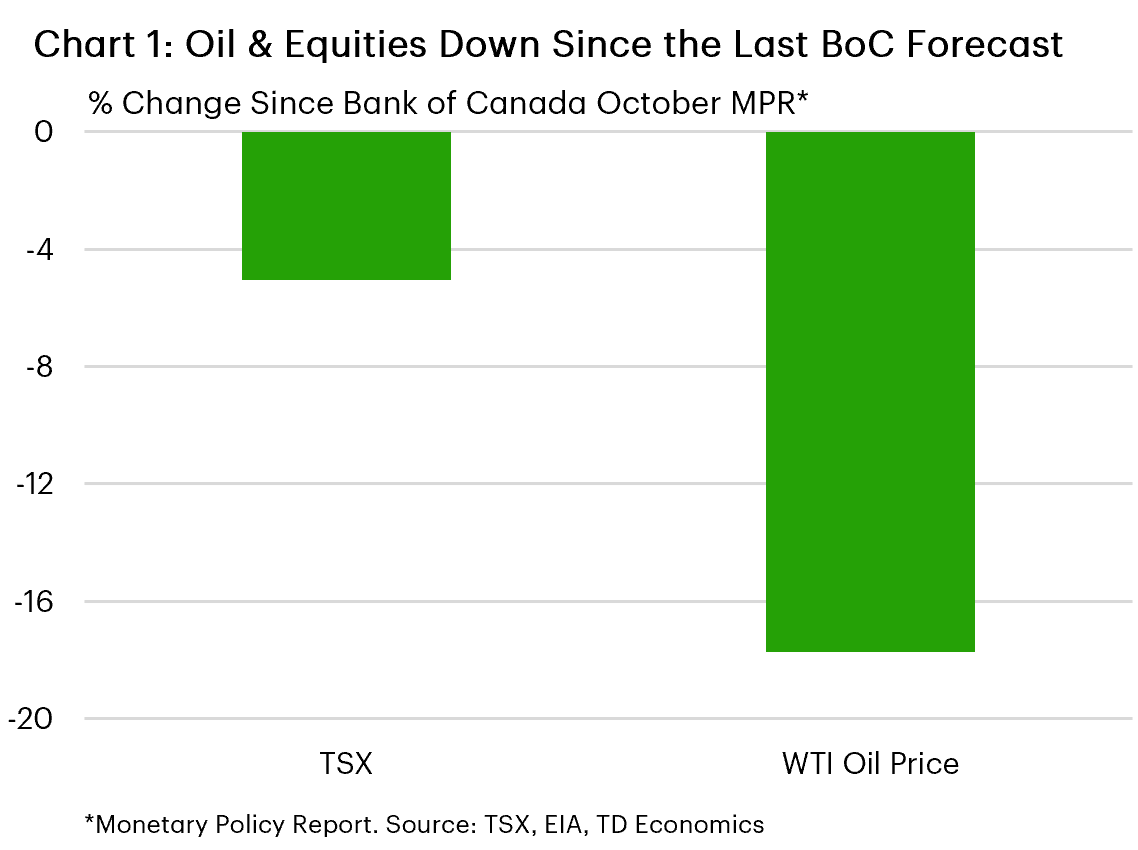

Post-BoC forecast, both equity markets and oil prices have declined (Chart 1). Equity losses erode household wealth, potentially weighing on consumer spending. Lower oil prices should alleviate inflationary pressure, with fourth-quarter inflation likely undershooting Bank forecasts. While economic data has generally underwhelmed, this week’s payroll report offered positives, including increased hours worked. September payroll employment rose just 0.7% year-on-year. Next week brings the Q3 GDP release and a November jobs report; we anticipate a muted 1.3% annualized GDP gain (Chart 2), below the Bank’s 2% projection. Overall, developments since the Monetary Policy Report suggest limited further tightening will be needed to contain inflation in Canada.
U.S. – AI-nxiety Meets a Resilient Economy
Markets swung volatilely this week, whether called a Huangover, Anthro-panic, or simply AI-nxiety. A Monday euphoria gave way to fresh tech-led selling, though post-Thanksgiving buying sentiment returned, with beaten-down semiconductors and AI names leading the charge. The rebound doesn’t signal an all-clear, as doubts about AI valuation sustainability, investment costs, and future rate paths persist. Adding to the mix, fresh tariff uncertainty resurfaced this week. The S&P 500 and Nasdaq are on track for a weekly gain but remain below October peaks.
The latest tariff proposal, unveiled Wednesday, follows the U.S. Trade Representative’s March Section 301 inquiry into “structural excess capacity” across 16 economies. It advances efforts to reconstruct the IEEPA tariff framework, invalidated by the Supreme Court last February. The plan imposes tariffs ranging from 15% to 20% on 14 economies, with higher rates for Singapore, India, and Vietnam—the only three lacking U.S. reciprocal deals. Tariffs take effect after a January 25, 2027 hearing. A key detail: most arrangements top up existing rates rather than stack atop them. China stands apart, where an additional 20% would combine with a 25% baseline, approaching a 45% total. Though headline rates appear steep, the incremental impact is modest, as most formalize existing structures. If enacted, the overall U.S. effective tariff rate would climb 2.5 percentage points to 14% (Chart 1), constraining growth and inflation effects.
Nevertheless, imposing additional tariffs while inflation measures drift from the Fed’s 2% target (Chart 2) presents challenging optics, particularly with robust underlying demand. The second estimate of Q3 GDP revealed the economy expanding at its fastest clip in three years, driven largely by household spending and business investment. Though October spending softened, the outlook heading into the holiday season remains upbeat. Solid income growth and a sharp November rebound in consumer sentiment suggest households have both the capacity and willingness to spend, boding well for a healthy holiday shopping period.
For the Federal Reserve, resilient demand and persistent price pressures sustain the case for tighter monetary policy, with the degree of tightening dependent on incoming data and financial conditions. Recent equity volatility has triggered modest financial condition tightening, though conditions remain far from stressed. Nonetheless, financial conditions remain a key watchpoint, especially alongside next week’s employment report. Sustained hiring and wage growth could prompt markets to price in elevated risks of further Fed hikes.
Also Read
- Ripple CTO Highlights: XRP Ledger Operates Without Coercive Consensus Mechanisms
- Israel Discount Bank Launches In-App Bitcoin and Ethereum Trading With 2% Buy and Sell Fees
- OpenAI Countersues Apple, Alleging Trade-Secret Theft and Supplier Pressure
- Chainflip Finalizes Loss Accounting After $12.6M Vault Breach, Paving the Way for a Recovery Plan


