






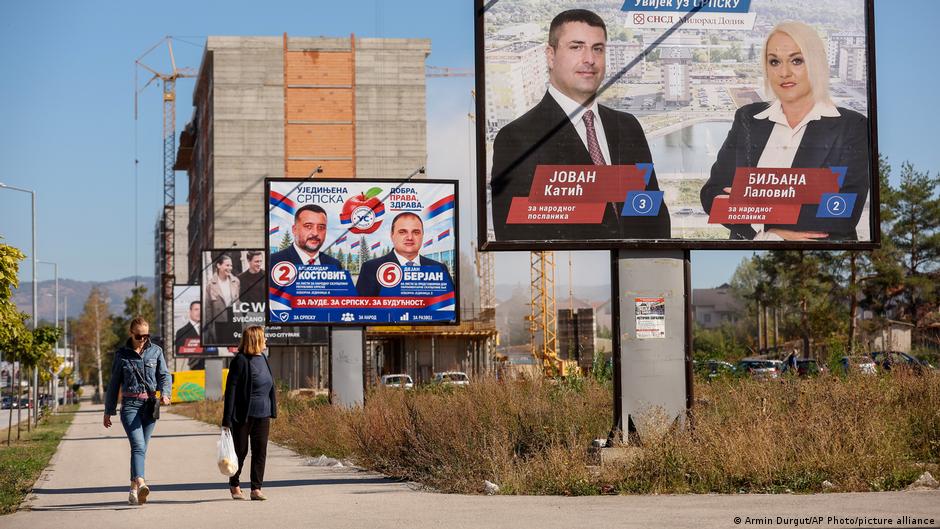
Voters in Bosnia and Herzegovina began casting ballots on Sunday in a general election involving close to 3.4 million registered electors. The contest spans multiple levels of government, from the federal presidency to legislative and executive posts in the country’s two main political entities.
On the ballot are members of the multiethnic, three-seat presidency, lawmakers for the federal parliament, and heads of institutions in the Federation of Bosnia and Herzegovina and Republika Srpska, the two largely autonomous entities that form the state.
The vote arrives at a difficult moment. Bosnia and Herzegovina is grappling with economic weakness, slow progress toward EU membership, and chronic political stalemate. Ethnically based parties from the two entities have often blocked decisions by the fragile central government, leaving reform efforts stalled.
The election pits long-established ethnic parties — the Bosniak SDA, the Serb SNSD and the Croat HDZ BiH — against multiethnic opposition coalitions led by the Social Democratic Party. Polls close at 7 p.m. local time (17:00 GMT), with preliminary results expected late Sunday.
A Complex Constitution Divided Along Ethnic Lines
Bosnia and Herzegovina’s economic, administrative and political powers are split among the multiethnic central government, the self-governing Brcko District, and two semi-autonomous entities. Each entity is further divided into cantons and communities.
This intricate structure, organized largely along ethnic lines, was established under the U.S.-brokered Dayton Peace Accords in 1995 after the 1992–1995 Bosnian war that followed the breakup of Yugoslavia.
Ethnic Tensions Persist
Roughly half of the population is Bosniak Muslim, while 31% are Orthodox Serb and 15% are Catholic Croat.
The country has remained relatively peaceful in recent years, but ethnonationalist parties continue to reinforce wartime divisions even as many voters say they want to move beyond rhetoric rooted in the conflict.
Dodik’s Influence Persists in Republika Srpska
In Republika Srpska, secessionist figure Milorad Dodik of the SNSD remains a dominant force despite not appearing on the ballot.
Former president of the Serb-majority entity, Dodik is barred from public office for six years after being convicted of defying the top international envoy overseeing the 1995 peace process.
Dodik-backed Savo Minic is running for the Republika Srpska’s presidency.
Dodik has repeatedly advocated close ties with Serbia and Russia. He recently returned from Moscow after meeting Russian President Vladimir Putin.
“Bosnia and Herzegovina is dead, it is an impossible country,” Dodik told supporters at his final campaign rally in Banja Luka on Friday.
Federation Races Highlight Unity and Reform
In the Federation of Bosnia and Herzegovina, Bosniak parties are pushing for a stronger central state. The leading Bosniak party, the SDA, has made preserving national unity against Serb separatism a central theme of its campaign.
Bosnian Croats have largely supported ethnic parties, including the Bosnian branch of Croatia’s ruling conservative Croatian Democratic Union. Incumbent Bosniak member of the presidency Denis Becirovic has pledged to pursue a renewed path toward EU and NATO accession.
EU Ambitions
Bosnia and Herzegovina has held candidate status for EU membership since 2022. Yet the opening of formal accession talks remains conditional on a range of reforms, including strengthening judicial oversight and adopting anti-corruption legislation.
EU enlargement: Montenegro on track to join bloc by 2028
To view this video please enable JavaScript, and consider upgrading to a web browser that supports HTML5 video


