







Physicists smashing gold nuclei together at nearly the speed of light have uncovered an unexpected pattern in the resulting particle spray. If confirmed, the finding could illuminate how the searing broth of quarks and gluons that permeated the early universe cooled and coalesced into the protons and neutrons composing ordinary matter today.
In every collision, particles eject sideways; the average force of this ejection fluctuates slightly from one event to the next. Theorists predicted the magnitude of these fluctuations would shift smoothly as collision energy changed. Instead, the variations dipped—shrinking and then growing again. This anomaly may signal a long-sought “critical point,” a unique condition where nuclear matter alters its transformation behavior between phases.
The signal, captured by the STAR experiment at the Relativistic Heavy Ion Collider (RHIC) at Brookhaven National Laboratory in New York, carries a statistical significance of 5 sigma—meaning a smooth trend would produce such a pronounced dip by random chance only once in 3.5 million trials. However, researchers caution the dip remains a tantalizing hint, not definitive proof of the phase transition. The findings were published September 22 in Physical Review Letters.
A Rulebook for Extreme Matter
Protons and neutrons consist of quarks bound by the strong force, mediated by gluons. Under sufficient heat or pressure, these particles melt into a quark-gluon plasma—a primordial soup thought to have filled the universe during its first milliseconds. Physicists aim to map this transition by measuring nuclear matter’s equation of state, the fundamental rulebook linking pressure, temperature, and density under the most extreme conditions in nature, such as neutron star cores.
The “critical point” is a key landmark in this rulebook. For water, it marks where the distinction between liquid and vapor vanishes; theorists have long suspected nuclear matter possesses an analogous point. At ultra-high temperatures, matter melts smoothly into quark-gluon plasma, but at higher densities the change may become abrupt. The critical point would mark where one transition type gives way to the other. Recent calculations suggest this point lies within reach of RHIC’s lower-energy collisions, though both experimental and theoretical confirmation remains elusive.
The work also bears on cosmology. Because the matter created in these collisions mimics the universe’s content a few microseconds after the Big Bang, mapping its behavior helps explain how the cosmos evolved from a quark-gluon soup into the protons and neutrons comprising everything today.

A Dip Where a Smooth Trend Was Expected
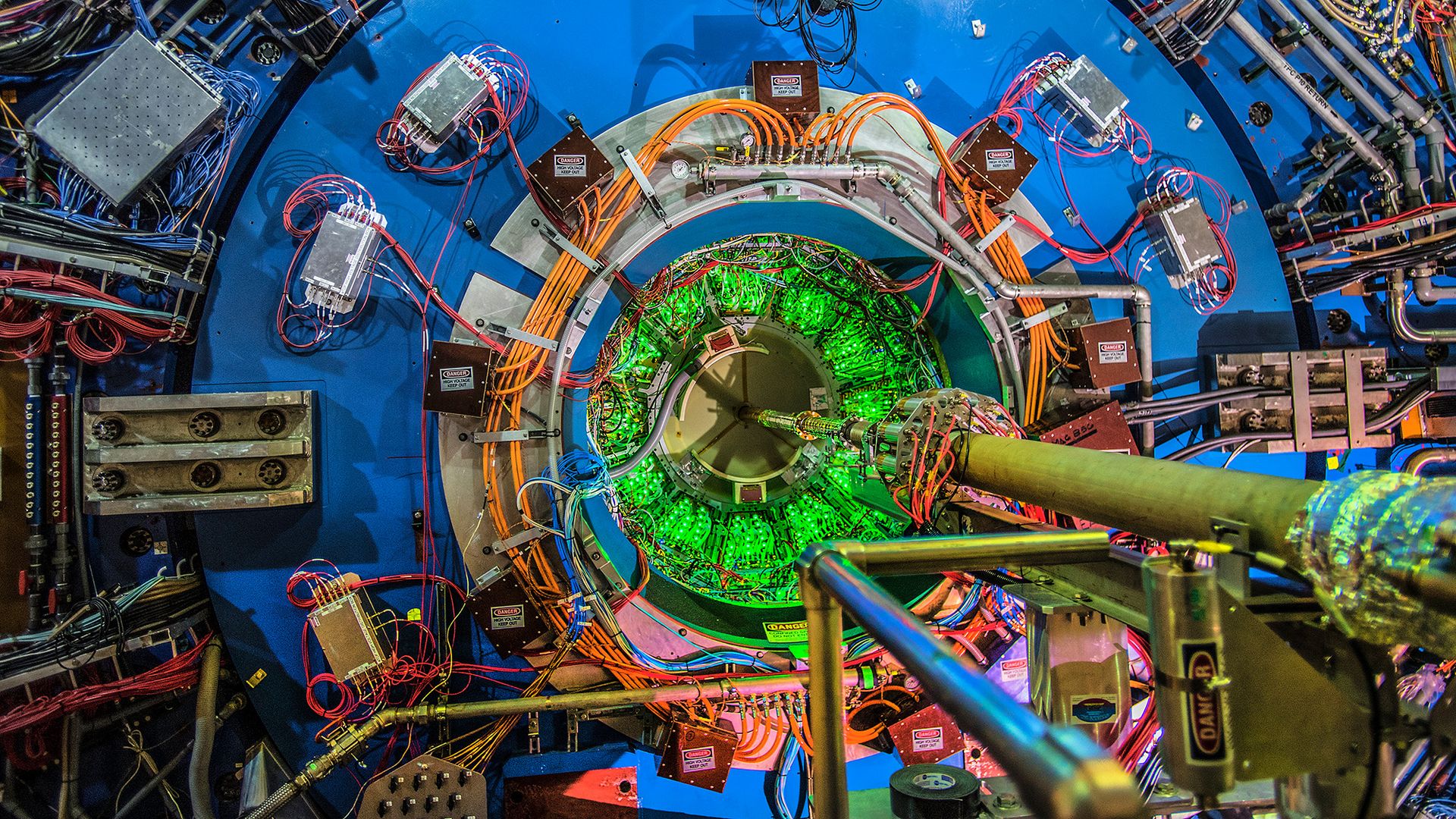
To probe this territory, researchers ran RHIC across a range of collision energies. Lower energies squeeze colliding matter more tightly. For the lowest-energy runs, STAR employed a “fixed-target” setup, firing a gold beam into a thin gold foil inside the detector rather than a counter-rotating beam, producing the densest matter RHIC can achieve.
Collision energies are measured in giga electron volts (GeV)—roughly the energy equivalent of a proton’s mass. The team analyzed roughly one billion collisions between 3 and 7.7 GeV per nucleon pair, the bottom of RHIC’s range, which extends to 200 GeV.
In each collision, the team measured how forcefully charged particles were flung sideways—a quantity called transverse momentum. They then sought correlations between particle pairs: whether both particles from the same collision tended to receive harder or gentler sideways kicks than average. These correlations reflect fluctuations in the fireball’s temperature and collective flow. Near a critical point, heat capacity is expected to surge, making temperature harder to perturb and weakening correlations.
“If the matter approaches a critical point or a phase change, we would expect to see those correlations change in an unusual, non-smooth way as we vary the collision energy,” said study co-author Rutik Manikandhan, a postdoctoral physics scholar at The Ohio State University.
That is precisely what appeared in the most head-on collisions. Instead of a smooth energy dependence, correlations showed a distinct dip. The dip departs from a smooth trend anchored by earlier STAR measurements at higher energies with 5-sigma significance. By contrast, a widely used collision simulation lacking a critical point reproduced the overall trend but not the dip. Off-center collisions showed only a faint hint of the same feature, too weak to constitute independent evidence.
Not the Final Word Yet
“The result is suggestive, not proof of a critical point,” Manikandhan emphasized. Effects unrelated to a critical point can also shape these fluctuations, and their potential contribution to the dip remains unclear.
Nevertheless, the dip “does point to a set of conditions where the behavior of nuclear matter changes, and it gives theorists a new, precise measurement to test their calculations against,” Manikandhan said.
Next, the team plans to use the correlations to extract the specific heat of the hot matter and compare it with supercomputer simulations calculating quark and gluon behavior from first principles. They will also test the dip against more theoretical models and combine it with other measurements, such as proton-production fluctuations. “Only when different measurements agree can we say confidently whether a critical point exists,” Manikandhan said.


