



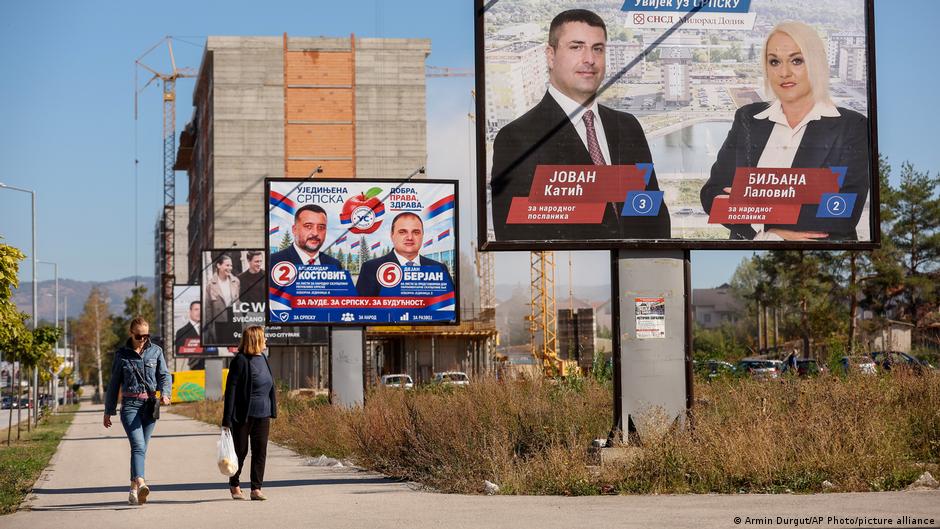
Voters in Bosnia and Herzegovina cast ballots on Sunday evening in a contentious general election that will determine officials across multiple layers of government, including members of the country’s tripartite presidency.
The vote involved approximately 3.4 million eligible citizens and saw early leads for three ethnic leaders: Serb nationalist Zeljka Cvijanovic, Bosniak moderate Denis Becirovic, and Croat nationalist Darijana Filipovic in the presidential races for their respective ethnic communities.
Cvijanovic’s campaign was supported by Milorad Dodik, the former Serb entity leader barred from holding public office after being convicted of defying international oversight mechanisms related to the 1995 peace process.
The election also determined federal parliament members and leaders for the two autonomous entities: the Muslim-Croat Federation of Bosnia and Herzegovina and the Serb-run Republika Srpska. The country faces economic challenges, stalled EU integration, and political gridlock exacerbated by ethnically based parties.
Ethnic parties—the Bosniak SDA, Serb SNSD, and Croat HDZ BiH—face opposition coalitions led by the Social Democratic Party. Polls closed at 7 p.m. local time, with preliminary results expected late Sunday.
Political Structure of Bosnia-Herzegovina
The nation’s governance is divided between a multiethnic central government, two semi-autonomous entities, and the self-governing Brcko district. These political divisions, established by the 1995 Dayton Peace Accords, split authority along ethnic lines following the 1992-95 war triggered by Yugoslavia’s dissolution.
Ethnic Tensions Persisting
Bosnia’s population includes approximately 50% Bosniak Muslims, 31% Orthodox Serbs, and 15% Catholic Croats. While peaceful in recent years, ethnonationalist parties sustain divisions despite public sentiment favoring reconciliation.
Milorad Dodik’s Continued Influence
In Republika Srpska, Milorad Dodik remains a pivotal figure despite ineligibility for office. His SNSD-backed candidate Savo Minic seeks the entity presidency, while Dodik advocates closer ties with Serbia and Russia, recently meeting with Vladimir Putin.
“Bosnia and Herzegovina is an impossible country,” Dodik declared at his final Banja Luka rally, underscoring his separatist stance.
Federation of Bosnia and Herzegovina Dynamics
Within the Muslim-Croat Federation, Bosniak parties push for a stronger central state to counter separatism. The SDA prioritizes national unity, while Bosnian Croats predominantly support their ethnic parties, including the Croatian Democratic Union. Incumbent Denis Becirovic has pledged renewed EU and NATO aspirations.
EU Membership Challenges
Since becoming an EU candidate in 2022, Bosnia and Herzegovina must implement reforms—including judicial restructuring and anti-corruption measures—to advance membership talks.
Embedded Video Example
To view this video please enable JavaScript, and consider upgrading to a web browser that supports HTML5 video