







British services sector activity gathered momentum in August, with the PMI Services index advancing from 52.1 to 52.5, marking its strongest performance since April and signaling a continuation of the recovery from the second-quarter slowdown. New business expanded for the second consecutive month, driven by improving corporate and consumer spending along with firmer investment sentiment. Domestic demand served as the primary catalyst for this improvement, though export sales contracted for the sixth straight month due to subdued European demand and lingering geopolitical uncertainty. Concurrently, the PMI Composite index climbed from 52.2 to 52.5, reaching its highest level since April, as accelerated services expansion counterbalanced softer manufacturing output growth.
Despite the uptick in demand, labor market conditions remained frail. Services employment contracted for the 23rd consecutive month, representing the longest uninterrupted sequence of job losses since the survey’s inception in 1996, although the rate of decline moderated to its slowest pace since October 2025. Firms continued to attribute the cuts to elevated costs, surplus capacity, hiring freezes, and increased automation. Conversely, business optimism improved for a third straight month, reaching its highest point since February, with 47% of firms projecting activity gains over the coming year compared to 13% anticipating a contraction. According to S&P Global’s Tim Moore, improving sales pipelines facilitated the slowest pace of job losses since October 2025.
Inflationary trends offered less encouraging signals. Services input-cost inflation accelerated from July’s five-month low, driven by rising fuel, transport, wages, food, and technology expenses, while output-charge inflation strengthened for the first time in four months as businesses sought to safeguard their margins. Moore noted that higher fuel and transport bills reignited overall input cost inflation in August. Overall, the survey indicates a firmer UK growth backdrop heading deeper into the third quarter, though this recovery persists alongside continued workforce reductions and renewed cost pressures.
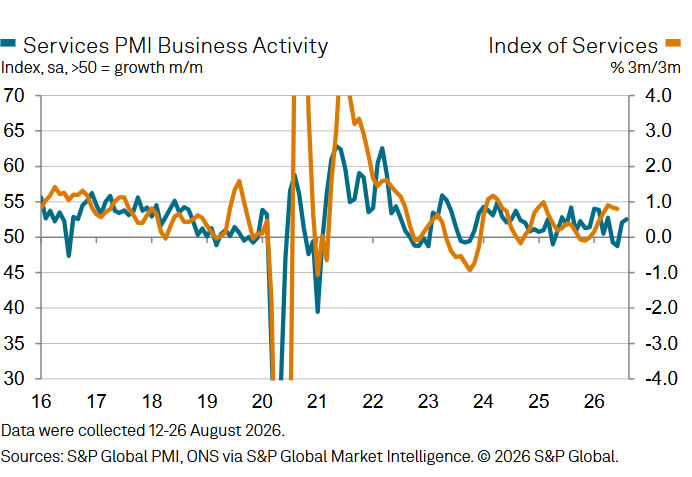

Data Summary
| Indicator | August | July | Trend |
|---|---|---|---|
| PMI Services | 52.5 | 52.1 | Growth accelerated to a four-month high |
| PMI Composite | 52.5 | 52.2 | Growth accelerated to a four-month high |
Components
| Component | Trend |
|---|---|
| Services new business | Rose for the second straight month |
| Services export sales | Fell for the sixth straight month |
| Services employment | Fell for the 23rd straight month; slowest decline since October 2025 |
| Services business confidence | Rose for the third month to highest since February |
| Services input prices | Inflation accelerated from July’s five-month low |
| Services output prices | Inflation accelerated for the first time in four months |
| Composite output | Growth accelerated to fastest since April |
| Manufacturing output | Growth slowed to a four-month low |
| Composite input prices | Inflation accelerated sharply |
| Composite business confidence | Improved to highest since February |
Key Takeaways
- British PMI Services advanced from 52.1 to 52.5, marking the quickest expansion since April and extending recovery from Q2 weakness.
- The PMI Composite rose from 52.2 to 52.5, also hitting its highest level since April.
- Domestic demand improved, with firms reporting firmer corporate and consumer spending and better investment sentiment.
- Export demand remained subdued, with services export sales declining for a sixth consecutive month.
- Employment remained a significant weak spot. Services firms reduced headcount for a 23rd straight month, the longest continuous decline since the survey began in 1996, though the pace of job losses slowed to the weakest since October 2025.
- Business confidence improved for a third consecutive month and reached its highest level since February.
- Inflation pressures reaccelerated, as higher fuel, transport, wages, food, and technology costs lifted input prices, while output-charge inflation also strengthened.
- S&P Global’s Tim Moore noted that higher fuel and transport bills reignited overall input cost inflation, leaving the August economic mix stronger on growth but still uncomfortable on employment and prices.
Also Read
- Michigan Court Halts Kalshi’s Sports Contracts, Imposes $500,000 Daily Penalty
- Japan’s Currency Chief Keeps FX Intervention Option Open
- BTC/USD Technical Outlook Hits New Low as Macro Stress Pushes Toward $70,000 Support
- Ontology mandates emergency v3.1.5 sync-node upgrade following mainnet security incident


