






For years, the United States and the European Union have accused China of appropriating their technology through espionage and cyberattacks.
Across sectors ranging from robotics and advanced semiconductors to precision engineering and automotive components, Chinese firms have allegedly recruited top engineers, surveilled Western competitors, and been connected to cyber intrusions aimed at extracting valuable trade secrets.
It is perhaps ironic, then, that China is now moving to prevent its own advanced technologies and skilled professionals from departing abroad.
How China is upping pressure on German businesses
To view this video please enable JavaScript, and consider upgrading to a web browser that supports HTML5 video
China’s Great Wall Around Its Top Minds
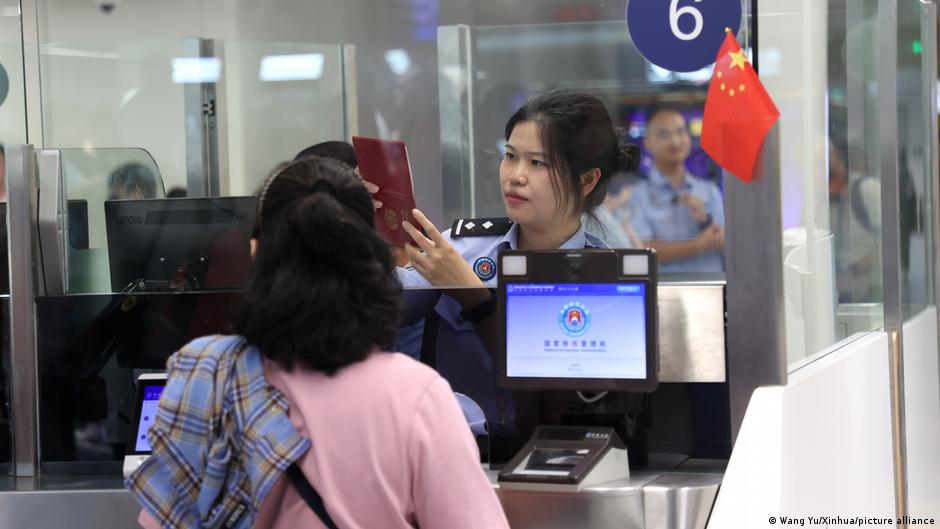
New entry-exit regulations that took effect last week empower Chinese authorities to prevent engineers, founders, and other specialists from leaving the country if their expertise in batteries, rare earths, or artificial intelligence (AI) is deemed a threat to “industrial and technological security.”
In recent months, Beijing has also strengthened controls on outbound investment, intensified enforcement against Chinese nationals holding wealth offshore, and placed new restrictions on deploying technical personnel overseas.
Henry Gao, a law professor at Singapore Management University (SMU), argues that, taken together, these restrictions “offer a rare glimpse into the true state of China’s economy.”
“These measures suggest that Beijing is deeply concerned about economic weakness and substantial capital outflows,” Gao told DW, adding that authorities are equally determined to halt “entrepreneurs and skilled personnel from leaving the country.”
The strain on China’s economy is increasingly difficult to conceal. While demand for exports remains robust — particularly for high-tech goods — the country’s property downturn has severely undermined domestic consumption.
Bank lending fell to a record low over the summer, and new car sales in August declined by nearly a quarter compared with the previous year.
Beijing Blocks Deals as Founders Seek to Exit
The same apprehensions now extend to the movement of people and money. A striking recent example is Manus, an AI startup founded by two Chinese nationals in Beijing. Last year, the company relocated its headquarters to Singapore, partly to circumvent U.S. investment restrictions and pursue broader global opportunities.
When Meta, the parent company of Facebook, attempted to acquire Manus last December for $2 billion (€1.74 billion), Beijing blocked the transaction and barred the company’s two founders from leaving the country.
Just this month, Chinese social media buzzed with speculation that Huawei founder and CEO Ren Zhengfei and his daughter, CFO Meng Wanzhou, may have departed the country.
The reports were picked up by media outlets in Taiwan and India but have not been confirmed by either the tech giant or Chinese authorities. At least one family member has since appeared in public in Beijing.
Wealthy Chinese Face Growing Challenges Moving Capital Abroad
Bloomberg Intelligence estimated that approximately $1 trillion in Chinese wealth left the country last year — the largest volume of “hot money” departures since records began in 2006.
Beijing has not altered its annual $50,000 foreign-exchange quota for household remittances. What has tightened, says Alicia Garcia-Herrero, chief economist for Asia-Pacific at French investment bank Natixis, are the unofficial channels the wealthy relied on to circumvent that cap.
“They haven’t changed the $50,000 quota. They are now squeezing the people and agents that money usually travels with,” Garcia-Herrero told DW.
An entire industry has emerged, both within China and internationally, to assist individuals and their capital in departing. Emigration agents arrange visas and relocations, while offshore brokers and trusts help Chinese nationals shelter wealth abroad.
Companies sometimes use foreign subsidiaries, public listings, or staff assignments to move money and expertise out simultaneously.
AI’s expanding power alarms China’s intelligence agency
To view this video please enable JavaScript, and consider upgrading to a web browser that supports HTML5 video
New Rules May Drive Workarounds
Gao of SMU warns that the new restrictions could prove counterproductive, as the greater the difficulty of moving capital or people abroad, the stronger the incentive for those with the means to find alternative routes.
“Over time, that could further erode confidence, accelerate capital flight, and deepen the very economic problems the measures are designed to contain,” Gao told DW.
Garcia-Herrero, meanwhile, believes the constraints on talent will matter more than the pressure on capital.
“You can still move money slowly, with approvals,” she told DW. “You cannot easily replace a process engineer who cannot board a plane — or who will not take an overseas job because of an indefinite ban.”
AI Talent Now Requires Permission to Travel
The risk is already being felt by China’s AI companies, which are rapidly closing the gap with their U.S. counterparts in the race to develop the most advanced AI systems.
In May, Bloomberg reported that Chinese authorities now require top AI researchers, founders, and executives at firms such as Alibaba and DeepSeek to obtain approval before traveling abroad.
Last year, some DeepSeek employees were reportedly asked to surrender their passports, according to tech news site The Information. Beijing has neither confirmed nor denied the practice.
Bloomberg reported in January last year that other technology engineers face similar pressure, including those assisting foreign companies in reducing their dependence on China by constructing factories in Vietnam and India.
Lawyers Advise Clients to Tighten Travel Disclosures
On behalf of foreign nationals, both Chinese and foreign firms sometimes frame a working visit to China to avoid scrutiny and visa delays. They may describe a trip as tourism, business meetings, or a factory tour rather than actual employment.
In anticipation of the new restrictions, international law firms such as DLA Piper advised companies to keep visa applications “truthful” and “complete,” warning that discrepancies between paperwork and actual activities could now result in an entry ban of up to five years.
The new regulations state that a visitor should, in principle, be informed if they are subject to a ban. However, Chinese authorities may withhold notification if doing so “may affect national security or the investigation of criminal cases.”
In an updated travel advisory earlier this month, the U.S. State Department went further, warning Americans to “exercise increased caution in mainland China due to … the use of exit bans without a fair and transparent process under the law, and the risk of unjust arrest or detention.”
Also Read
- Top AI Executives to Address UN Security Council on AI Risks and Regulation
- Nasdaq Reaches Record High as Dow Jones Futures Remain Steady; Sandisk and Micron Show Strong Buy Signals
- Xi Jinping Arrives in Washington for High‑Stakes U.S.–China Summit
- Turkey detains Tera chairman amid $18 bn Ponzi‑style fund probe affecting hundreds of thousands of investors


