






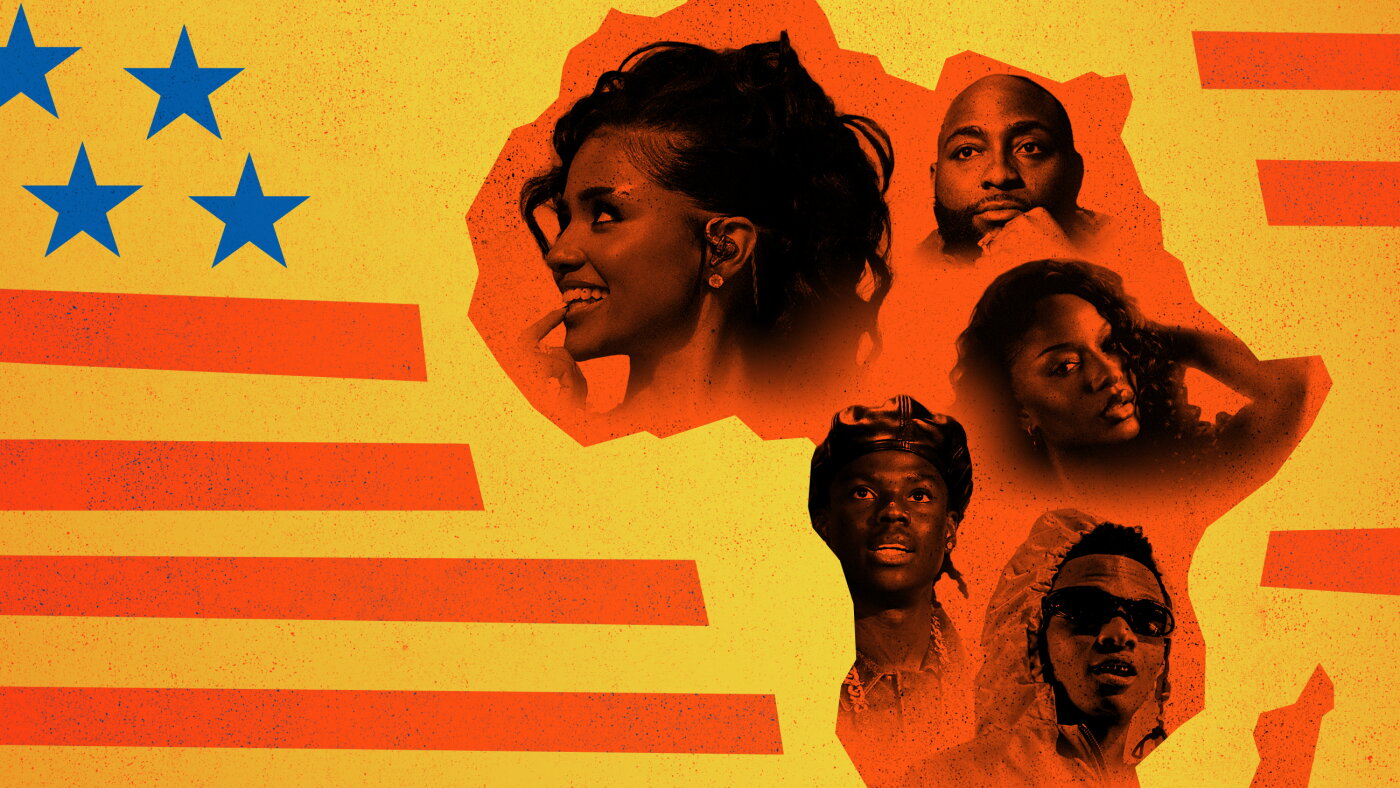
Tyla’s 2024 Grammy made African pop’s American breakthrough feel inevitable. For the artists following her, the route to lasting crossover success has become less certain.

The artists shown here reflect African pop’s recent westward expansion, moving clockwise from the upper left: Tyla, Davido, Ayra Starr, Wizkid and Rema.
Photography by Patrick T. Fallon, Shotbycozyy, Axle Jozeph, Leon Neal and Theo Wargo/Getty Images; illustration by Jackie Lay.
When the South African singer Tyla accepted the first Grammy for best African music performance in 2024, it seemed as though the timing had finally come together for the continent’s pop music. She was 22, poised to become a global star and positioned to energize a broader push. “I’d never thought I’d say I’m a Grammy winner at 22 years old,” she told listeners who might not yet know her. Then she framed the achievement in broader terms: “Thank you to the Recording Academy for this category. It’s so important.”
The category’s creation looked like long-overdue institutional recognition for music from the region. Yet the inaugural field told a more complicated story. The other nominees were all from Nigeria, the country that had set the international standard for African pop over the previous decade under the contested label Afrobeats. South Africa’s amapiano sound was being steadily absorbed into that framework, and Tyla emerged as the most visible symbol of the resulting hybrid. Her victory placed an almost unfair burden on her as a measure of Afro-pop’s sound, reach and status.


After a two-year buildup marked by a race-related controversy, a Coke commercial, several Met Gala appearances and a second Grammy in the category she had helped establish, Tyla returned this summer with A*Pop, the follow-up to her 2023 debut. The title made her intentions clear, and she explained them to Billboard Africa: “I’ve always wanted to be this pop star, but I hated feeling like I had to tailor myself to pop. I wanted to tailor pop to me instead,” she said. “I bring the ‘A’ to pop, it’s African pop. African music is pop music.”
In the years before Tyla’s breakthrough, the American music industry appeared to accept that premise only reluctantly. Her rise helped recenter the mainstream, and artists across pop began showing the influence of her sound. She is returning, however, to a different market in which the prospects for an Afro-pop crossover have narrowed considerably. A*Pop led a group of summer releases from artists now reassessing the genre’s cultural position. Taken together, they offer a snapshot of Afro-pop’s health and possibilities. Whether the expansion effort can be called successful depends partly on how its global reach is measured.

Afro-pop as it is generally understood today has existed as a recognized scene, a functioning industry and a loosely defined cluster of sounds for only about two decades. Its most important advances came in the mid-2010s, when Wizkid, Davido, Tiwa Savage, Burna Boy and Olamide began defining a shared aesthetic. The term “Afrobeats” was also clearly distinguished from “Afrobeat,” the funk tradition pioneered by Fela Kuti. Its most influential innovation was a more connected sonic network: it modernized West African pop forms such as highlife, juju and galala and linked those traditions to Western pop. The exchange was not abstract. Davido attended college in Alabama before leaving to pursue music full-time, while Tiwa Savage and Burna Boy studied in England.
U.S. labels noticed quickly. Davido signed with Sony in 2016, and Wizkid and Burna Boy joined RCA and Atlantic in 2017, prompting a rush of interest. Warner formed a partnership with the Nigerian label Chocolate City Entertainment in 2019. That same year, Universal Music Group licensed its catalog to the Nigerian streaming service Udux and signed Tiwa; in 2020 it launched the Def Jam Africa sublabel. In 2022, the independent distributor Empire opened Empire Africa.
Industry recognition arrived alongside commercial breakthroughs. “Essence,” Wizkid’s slow-building pandemic hit with Tems, reached the Top 10 of the Hot 100 and, in summer 2022, became the first song to spend an entire year in the Top 10 of the R&B/Hip-Hop airplay chart. The record demonstrated the song’s American reach, but it also exposed its limitations: although it was neither hip-hop nor R&B, it had been forced into established “urban” formats. Billboard responded during the song’s run by introducing a U.S. Afrobeats chart. Soon after, the next generation of superstar Rema surpassed “Essence” with 2023’s “Calm Down,” which reached No. 3 on the Hot 100 with help from Selena Gomez. It became the continent’s longest-charting song ever, its first to reach a billion U.S. streams on Spotify and its most-played song on American radio. “We used to dream of this,” Tega Oghenejobo, Rema’s label COO at Mavin Records, told Billboard. “But now it’s time to put in work to properly represent the culture and connect with more listeners in the U.S.”

By early 2024, when “Water” peaked and made Tyla the first South African to enter the Hot 100 since Hugh Masekela in 1968, the foundation seemed to be in place. That year, Universal Music Group purchased a major stake in Mavin Records, while Tyla became part of a wider wave of women taking control of the movement and making gains in American culture. At the time, I described Ayra Starr, Tyla and Tems as “surefire hits in a time when fame is difficult to quantify,” noting that three pivotal albums released within three months represented a substantial crack in African music’s glass ceiling.
Fame is even harder to measure now. Tems has continued to rise, making history in 2025 as the first Nigerian to win multiple Grammys and reaching No. 1 on the U.K. charts with her Dave collaboration “Raindance.” Tyla’s “Push 2 Start” went platinum, and “Chanel” from A*Pop earned gold. Even so, the initial excitement has cooled. Afro-pop songs have been largely crowded out of the Top 40 in recent years, and the U.S. Afrobeats chart has become relatively static: “Water,” “Push 2 Start” and “Calm Down” remained near the top of its 2025 year-end list.
The result is that Afro-pop’s takeover of the American market never fully materialized, at least not in the way K-pop’s did. The economic gap has several causes. Colorism can amplify xenophobia, while Afro-pop has not yet been optimized for social engagement and video-led feeds in the same way. There is also a structural difference: the “K” in K-pop denotes one country, while Afro-pop represents many. West Africa’s prominence complicates the picture further. Apart from Tyla and a brief Chris Brown appearance, the best African music performance category has featured only one non-Nigerian nominee, concentrating power in a way that distorts the broader continental story. If “Water” winning the inaugural African Grammy sounded like floodgates opening, Tyla’s 2026 win for a track from the deluxe edition of the same album feels more like a sign that momentum may be stalling.
A music genre is not the same as its market position, but commercial pressures clearly shape the music itself, particularly when capital flows and investors expect returns. Afro-pop is already responding to those pressures after its first surge. Perhaps the form simply has not yet had its Kpop Demon Hunters moment; the fact that some of the early bets have not paid off does not mean the long-term case is weak. More importantly, the artists spanning the genre’s current spectrum show that meaningful progress can be measured first by creative benchmarks rather than commercial ones.
Davido sits at the center of the overlap between artists who embrace Afrobeats as a label, embody its sound and make it synonymous with African pop. He presented his July album, Oriadé—which translates as “the head that wears the crown” and evokes the acceptance of a royal destiny—as a tribute to his journey. The music moves from the gleaming, R&B-inflected sound of his early work (“Julie”) to the stomping bop of the ’10s (“I Know Who I Be”) and the shuddering amapiano of his later career (“Gimme Dat Ting”). If a healthy scene allows veterans to settle into legacy roles, Oriadé measures Davido’s standing: a deliberate map of a path he both traveled and helped create.
CKay’s music, rooted in Alté—the Afrobeats offshoot that gave the genre a more experimental edge—shows how its substyles have evolved since the U.S. push. His seductive viral hit “Love Nwantiti,” the first No. 1 on Billboard’s Afrobeats chart when it appeared in 2022, and the more restrained “Emiliana” defined a cooler version of Nigeria’s throbbing, polyrhythmic pop: music possessed by lover-boy swagger. BANGER BOY, released last month, signals a willingness to change. Its opening sounds familiar, but the drums then crackle like sparklers and the song turns anxious, with CKay unable to save a woman who “belongs to the streets.” The intensity grows on the springy “SHEGE,” where he declares, “Foreplay is a formality for the action” and “Give me body, I go give you satisfaction.” The cover, showing him setting off a giant firework on a beach, matches music moving toward more propulsive and brazen territory. CKay clearly wants to lean into distinctly African songcraft while also speaking to the venues where people gather, balancing the scene’s natural evolution with market demand for the sound.

Ghanaian-American party gyal MOLIY takes that club-oriented shift even further. Much Afro-pop is dance music by nature, given its rhythmic complexity and intensity, but only recently has it entered a sustained conversation with EDM and rave culture. MOLIY’s Afrofusion twerk anthem “Shake It to the Max (Fly),” which found a second life on social media last year by joining Alté and dancehall, extends that connection. After her Ghanaian collaborator Amaarae’s 2025 twisted Eurodance fantasy Black Star, MOLIY opens her maximalist imagination on BADDIES <3 MOLIY. The album is guided by a DJ’s instincts and draws on Latin dembow, amapiano, recession pop and more. Its synth-pop textures are supported by insistent, almost bass-boosted drums. “Tometo” arrives with a festival drop; the hook on “Bukshot” updates one from “Work,” the 2002 soca-inflected single by the Nuyorican house duo Masters at Work; and “Popstar xoxo” sounds like a virtual recreation of a cheap late-aughts ringtone hit. The record searches for “borderless music”—pop rooted in Africa but not confined to it. Its exploration feels driven by playfulness and an urge to try everything possible.
This line of thinking brings us back to Tyla, who shares similar ambitions but has lately appeared more calculating about the pursuit and less focused on the work itself. She has insisted that A*Pop was designed to redefine what an African pop star can be, seeking an entirely integrated experience in which the “A” is a foundation rather than a modifier. Pop from the continent is often treated as a software update to American pop rather than a separate language, so rebuilding the system from the ground up is a legitimate artistic goal. Yet her attention to external questions—how outsiders view Africa, how they relate to her Africanness or how she might earn acceptance as a fully fledged “pop” artist—may have distracted from what made her debut so groundbreaking.
The 2024 album Tyla succeeded through finesse: its songs were “sweat-soaked but subtle,” sensation-driven, with vocals marked by the breathlessness of intimacy and movement. A*Pop feels less like a direct expression of Tyla and more like roleplay. That is not to dismiss it as a risky album. “Right Now” sits close to the situationship R&B of Summer Walker and Kehlani, while “Feel Something” sounds like a possible vision of the genre’s future—both alien and familiar. She also leans heavily into South African styles, and on “Is It,” “Mr. Nonchalant” and “She Did It Again,” she successfully creates another mode for herself. More often, however, the focus feels dispersed. In trying to satisfy demand, the music loses some of its distinctive character and never quite becomes a complete statement about Tyla, African stardom or the “A” itself.
Perhaps the most encouraging sign of a sustainable Afro-pop future is another early harbinger: Ayra Starr, Tyla’s closest peer in the effort to define the next generation of African pop. They are the same age, have been active for roughly the same length of time and emerged close together, although Starr broke through slightly earlier. The radiant 2022 single “Rush” put her at the forefront of the Nigerian sound. Her next album, The Year I Turned 21, used songs about self-discovery and growing into adulthood to trace that development. Starr Girl, released in August, is far more confident than A*Pop and much less preoccupied with the observer’s perspective. It does not attempt to prove what an Afro-pop star can be; it simply inhabits that role.
At the most basic level, Starr understands hooks and has a rich, oaky voice that settles smoothly, like brandy. She also knows how the seams of her music come together. As she refines the Afrobeats blueprint, tracks that test its boundaries—“Tornado,” “Hot Body”—and those that move beyond it—“Amazing,” “Letter to God”—never feel forced or outside her range. The deeper tensions are cultural as much as sonic. In a Substack post, Starr described Starr Girl as an album about being a young African woman in America, discovering herself between two cultures, and said its music “is a bridge between past and present, tradition and transformation, self and society, accepting complexity and turning it into strength.” Across these spaces, she has sounded unusually collected and multifaceted. What matters most is the final movement: the inner life informing the outer expression, rather than the reverse.
Starr Girl did not enter the Billboard 200, but that may say more about the chart than about the artist. It is worth questioning whether the American market should still be treated as an unquestioned cultural hegemony. Charts and Top 40 radio have shown less turnover in recent years and have become markedly less diverse at the top. Even if the pattern holds and Afro-pop never receives another mainstream breakthrough, the artists driving the movement will still have produced meaningful change while pushing beyond established boundaries. On “Treasure,” Starr sings, “I do this for myself / And the people wey dey follow me for years” and “I be chaser and I’m headed for the treasure.” Each time that line appears, it suggests that what is most valuable about this moment cannot be measured by numbers alone.


