




Circle Pushes For Broader Access to EU Via Reformed MiPA Stablecoin Rules
Circle urges the European Union to expand its Markets in Crypto‑Assets Regulation (MiCA) to accommodate foreign‑regulated stablecoins while easing reserve requirements that currently constrain global issuers.
A USDC sponsor has put forward a recognition scheme that would permit eligible overseas stablecoin companies to issue tokens throughout Europe without obtaining full authorisation as EU‑regulated entities, supporting a broader effort to integrate the international market within the bloc’s oversight.
The platform highlighted that only three of the world’s twenty‑five largest stablecoins by market value—USDC, USDG and EURC—are presently governed by MiCA, even though roughly thirty e‑money tokens have secured authorisation since the framework came into effect.
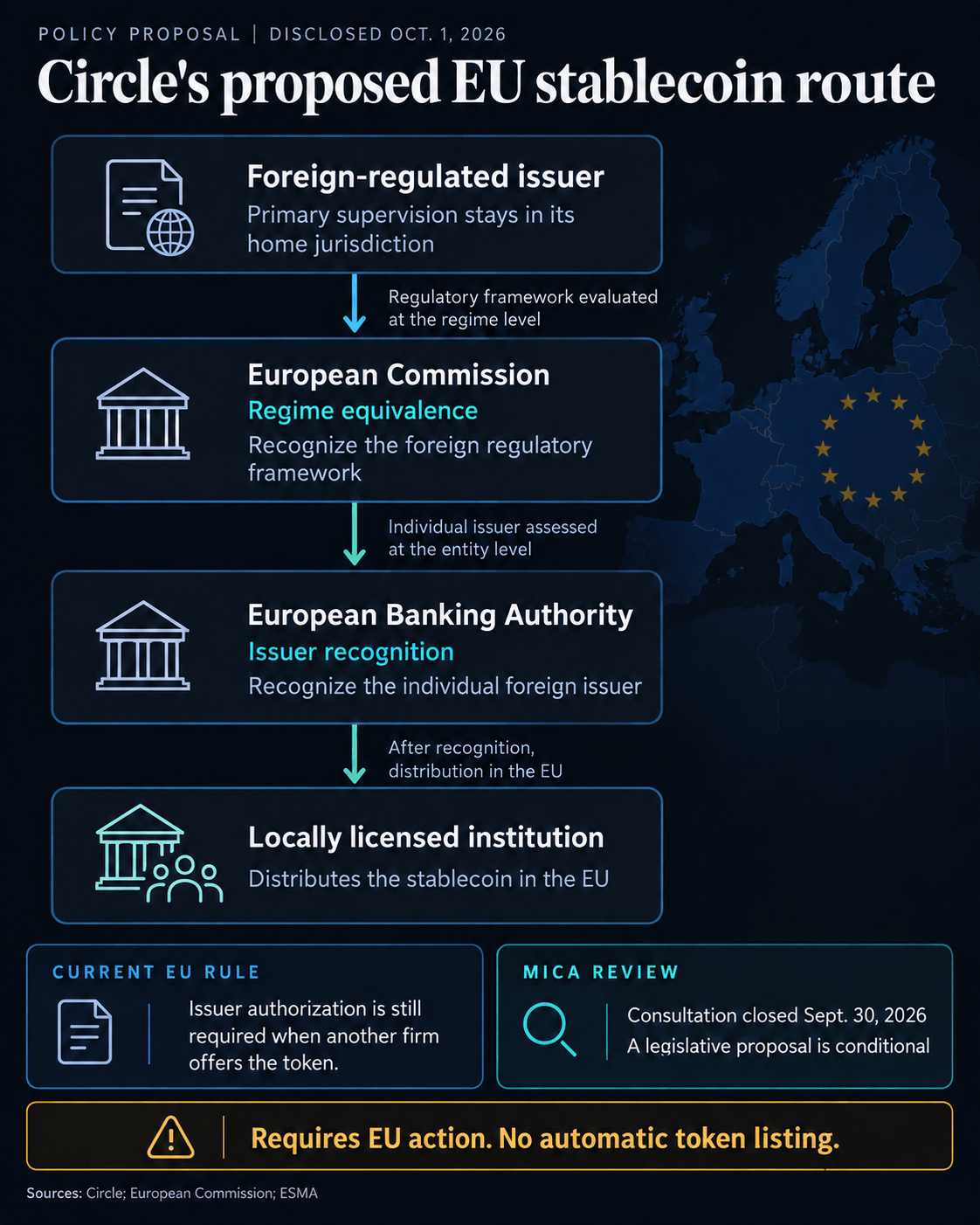
Under its proposal, the European Commission would first assess whether a foreign regulator’s system meets EU standards. The European Banking Authority (EBA) would then recognise individual issuers, leaving primary supervision in their home jurisdictions while they distribute tokens through locally licensed intermediaries.
This approach presents an alternative to the prevailing MiCA provisions, which generally demand that e‑money token issuers wishing to trade or distribute publicly in the bloc obtain EU authorisation.
Circle also advocates maintaining multi‑issuance structures, whereby a MiCA‑authorised European entity may co‑issue a globally circulating stablecoin alongside a foreign‑regulated counterpart. It argues that prohibiting such arrangements could drive European users toward unregulated offshore platforms lacking adequate protection.
MiCA stablecoin banking reserve rule draws wider opposition
Circle is also challenging a requirement that e‑money token issuers keep at least thirty percent of reserves in commercial‑bank deposits, escalating to sixty percent for tokens classed as significant. It seeks to replace this mandate with a broader liquidity standard, arguing that compulsory bank deposits increase issuers’ exposure to bank credit and counterparty risk.
The argument reflects previous criticism from Tether chief executive Paolo Ardoino, who warned that forcing large stablecoin issuers to place sizable reserves in banks could create systemic vulnerabilities should those institutions fail to meet swift withdrawals. Ardoino stated last month that Tether declined to pursue an EU licence owing to the same objection.
Comparison highlights that both Circle and Tether endorse a view that concentrating stablecoin liquidity within commercial banks may disincentivise European users toward offshore platforms where protective regulation is absent.
Additionally, Circle calls on the EU to remove a thirty‑five percent cap on exposure to a single sovereign and to lift a rule limiting deposits with an individual bank to one and a half percent of that lender’s total assets. Such restrictions can hinder dollar‑staked stablecoins from anchoring reserves on high‑quality sovereign securities and compel larger issuers to fragment reserves across numerous banks.
While regulators consider tightening MiCA elsewhere to address risks associated with multi‑issuer stablecoin structures, the overall picture remains tense as existing frameworks impose safeguards that may exclude legitimate global market participants.