




Coinbase achieved a $719 million quarterly profit in the third quarter, demonstrating financial resilience despite a downturn in crypto trading volumes, driven largely by strategic investment gains.
The exchange’s Q3 earnings, released on October 29, reported revenue of $1.216 billion, remaining relatively stable compared to the previous quarter but representing a 35% decline year over year. Crypto spot trading volume dropped 8% to $134.5 billion, while transaction revenue fell 44% from the prior year to $590 million.
Chief Financial Officer Alesia Haas noted that Coinbase marked its 15th consecutive quarter of positive adjusted earnings before interest, taxes, depreciation, and amortization (EBITDA), which rose 60% quarter-over-quarter to $333 million.
This turnaround reversed a $359 million loss from the second quarter, highlighting the success of Coinbase’s diversification strategy. Prediction markets surpassed $200 million in annualized revenue, while subscription and services contributed nearly half of the company’s net revenue.
The quarterly results also underscored rising costs within its USDC stablecoin business alongside increased investments in Bitcoin and Ethereum.
Prediction Markets Emerge as Coinbase’s Fastest-Growing Business
Coinbase’s prediction-market division has rapidly become a vital revenue stream, helping to offset sluggish activity in its traditional crypto exchange operations.
According to the company’s Q3 earnings presentation, prediction markets exceeded $200 million in annualized net revenue during the quarter, achieving an 82% compound quarterly growth rate since launching.
The company also reported a more than 60% increase in daily prediction-market traders compared with the previous quarter, cementing the product as one of its fastest-growing business lines by revenue.

Coinbase CEO Brian Armstrong described prediction markets as “one of the fastest-growing products in Coinbase history,” highlighting robust demand for cryptocurrency-related event contracts even during historically slow sports-betting periods.
This momentum is helping Coinbase diversify its transaction business beyond conventional spot trading.
Prediction markets and derivatives together accounted for approximately 25% of transaction revenue during the quarter, while customers trading event contracts also generated additional cryptocurrency spot trading activity.
These gains helped cushion declining crypto trading volumes. Coinbase’s share of global crypto trading activity increased to 10.7% from 5.6% a year earlier, supported by growth across spot and derivatives products.
Meanwhile, subscription and services revenue increased 3% quarter over quarter to $570 million, representing 49% of net revenue.
Haas said the expansion was making Coinbase more resilient because prediction-market revenue was “less correlated to crypto volatility.”
The exchange plans to expand prediction-market engagement through additional event categories and product integrations while developing USDC-native clearing infrastructure to improve trading economics.
Haas said:
“We obtained CFTC approval for our own DCO to support predictions. And so what this means is we have the opportunity to own more of the stack. That means we can launch our own contracts, and we can also then earn better economics.”
Coinbase’s Record $22 Billion USDC Holdings Conceal Growing Rewards Costs
While prediction markets provided a new growth opportunity, Coinbase’s established stablecoin business faced a different financial challenge.
The exchange reported a record $22 billion in average USDC balances across its products, a 49% year-over-year increase representing about 30% of the stablecoin’s average circulating supply.
However, Coinbase’s Q3 filing showed that stablecoin revenue declined 5.4% to $306.9 million from a reclassified $324.5 million a year earlier.
At the same time, USDC rewards expenses increased 15.8% to $129.2 million from $111.6 million, reflecting the growing cost of attracting and retaining stablecoin holders.
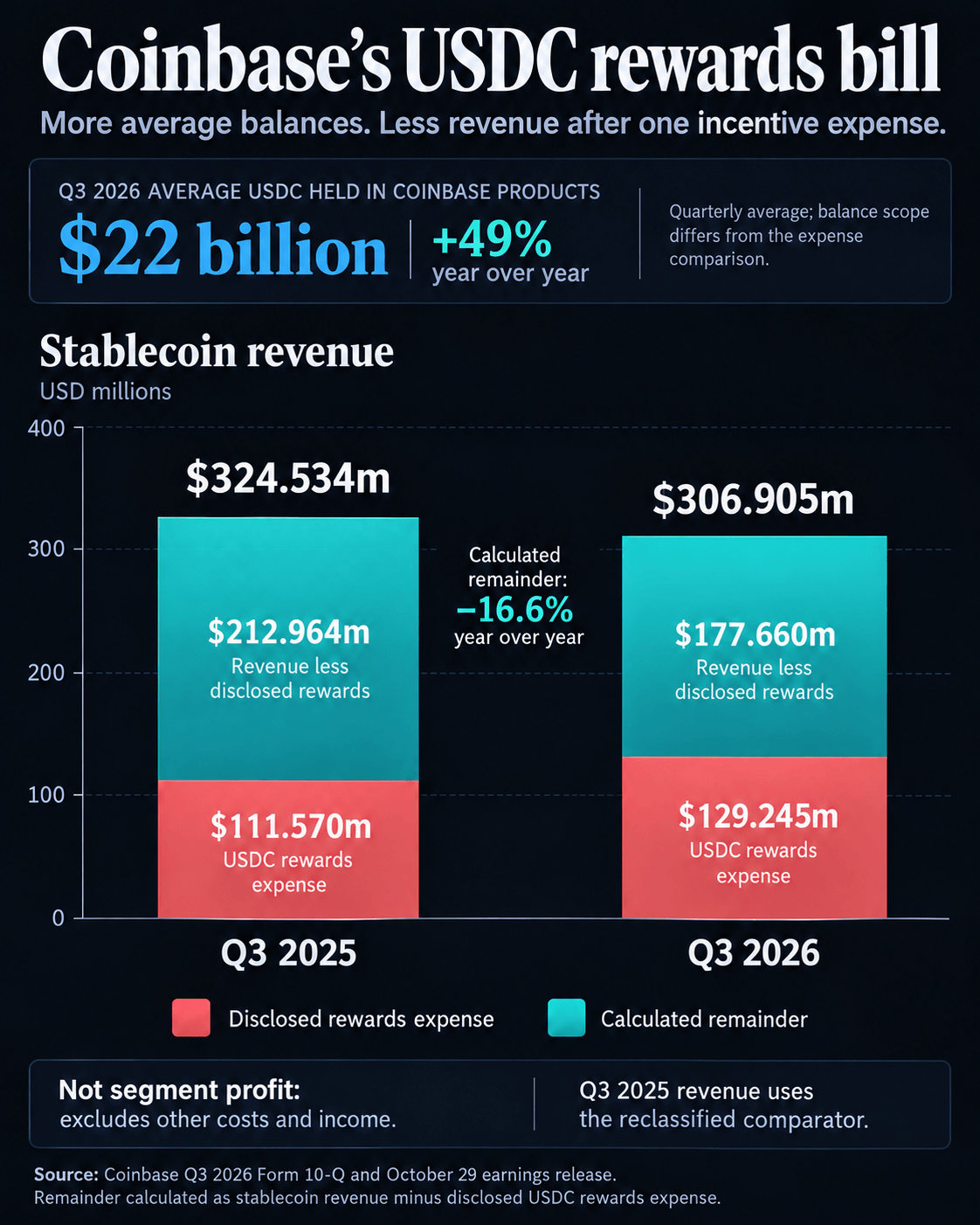
Subtracting the disclosed rewards expense from stablecoin revenue leaves approximately $177.7 million, down from $213 million in the comparable quarter.
This represents a $35.3 million decline, or 16.6%, despite the substantial expansion in USDC balances. The calculation excludes other income and expenses associated with the stablecoin business.
This divergence reflects competing pressures on Coinbase’s commercial arrangement with Circle, the issuer of USDC.
Coinbase’s filing attributed an $84.6 million positive revenue contribution to higher average USDC balances, while lower interest rates created a $52.8 million drag on revenue.
Interest income generated by the reserves backing USDC remains an important component of the economics shared between Coinbase and Circle. Lower rates therefore reduce the revenue available even as more customers hold the stablecoin.
The exchange has also been paying increasingly substantial rewards to support adoption. Still, the firm is looking to attract more participants to the USDC ecosystem. Haas said:
“Circle and we both have a goal to grow overall USDC market cap and adoption. In some cases, we could partner together to bring on more participants into the USDC ecosystem. We could also work independently to partner with various parties and bring them as partners on our respective platforms.”
Coinbase Increases Bitcoin and Ethereum Investments as Crypto Prices Lift Profits
Beyond its expanding trading and stablecoin operations, Coinbase also increased its direct exposure to cryptocurrency markets during the quarter.
A comparison of its second-quarter and third-quarter filings shows that the exchange’s Bitcoin holdings for investment increased by 643 BTC, from 17,311 BTC at the end of June to 17,954 BTC in September.
Its Ethereum investment holdings also increased by 2,370 ETH, rising from 150,279 ETH to 152,649 ETH over the same period.
Together with other digital assets, the company’s cryptocurrency investment portfolio increased in fair value from $1.47 billion to approximately $2.22 billion, representing a 51.5% quarterly increase.
Much of that increase reflected higher cryptocurrency valuations, which also contributed significantly to Coinbase’s reported profitability.
The exchange recognized approximately $715 million in gains on crypto assets held for investment during the quarter, helping drive its $719 million net profit after three consecutive quarterly losses.
However, adjusted net income, which excludes those investment gains and certain other items, stood at $78 million.
This distinction highlights Coinbase’s continued financial exposure to cryptocurrency prices even as prediction markets, stablecoins, and subscription services become more prominent sources of revenue.
In its filing, Coinbase estimated that a hypothetical 50% increase or decrease in cryptocurrency prices would change the fair value of its investment portfolio by approximately $1.1 billion, with the resulting gain or loss flowing through its earnings.
Also Read
- Pakistan’s Official Currency Rates (Oct 30, 2026): Dollar at Rs278.54, Pound at Rs373.04 – UrduPoint
- Ripple Secures Federal Trust Charter, But XRP Demand Remains Unchanged
- Pakistani Rupee Edges Up Against Dollar in Interbank Trading
- Franklin Templeton Leads Surge as XRP ETFs Hit October Peak Inflows