



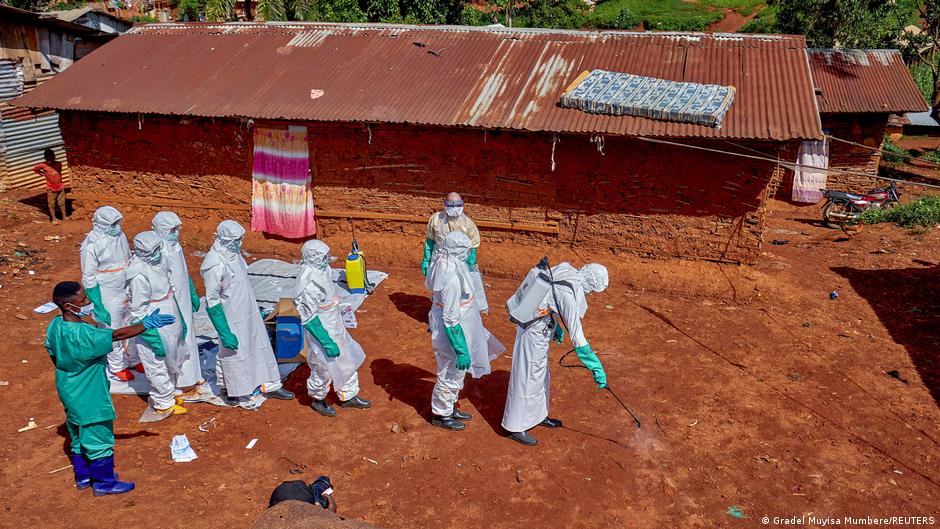
Three weeks into the latest Ebola outbreak in the Democratic Republic of Congo, the statistics are sobering: 397 confirmed cases and 63 deaths, according to data from the African Union’s Africa Centres for Disease Control and Prevention.
Despite these fatalities, deep-seated skepticism persists. “The community does not believe in this disease,” explained John Tumujimbe, who leads a team dedicated to safe and dignified burials in Mongbwalu, an epicenter of the outbreak in the northeastern Ituri province.
Tumujimbe noted that early suspicions pointed toward malaria, typhoid, or diarrheal diseases. However, after a surge in deaths, samples were sent to the National Institute for Biomedical Research (INRB) in Kinshasa. The institute confirmed the presence of Ebola, marking the 17th epidemic recorded in the DRC since the virus’s discovery in 1976.
Mistrust Sparks Violence and Arson
Health officials report that scientific explanations have been widely rejected by many Mongbwalu residents. One anonymous resident recalled early theories claiming that coffins were the primary source of transmission, a rumor Tumujimbe also encountered.
Other baseless claims suggested that paramedics and aid workers were utilizing vehicle antennas to spread the virus. This atmosphere of fear culminated in late May when an angry mob stormed the general hospital in Mongbwalu. Protesters demanded the return of deceased relatives and set fire to a Doctors Without Borders tent, forcing the organization to evacuate its staff.
Hospital director Richard Lokudi described the event as a state of “panic,” which allowed eighteen patients under observation to escape. Health workers now fear these individuals may have inadvertently transmitted the disease to those sheltering them, a situation exacerbated by the lack of a vaccine for the current Bundibugyo variant.
Persistent Myths Impeding Public Health
Christopher Nehring, a disinformation researcher and co-author of a Konrad Adenauer Foundation report on the epidemic, notes that similar narratives typically emerge during every health crisis.
Goma youth fight Ebola myths in the DRC
To view this video please enable JavaScript, and consider upgrading to a web browser that supports HTML5 video
“Common narratives include claims that the disease is a lab-created bioweapon, that vaccines are more dangerous than the virus, or that a secret cure is being withheld,” Nehring explained. “Big Pharma is often cast as either the profiteer or the architect of the crisis. These themes have existed for decades in various forms.”
Ange Kasongo, founder of the Kinshasa-based fact-checking organization Balobaki Check, highlighted how local economic pressures further complicate the response. In the gold-mining regions of Ituri, some residents attribute the deaths to mystical acts intended to eliminate business competitors rather than a biological virus.
Kasongo also identified a viral WhatsApp conspiracy claiming a plot between President Felix Tshisekedi and renowned virologist Jean-Jacques Muyembe to decimate the population of eastern Congo. Balobaki Check found no evidence to support these claims.
Funding Cuts and the Information Gap
The fight against the epidemic is being hindered by a decline in global emergency aid. In 2025, the United States withdrew from the World Health Organization, alongside significant funding cuts to USAID and the CDC’s crisis management programs. European governments have also reduced financial support, partly due to increased military spending following the war in Ukraine.
Nehring argues that these budget cuts directly impact the ability to combat fake news. “If funding for health aid is slashed, budgets for health communication are inevitably reduced as well,” he stated.
While Kasongo acknowledges that authorities are striving for clarity, she emphasizes the difficulty of bridging communication gaps. She questioned how to effectively disseminate information orally and in local dialects, rather than relying solely on French and the four national languages. She stresses that engaging community leaders and providing them with reliable data is essential for success.
Protests in Kenya over Ebola quarantine center turn deadly
To view this video please enable JavaScript, and consider upgrading to a web browser that supports HTML5 video
Also Read
- The Jerusalem Post Launches Inaugural Asia-Pacific Summit in Sydney
- US Senior Advisor Proposes Unified Government Framework for Libya, FT Reports
- Japanese Authorities Investigate Major Ice Cream Manufacturers for Alleged Price-Fixing</TITLE]The investigation into suspected price-fixing cartels within the ice cream industry comes at a time when Japan is grappling with record-breaking summer temperatures.
- Emergency Response Saves Lives After Small Aircraft Crashes on Texas Highway