






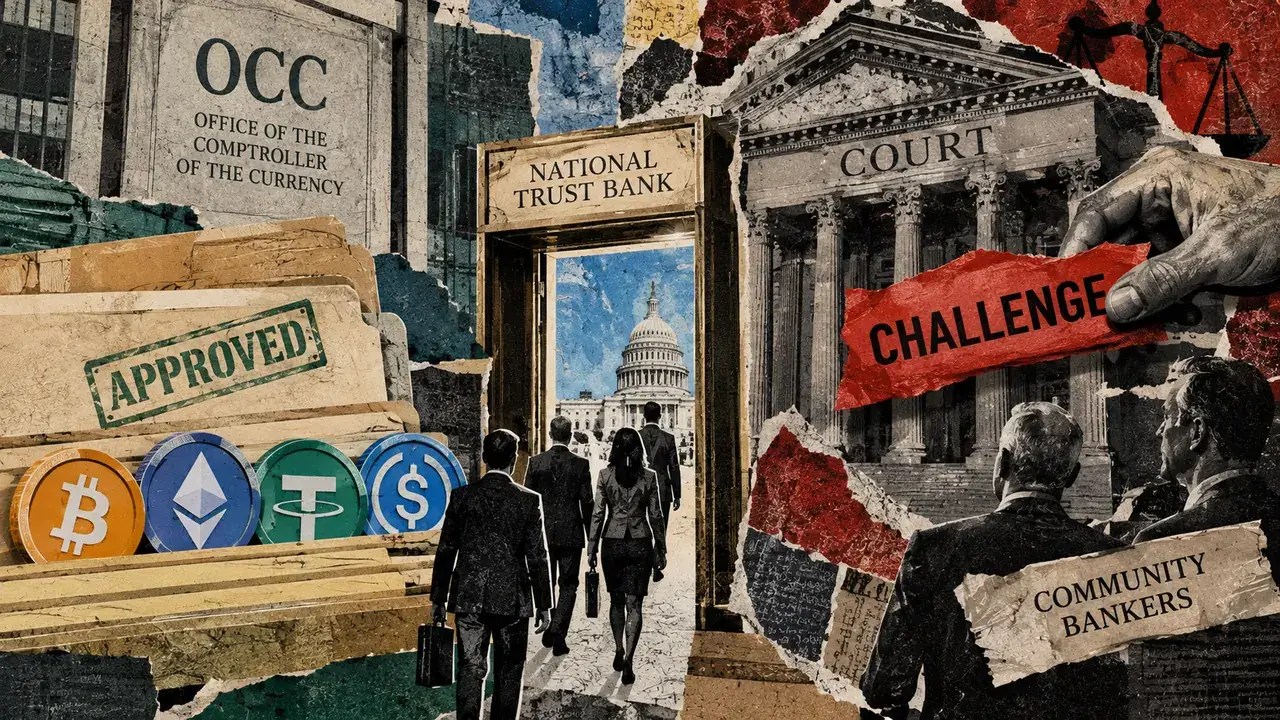
ICBA Lawsuit Challenges OCC’s Expanded Trust‑Bank Charter
The Independent Community Bankers of America (ICBA) filed a complaint in federal court in Washington on October 2, 2024, shortly after the Office of the Comptroller of the Currency (OCC) approved three new national trust banks—Agora National Trust Bank, Catena Trust Bank, and Bastion Platforms. In the suit, ICBA seeks to vacate the OCC’s national trust‑bank rule and Interpretive Letter 1176, arguing that the agency overstepped its statutory authority by broadening limited‑purpose trust charters to encompass fintech and cryptocurrency businesses. The group contends that the rule allows non‑depository, non‑fiduciary crypto activities to be conducted under a lighter regulatory framework than that applied to traditional insured banks.
According to the complaint, the OCC has approved or conditionally approved 21 trust‑bank charters to date, with 13 of those linked to crypto‑related entities. The lawsuit claims this expansion effectively circumvents the rigorous oversight that depository banks must endure.
Accelerated Approvals Despite Industry Opposition
Banking associations have contested individual applications, yet the OCC continued to grant charters. In December 2025, five crypto‑linked national trust applicants—BitGo, Fidelity Digital Assets, First National Digital Currency Bank, Paxos, and a Ripple‑affiliated entity—received approvals. Subsequent approvals included Bridge, National Digital Trust, and Foris DAX (parent of Crypto.com) in February 2026, Coinbase in April, and Laser Digital in May. The most recent approvals—Agora, Catena, and Bastion—were granted on September 18, 2026, with some remaining conditional.
The OCC finalized its national trust‑bank rule in February 2026, effective April 1, replacing the narrower term “fiduciary activities” with the broader language “the operations of a trust company and activities related thereto.” The agency maintains that this wording preserves its chartering authority, noting that national trust banks have historically performed non‑fiduciary functions such as custody, citing 12 U.S.C. § 24(Seventh) as legal backing.
Legal Framework and Judicial Review
In its February rule, the OCC referenced the Supreme Court’s Loper Bright decision, emphasizing that courts must exercise independent judgment when a party with standing disputes the National Bank Act’s authorization of national trust‑bank charters. ICBA’s lawsuit now asks the court to determine the scope of that authority, effectively forcing a judicial resolution of the rule’s validity. The OCC had previously signaled that courts would settle the legal basis for the newly approved crypto trust charters.
Specific objections have been lodged against Coinbase and Ripple, requesting that the agency deny those applications. The broader suit, however, aims to have the entire rule and interpretive letter invalidated, with ICBA also seeking declaratory and injunctive relief to halt further approvals.
Pending Applications and Regulatory Uncertainty
As of August 2026, the OCC reported receiving 40 de novo charter applications over roughly 18 months, with 23 involving digital‑asset activities. Pending applicants include zerohash, Dakota National Trust Bank, Payward (Kraken), Lorum National Trust Bank, EDX Trust, and PAYO Digital Bank. Whether the OCC will continue processing these applications under the current rule while the litigation proceeds remains an open question.
Industry Projections if the Rule Is Upheld
If the court rules in favor of the OCC, national trust banks are poised to become a primary federal vehicle for crypto custody and stablecoin infrastructure. Financial institutions have projected substantial market growth: JPMorgan anticipates $500 billion in crypto‑related activity by 2028, Coinbase forecasts $1.2 trillion by the same date, and Standard Chartered projects $2 trillion. Citi’s 2030 scenarios range from $1.9 trillion under a base case to as high as $4 trillion in an optimistic outcome. FDIC‑insured banks held approximately $20.7 trillion in deposits during the second quarter of 2026, meaning that even the lower $500 billion estimate represents roughly 2.4 % of that base.
For Bitcoin specifically, a favorable ruling would likely expand bank‑supervised custody and settlement‑linked services for institutional investors, deepening integration between traditional finance and digital assets.
Consequences of a Court‑Imposed Limitation
Conversely, if the court vacates or narrows the OCC’s rule and Interpretive Letter 1176, the impact would be most acute for activities that sit at the periphery of traditional fiduciary services—particularly stablecoin issuance, reserve management, non‑fiduciary custody, conversion, payments, and settlement. Firms that have structured their operations around these functions may need to reorganize, potentially spinning off non‑fiduciary activities into separate affiliates, state‑chartered trust companies, or partner‑bank arrangements. Pending charters could face stricter scrutiny.
Bitcoin custody itself is expected to remain viable, though the regulatory “wrapper” for adjacent services such as conversion, execution, settlement, staking‑like activities, and collateral movement would become less flexible. The San Francisco Federal Reserve estimates that stablecoin issuers’ demand for Treasury securities could double to roughly $400 billion by 2030, underscoring the broader financial‑system implications of the court’s decision.
Judicial Decision Sets Precedent for Non‑Fiduciary Crypto Infrastructure
The litigation places a pivotal question before a federal judge: how much non‑fiduciary market infrastructure can be accommodated within a national trust‑bank charter. As the OCC originally indicated, the resolution will determine the future regulatory pathway for crypto firms seeking to operate under a federal charter. The outcome will shape the balance between fostering innovation in digital‑asset services and preserving the safeguards that underpin community banking.
Also Read
- Hedge Funds’ $1.2 Trillion Treasury Basis Strategy Depends on Overnight Financing—and That’s the Vulnerability
- Chainalysis Leverages AI to Tie $387M Bitget Hack to North Korean Actors
- Crypto Job Listings Surge to 1,200+ in September as Applications Drop
- PewDiePie Says OpenAI Suspended His Account Twice During Development of Local AI Assistant Ajax


