







Sterling Climbs While Dollar and Aussie Decline Amid Diverging Central Bank Signals
Today’s market themes:
- Dollar: Softer-than-expected headline and core PCE data supported New York Fed President John Williams’ view that rates may not need to rise urgently, reducing October Fed hike odds from roughly 51% to 37.1%.
- Aussie: Although headline CPI rose to 4.0% year-over-year, a weaker-than-forecast trimmed mean failed to restore rate-hike expectations following Governor Michele Bullock’s cautious tone, leaving the AUD as the weakest major currency despite a generally softer Dollar.
- Sterling: Upwardly revised GDP figures reinforced growing expectations for Bank of England tightening, with input from Governors Andrew Bailey and Dave Ramsden lifting November hike probabilities to around 89%.
Sterling advanced, the Dollar retreated, and the Aussie declined even further. The key differentiator was not just the data, but the starting positions of each central bank ahead of these releases.
The US inflation report delivered the most significant blow to recently aggressive Fed rate hike expectations. Headline PCE rose by 0.3% month-over-month, falling short of the 0.4% consensus, while core PCE increased by 0.2%, missing the 0.3% forecast. Year-over-year, headline inflation stood at 3.4% compared to an expected 3.7%, and core inflation was 3.0% versus 3.4% projected.
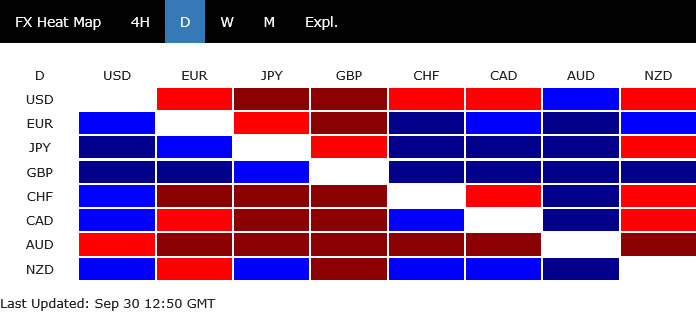

Currency Heat Map.
Soft PCE Report Reinforces Fed Official’s Call for Caution
This particular inflation report posed the strongest test yet to the previously dominant trade favoring a near-term Fed rate increase.
Headline PCE inflation rose by 0.3% month-over-month, below the 0.4% consensus, while core PCE increased by 0.2% month-over-month, also undershooting the 0.3% forecast. On an annual basis, headline inflation came in at 3.4% year-over-year versus 3.7% expected, while core inflation was 3.0% versus 3.4% expected.
The annual figures show substantial deviation, though they must be interpreted cautiously due to recent benchmark revisions from the Bureau of Economic Analysis affecting historical baselines. The clearer signal emerged from the monthly changes: both headline and core measures missed expectations.
Market responses followed suit. The likelihood of an October Fed rate hike dropped from approximately 51% prior to the release to 37.1%, leaving a hold at 62.9% as the predominant market stance.
This adjustment aligns closely with Williams’ comments earlier in the week. He emphasized that the September rate increase left policymakers with “no need for urgency” when considering future moves, while keeping options open for additional hikes later in the year. While PCE did not rule out further tightening, it diminished arguments for immediate action.
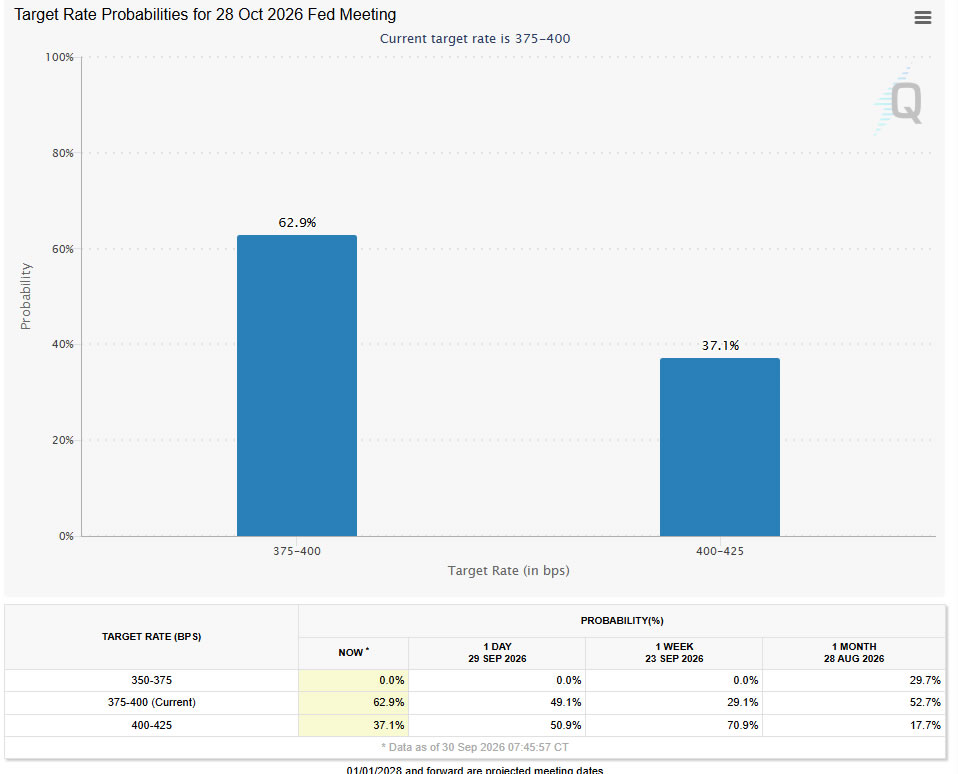

Key Highlights from the US PCE Report
- Headline PCE: +0.3% month-over-month (+0.4% forecast); +3.4% year-over-year (+3.7% expected).
- Core PCE: +0.2% month-over-month (+0.3% forecast); +3.0% year-over-year (+3.4% expected).
- Fed hike odds for October: declined from around 51% to 37.1%; 62.9% chance of holding steady.
- Note: Annual comparisons affected by BEA revisions to past data.
Consumer Spending Growth Mitigates Dovish Interpretation
The report wasn’t universally soft.
Personal spending rose by +0.9% month-over-month, exceeding the 0.8% forecast, while real personal consumption expenditures increased strongly by +0.6%. Personal income, however, grew only +0.2%, and real disposable income remained flat.
Consumers sustained robust spending momentum despite slower income growth.
This dynamic complicates the narrative. While inflation data cooled arguments for immediate tightening, spending figures suggested ongoing economic vitality rather than signs of contraction.
Energy effects persisted throughout the report. Gasoline prices climbed notably, contributing to elevated readings in certain categories. Despite these influences, overall price indices still fell short of market projections.
The Dollar’s response reflected reduced confidence in imminent Fed tightening rather than a broad pivot toward anticipating sluggish US growth.
- Personal spending: +0.9% month-over-month (+0.8% forecast); real PCE +0.6%.
- Personal income: +0.2% month-over-month; real disposable income unchanged.
- Energy sector: notable increases in gasoline prices, contributing to mixed inflation signals.
Aussie Weakens Despite Mild Underlying CPI Surprise
Australia presented a contrasting scenario.
Headline CPI rose from 3.5% to 4.0% year-over-year, matching forecasts precisely, while the monthly pace slowed from 1.0% to 0.4%, again aligning with consensus estimates.
Underlying indicators painted a softer picture.
Trimmed mean CPI eased from 0.5% to 0.2% month-over-month, below the 0.3% forecast, while the annual rate held steady at 3.6% for the third consecutive month.
Significant swings in headline versus core measures stemmed largely from volatile components like automotive fuel, which jumped +14.8% month-over-month following a 7.5% gain in July—driven by global oil price movements and the rollback of temporary government fuel-excise reductions. Electricity costs also surged, though both elements are excluded from the trimmed mean calculation.
This renders August’s report a case of elevated headline readings masking moderate underlying inflation.
Nevertheless, the AUD ended up as the poorest-performing major currency of the session.
Summary of Australia’s CPI Data
- Headline CPI: rose from 3.5% to 4.0% year-over-year (in line with expectations); monthly rate eased from 1.0% to 0.4%.
- Trimmed mean CPI: declined from 0.5% to 0.2% month-over-month (below 0.3% forecast); annual rate stable at 3.6%.
- Automotive fuels: surged +14.8% month-over-month after a 7.5% jump in July, influenced by oil prices and excise relief reversal.
- Electricity contributed significantly to headline inflation but is excluded from the trimmed mean index.
CPI Data Fails to Reverse RBA Policy Pricing Trends
This underperformance reflects more on Tuesday’s RBA policy meeting than today’s CPI numbers.
The Reserve Bank of Australia raised its cash rate to 4.60% unanimously, signaling readiness to hike again if warranted. Yet Governor Bullock’s press conference introduced notable ambiguity regarding whether another rate increase would actually be necessary.
Her message centered on the possibility that current restrictive settings may suffice, rather than assuming further hikes as a baseline outcome.
The muted monthly trimmed mean reading provided little counterpoint to that stance. If anything, it supported the idea that recent tightening might be adequate, offering no compelling reason to reprice near-term policy action upward.
That context explains the surprising price movement.
In typical circumstances, a soft US PCE report and weakening Dollar would offer some support to commodity-linked currencies like the AUD. Instead, the Aussie continued its descent even against the Dollar.
Post-RBA repricing proved strong enough to eclipse any positive spillovers from external Dollar weakness.
Sterling Builds Upon Earlier BoE Tightening Repricing
Sterling occupied the opposite end of the spectrum.
Revised UK Q2 GDP showed growth climbing from 0.4% to 0.5% quarter-over-quarter, with the annual rate rising from 1.2% to 1.4%. These upgrades bolstered perceptions of economic resilience entering the second half of the year.
However, GDP wasn’t the catalyst behind Sterling’s rally.
Rally drivers included BoE Governor Andrew Bailey, who underscored challenges facing policymakers if persistent energy-driven inflation pressures remain. Deputy Governor Dave Ramsden followed up on Monday by openly entertaining the prospect of another hike should inflationary risks intensify.
GDP served as the third supporting factor.
Markets now assign nearly 89% probability to a November rate hike, with forward curves implying multiple additional increases extending into 2027.
The takeaway is clear:
GDP validated the Sterling rally—it didn’t initiate it.
Essential Data Points from the UK GDP Revision
- Q2 GDP: revised upward from 0.4% to 0.5% quarter-over-quarter; annual rate adjusted from 1.2% to 1.4%.
- Probability of a November BoE rate hike: approximately 89%, with markets pricing in several more hikes through 2027.
- Sequence of events: Bailey’s warning about energy-related inflation, followed by Ramsden’s openness to additional tightening, then GDP data confirming economic strength.
UK Growth Remains Solid, Though Domestic Demand Shows Signs of Slowing
GDP breakdown reveals nuances requiring measured interpretation.
Output expansion spanned multiple sectors, notably services and construction. However, expenditure-side analysis highlights net exports driving much of the momentum. Export volumes rose by 2.8%, led by strong performance in goods exports, while household spending grew just +0.3%.
Government consumption declined slightly by -0.5%, though this figure appears skewed by June’s extreme heatwave and related disruptions to public services including schools.
At the same time, general government net borrowing increased from 4.2% to 5.2% of GDP, drawing focus toward the upcoming October 28 Budget and potential implications of tighter fiscal policies on economic momentum.
Overall, Sterling benefits from a clear near-term policy narrative, though longer-term growth prospects face headwinds.
Currently, attention remains focused on near-term policy developments.
- Export volumes: increased by +2.8%, with notable strength in goods exports.
- Household consumption: modest increase of only +0.3%.
- Government consumption: dipped by -0.5% (impacted by June heatwave and school closures).
- General government net borrowing: rose from 4.2% to 5.2% of GDP, raising questions ahead of October 28 Budget.
Energy Shocks Generate Divergent FX Reactions Across Economies
Rising energy prices wove through all three stories, yet each generated distinct currency responses.
In the US, energy pressures continued influencing select PCE components, but overall inflation still disappointed relative to market expectations, prompting investors to pull back from October Fed hike bets.
In Australia, fuel and electricity costs propelled headline CPI sharply higher, but underlying measures stayed relatively subdued, failing to reignite anticipation for additional near-term RBA tightening.
In the UK, ongoing energy-related inflation concerns emboldened BoE officials to signal greater willingness to maintain restrictive policies, especially amid evidence of economic resilience.
Thus, identical underlying dynamics yielded divergent FX outcomes driven by unique central bank contexts.
- The Dollar weakened due to diminished expectations for immediate Fed tightening.
- The Aussie faltered as skepticism over post-hike sufficiency overshadowed external Dollar weakness.
- Sterling strengthened as investors grew confident the BoE tightening cycle has room to extend.
Central Bank Stances and Their Impact on Three Major Currencies
| Currency | Data Surprise | Pre-Existing CB Stance | FX Outcome |
|---|---|---|---|
| USD | PCE below forecasts; solid spending | Williams: cautious on urgent hikes | Dollar softened; Oct hike odds dropped to 37.1% |
| AUD | Hot headline CPI; cool core measure | Bullock: current stance possibly adequate | AUD weakest major; extended losses post-RBA |
| GBP | Stronger GDP revision | Bailey/Ramsden: consider more tightening | Sterling rallied; Nov hike odds near 89% |
Frequently Asked Questions
Why did the Dollar decline despite robust consumer spending?
Although personal consumption expenditures rose strongly, inflation still failed to meet expectations. Markets interpreted the disappointing core and headline PCE readings as validation of Williams’ call for patience, reducing October Fed hike odds from roughly 51% to 37.1%.
What drove the Aussie lower despite a sharp rise in headline inflation?
The trimmed mean—an important gauge for the RBA—missed expectations at just 0.2% month-over-month, and Governor Bullock’s post-meeting remarks already implied that current policy levels might be sufficient. This dynamic left little basis for repricing near-term tightening expectations upward.
Did GDP spark Sterling’s upward movement?
No. The BoE tightening repricing began with hawkish statements from Governors Bailey and Ramsden earlier in the week. GDP merely reinforced an existing trend by confirming the economy’s resilience.
Main Insights
- US headline and core PCE underperformed forecasts, dropping October Fed hike odds from around 51% to 37.1%; strong spending (+0.9% m/m) prevented a purely dovish read.
- Despite headline CPI rising to 4.0% y/y, AUD was the weakest major currency after trimmed mean inflation surprised low at just 0.2% m/m.
- AUD lagged even against a broadly weaker Dollar, underscoring how post-RBA repricing outweighed external tailwinds.
- UK Q2 GDP revision boosted growth assumptions, backing a BoE tightening trend initiated by Bailey and Ramsden; markets now see nearly 89% odds of a November hike.
- Shared energy shocks produced opposing FX reactions because each central bank approached the data from a fundamentally different policy starting point.
Upcoming Market Focus
Investors await Friday’s nonfarm payrolls report to assess whether labor market trends support or complicate today’s ADP-based snapshot. Additional Fed speak could test the durability of Williams’ “no urgency” message across the broader committee. For Australia, upcoming data may clarify whether the post-RBA cautious tone maintains traction. Finally, the UKOctober 28 Budget warrants scrutiny, particularly in light of rising public debt, as fiscal tightening risks tempering the growth narrative fueling Sterling’s rally.


