






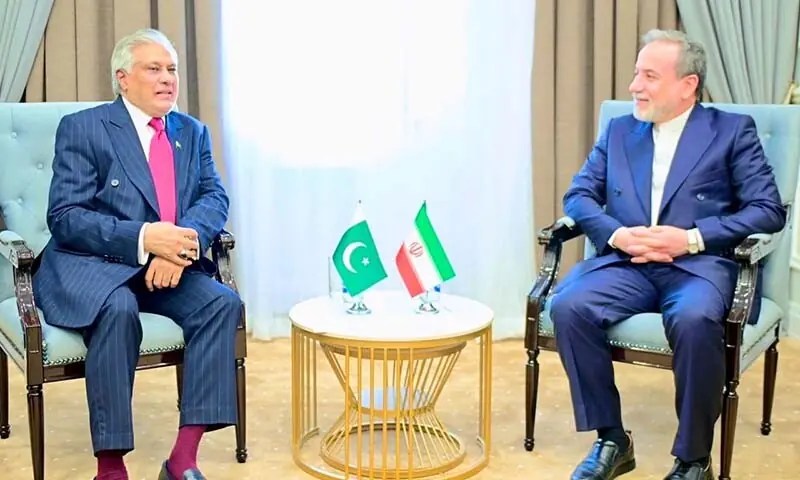
Deputy Prime Minister and Foreign Minister Ishaq Dar said on Friday that the commitments outlined in the Islamabad MoU must be built upon during his meeting with Iranian Foreign Minister Abbas Araghchi.
The meeting followed recent reciprocal strikes, in which the United States targeted Iranian military sites along its southern coast, while Iran struck U.S. bases in Gulf states.
The Foreign Office said the diplomats met on the sidelines of the Shanghai Cooperation Organisation’s Council of Foreign Ministers Meeting in Cholpon‑Ata, Kyrgyzstan, where they reviewed the current regional situation and bilateral relations.
“Deputy Prime Minister and Foreign Minister expressed deep concern over recent regional tensions and highlighted the importance of dialogue, restraint, de‑escalation by all parties, and sustained diplomatic engagement to secure lasting peace and stability,” the Foreign Office said in a post on X.
“He emphasised the need to build upon the understandings reached under the Islamabad MoU of June 2026.”
According to the Foreign Office, Araghchi thanked Pakistan for its continued diplomatic support and efforts to promote regional peace and security, noting Islamabad’s role in safely returning and repatriating Iranian fishermen and sailors, including those from vessels intercepted by the United States.
“The two sides agreed to maintain close coordination and regular consultations on matters of mutual interest and reaffirmed their commitment to working together for regional peace, stability and shared prosperity,” the statement concluded.
The renewed fighting since July 8 has cast further doubt on the future of the MoU signed on June 18, which sought to reopen the Strait of Hormuz and end the war after an additional 60 days of negotiations.
Two weeks after the interim truce collapsed, the United States launched air strikes on Iran late Thursday and early Friday, marking the 13th consecutive night of attacks.
US Central Command (Centcom) said the latest strikes lasted more than two hours.
“Centcom targeted Iranian military command centres, drone storage facilities, communication networks, coastal surveillance sites and maritime capabilities to further diminish the threat Iran poses to civilian mariners and commercial vessels transiting the Strait of Hormuz,” it said in a statement.
On both Thursday and Friday, Iranian state media reported that missiles struck Qeshm Island in the Strait of Hormuz, the nearly closed waterway at the heart of a conflict now in its fifth month, which has killed thousands and raised fears of a global economic downturn.


