







TL;DR: A week of significant catalysts — a hawkish-leaning jobs report, renewed White House pressure on the Federal Reserve, yen-driven currency moves, and persistent geopolitical risk — left the Dollar, Treasury yields, and the Dow all testing important technical thresholds without confirming a breakout. The upcoming August CPI release on September 11 now stands as the decisive data point that could finally resolve this widespread indecision.
Markets Engaged With the News Cycle but Refused to Choose a Direction
Several major catalysts accumulated throughout the week, each individually capable of forcing a meaningful repricing across US assets. A surprisingly resilient employment report challenged fears of labor-market deterioration. Federal Reserve officials laid out conditional paths for either pausing or tightening depending on inflation outcomes. The White House renewed its pressure on the Fed with notable intensity. Yen strength applied independent downward pressure on the Dollar. Geopolitical developments maintained an inflation-fueling energy risk premium.
Yet by Friday’s close, none of these forces had established dominance.
The Dollar approached significant resistance, reversed, but ultimately held above a critical near-term support level. Both the 2-year and 10-year Treasury yields probed major breakout zones before retreating without sustained gains above them. The Dow maintained its support base without successfully resuming its record-setting advance. Every market responded to the week’s developments — sometimes sharply — yet each finished within the same unresolved technical framework it began with.
This paradox deserves attention heading into the new week. Markets were neither complacent nor dismissive of incoming data. They were actively weighing competing narratives, only for those offsetting forces to neutralize one another. Robust economic growth pointed toward higher rates. Signs of moderating inflation supported patience. Political intervention suggested the Fed should hold. Crude oil stopped short of delivering another inflationary shock. Equities showed enough resilience to prevent a broader risk-off repricing.
The outcome was not a lack of movement, but rather an absence of confirmation. This distinction carries weight because the coming week features one data release with the potential to force resolution: August CPI.
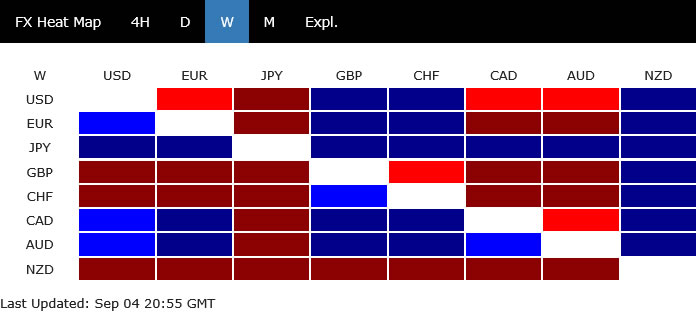

Currency heatmap.
Employment Report Dispelled July’s Labor-Market Worries
Friday’s employment data delivered the week’s most unambiguous hawkish signal. Nonfarm payrolls rebounded from a revised 21K in July to 162K in August, substantially exceeding the 58K consensus expectation. While the headline figure was impressive, the accompanying revisions may have carried greater significance for the broader economic narrative. July’s initially reported contraction of 23K was upgraded to a 21K gain, while June was revised upward from 20K to 31K. Cumulatively, the prior two months saw upward revisions totaling 55K.
This materially alters the interpretation of recent labor-market momentum. Prior to Friday’s release, July’s negative payroll reading had raised the possibility that employment growth was transitioning from deceleration to outright contraction. Combined with other softening labor indicators, this had given markets legitimate grounds to consider that the Fed might need to weigh downside employment risks more heavily. The August report largely eliminated this concern.
Unemployment held steady at 4.1%, even as labor-force participation edged higher. Average hourly earnings increased 0.3% month-over-month, while private payrolls rose by 127K. Hiring was not uniformly distributed across sectors — a notable portion of the headline gain originated from food services and local government education — yet the report remained far too strong to support narratives of an economy approaching labor-market contraction.
Perhaps most importantly, the revisions signal to markets that July was never as weak as initially reported. This subtly but significantly shifts the Fed debate. A strong payrolls report does not automatically compel the Fed to raise rates. However, it removes one of the most persuasive arguments for patience: the concern that tighter policy might be working against a rapidly weakening labor market.
In essence, Friday’s report accomplished more than adding one strong month. It restored credibility to recent economic history.
Fed Rate Expectations Shifted, but Only Back Toward a Hawkish Tilt
Markets responded to this reassessment. The implied probability of a September rate hike climbed from 49.4% before the employment report to 59.4% afterward. This represents a meaningful adjustment, though hardly a decisive one. Notably, just one week earlier, markets had already been pricing approximately 57% odds of a hike.
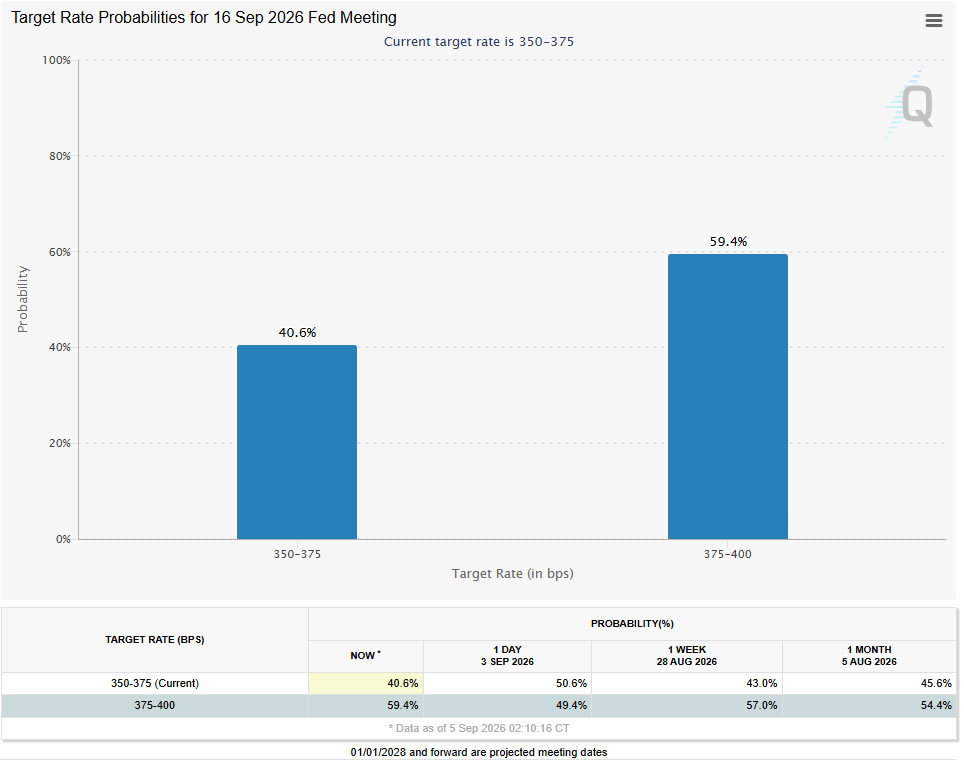

This comparison reveals important context. Federal Reserve Governor Christopher Waller’s earlier-week remarks had pushed rate expectations back toward an even split. Friday’s employment report then reversed that shift and restored a modest tightening bias. Yet despite payrolls exceeding expectations by more than 100K and prior months being revised substantially higher, markets still settled at approximately three-in-five odds.
The employment report, therefore, did not generate a fresh hawkish breakout in Fed rate pricing. It largely re-established the debate as it existed before Waller’s comments. This restraint stands as one of the week’s most telling developments.
If investors had believed the August jobs report resolved the September policy decision, hike odds should have moved considerably closer to levels reflecting near-consensus expectations. Instead, the market is communicating something more nuanced: labor data now favor tightening at the margin, but inflation data retain the power to override that conclusion.
This is precisely why front-end yields carry such significance. The 2-year yield briefly traded above 4.40%, but failed to maintain that level. Fed rate pricing and the Treasury market are essentially conveying the same message: employment has strengthened the case for tightening, but not sufficiently to establish conviction. A hawkish lean has emerged, but a hawkish resolution has not.
Waller Clarified Why Employment Data Alone Could Not Resolve September
Waller’s earlier-week remarks provide the clearest framework for understanding this market restraint. He did not characterize the labor market as being in distress, instead describing it as “in satisfactory shape,” citing low layoffs and claims data, and projecting that August employment would deliver broadly similar results. He also emphasized that monetary policy remained only mildly restrictive and acknowledged that modest inflationary acceleration could justify tighter policy.
However, his central message was not centered on payrolls. It focused on disinflation.
Waller highlighted the decline in three-month annualized core inflation from 4.76% in February to 3.05% through July, characterizing this improvement as substantial. He argued that underlying inflation dynamics may be more favorable than headline core measures suggest, partly because non-market and imputed services had accounted for a disproportionate share of recent increases.
His policy criterion was explicit. Should disinflation continue, he would lean toward supporting unchanged rates and allowing current policy additional time to operate. Should inflation print hot, he would consider raising rates.
Friday’s employment report complicates this framework without dismantling it. Waller had anticipated employment remaining broadly steady rather than materially strengthening. Friday’s assessment proved overly cautious. August payrolls substantially exceeded what he appeared to expect, while upward revisions substantially reduced July’s apparent weakness. This weakens one component of the hold case because the labor market now appears less vulnerable. However, it does not alter his hierarchy of evidence.
Waller had already signaled that his September vote would be influenced more heavily by August inflation data than by employment figures. Stronger jobs therefore raise the threshold for holding, but do not automatically clear the threshold for hiking. This is the nuance the market appears to be pricing. The employment report removed one justification for holding. CPI must still provide adequate justification to hike.
Trump Applied Pressure From the Opposite Direction
Political pressure introduced another force pulling markets away from a clean hawkish resolution. President Donald Trump responded to the robust employment report not by acknowledging the stronger case for restrictive policy, but by intensifying his demand for lower interest rates. He argued that a stronger US economy and improved credit standing should translate into reduced borrowing costs, then connected this demand directly to trade policy considerations.
Trump threatened to halt trade with countries maintaining trade surpluses against the United States unless the Federal Reserve reduced rates, subsequently singling out Canada as an example.
This represents a notable escalation because monetary policy criticism is now explicitly linked to external trade access. The underlying logic also runs directly counter to the standard market interpretation of strong employment data. A labor market exceeding expectations typically reduces the urgency for monetary easing and, when inflation remains above target, can strengthen the case for tighter policy. Trump instead interpreted employment strength as evidence that the United States merits lower rates.
This creates a second policy axis operating alongside the Fed’s own reaction function. The Fed is evaluating whether inflation has been sufficiently contained to justify patience. The White House is questioning why a stronger nation should bear elevated rates at all. These represent fundamentally different frameworks.
Administration messaging has not been entirely unified. Vice President JD Vance has also advocated for lower rates. National Economic Council Director Kevin Hassett, however, adopted a more measured stance on Friday, acknowledging that the case for holding rates steady was compelling.
Fed Chair Kevin Warsh added another dimension. Just one week prior, Warsh had stressed monetary discipline, reaffirmed the Fed’s 2% inflation target, and emphasized that short-term rates remain the primary instrument for fulfilling the Fed’s mandate. Markets interpreted his remarks as reopening the possibility of a September rate hike.
This leaves an unresolved political-policy tension heading into the September meeting: Trump is intensifying pressure for rate cuts precisely as stronger employment is making tighter policy more defensible for the Fed. There is no current evidence that political pressure is overriding the Fed’s reaction function. However, it introduces additional uncertainty regarding how aggressively markets should price the tightening scenario.
Oil Failed to Provide a Complementary Inflation Signal
Energy markets represented another potential source of directional resolution, but they too fell short. The US-Iran conflict escalated materially during the week, with retaliation broadening across multiple countries and rhetoric intensifying. Nevertheless, WTI crude failed to decisively clear 93.50 resistance.
This does not suggest geopolitical risk has dissipated, nor does it diminish the relevance of energy prices to the inflation outlook. Rather, it indicates that oil did not deliver a breakout strong enough to reinforce the hawkish interpretation already emerging from the employment report.
This carries significance because Waller and colleagues in the dovish-to-neutral camp are specifically awaiting evidence on inflation. Had crude broken sharply higher, markets could have entered CPI week already questioning whether recent disinflation was vulnerable to another energy-driven shock. Instead, the failure to clear resistance leaves that transmission channel contained for now.
Oil thereby removed one potential source of immediate confirmation. Strong employment data pointed toward higher rates. Political pressure pointed toward lower rates. Waller directed attention toward CPI. Oil declined to adjudicate the debate. This explains precisely why markets finished the week where they did.
Technical Analysis: Four Markets, One Consistent Pattern
Dollar Index: Bearish Bias Persists, but Sellers Still Require 98.55
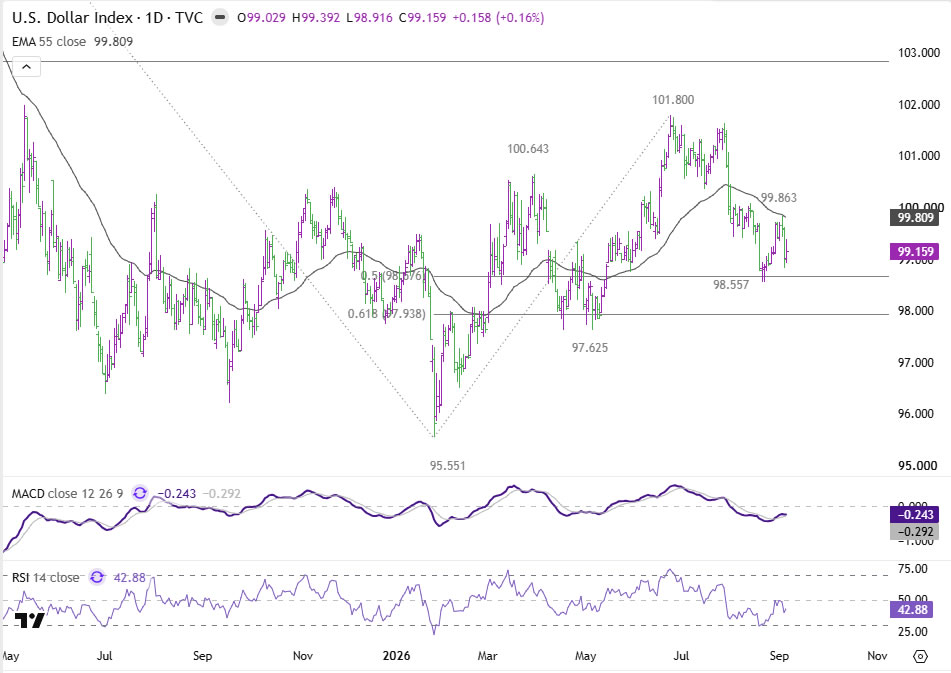
The Dollar Index attempted a recovery during the week but failed precisely where technical resistance became significant. DXY was rejected in the 99.79–99.86 zone, where the 38.2% retracement of the decline from 101.80 to 98.55 (approximately 99.79) converges with the 55-day EMA near 99.80.
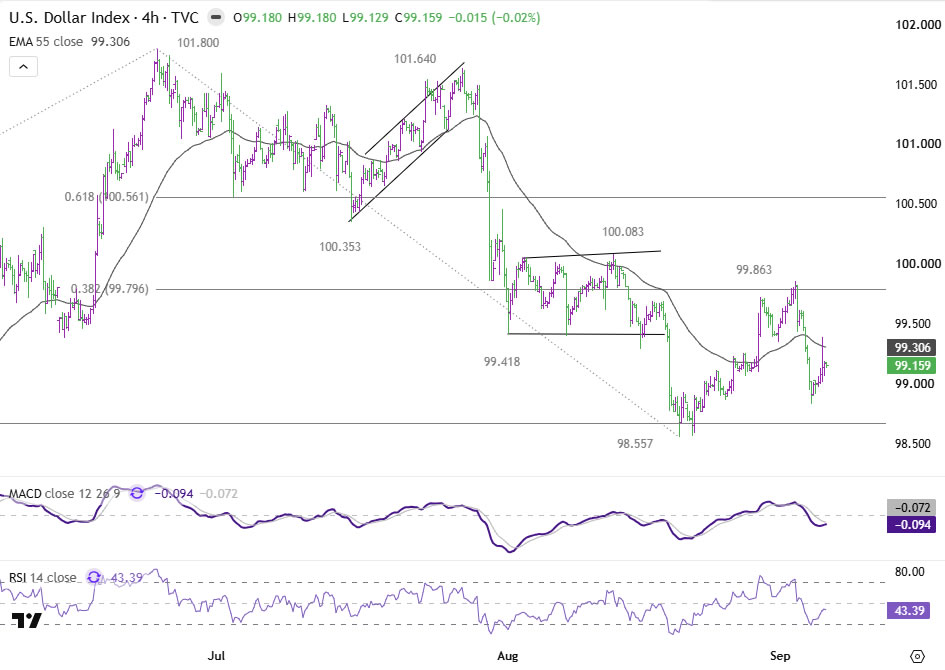

This rejection preserves the integrity of the decline from 101.80 and leaves near-term risk tilted to the downside. However, sellers have yet to demonstrate control. Critical support remains at 98.55. A decisive break below this level would reinforce the case that the rebound from 95.55 completed at 101.80 as a three-wave corrective structure, bringing a deeper decline toward 97.62 support next, with a sustained break opening the path back toward the 95.55 low.
On the upside, a firm break above 99.86 would instead indicate that the decline from 101.80 has concluded and would weaken the immediate bearish outlook.
DXY therefore concludes the week caught between two confirmation thresholds. Below 99.86, the downside structure remains intact. Above 98.55, the breakdown remains incomplete. This represents technical indecision in its most explicit form.
US 2-Year Yield: Employment Report Could Not Sustain 4.42%
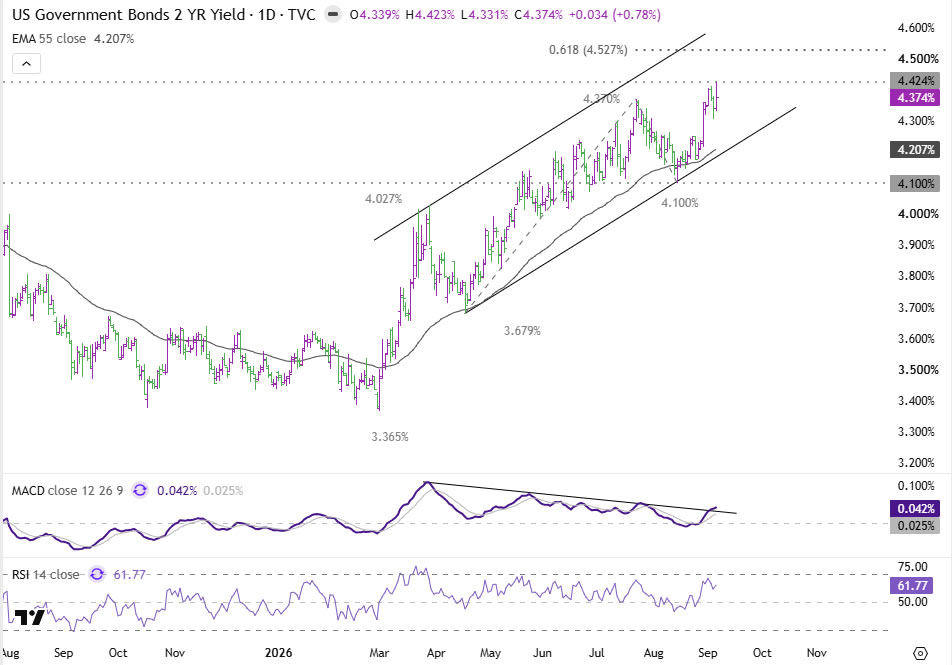
The front end of the curve produced perhaps the cleanest failed breakout of the week. The 2-year yield rose to 4.423%, effectively testing both the psychologically significant 4.40% level and the 2025 high near 4.424%, before retreating to close around 4.37%.
This carries particular weight because the 2-year yield serves as the closest market proxy for near-term Federal Reserve expectations. Had Friday’s employment report decisively shifted the policy trajectory, confirmation would have appeared here first. Instead, the yield reached resistance and stalled.
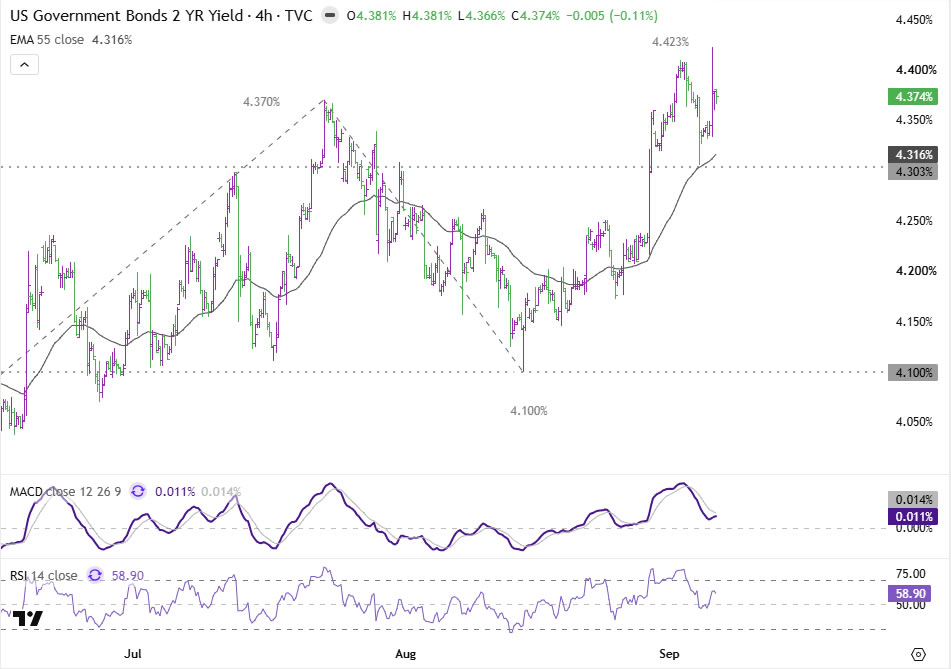

Further upside remains favored while 4.316% support holds. A firm break above 4.423–4.424% would confirm renewed upward momentum and target 4.527%, the 61.8% projection of 3.679% to 4.370% from 4.100%.
However, failure at current resistance preserves the broader trading range. A break below 4.316% would suggest the latest upside attempt has failed more materially and could trigger a deeper pullback toward rising channel support, currently around 4.19%.
The front end is therefore leaning hawkish but withholding confirmation.

US 10-Year Yield: 4.81% Represents the Long-End Breakout Threshold
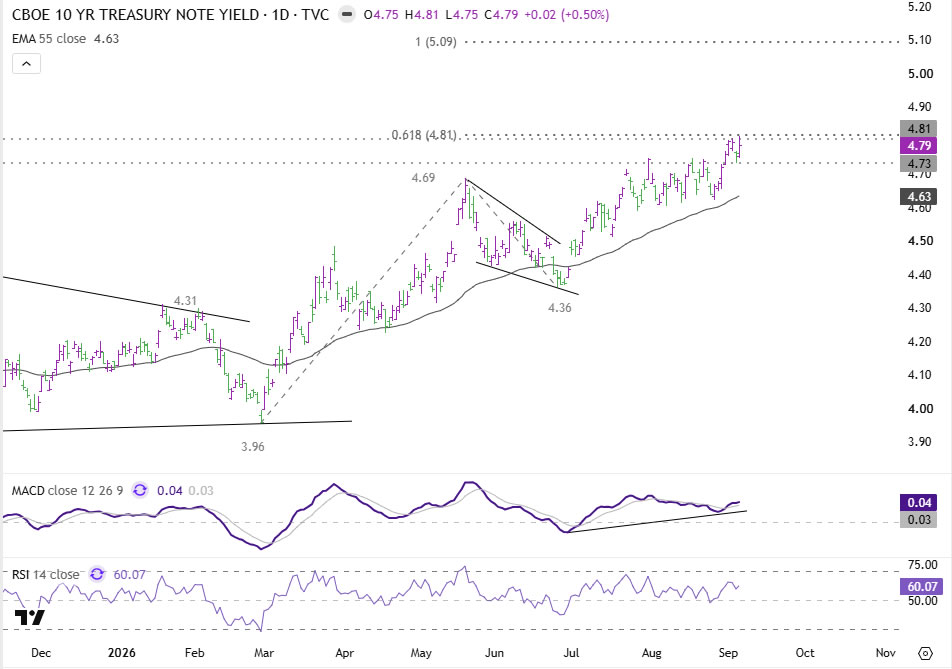
The 10-year yield tells an almost identical story. It advanced to 4.81%, retesting major 2025 resistance, but could not establish itself above that level and finished around 4.79%.
The near-term bias remains higher while 4.73% holds. A decisive break above 4.81% would confirm another leg higher and open the path toward 5.09%, the 100% projection of the rise from 3.96% to 4.69% measured from 4.36%. This would also bring the psychologically significant 5.00% area and the 2023 peak back into immediate focus.
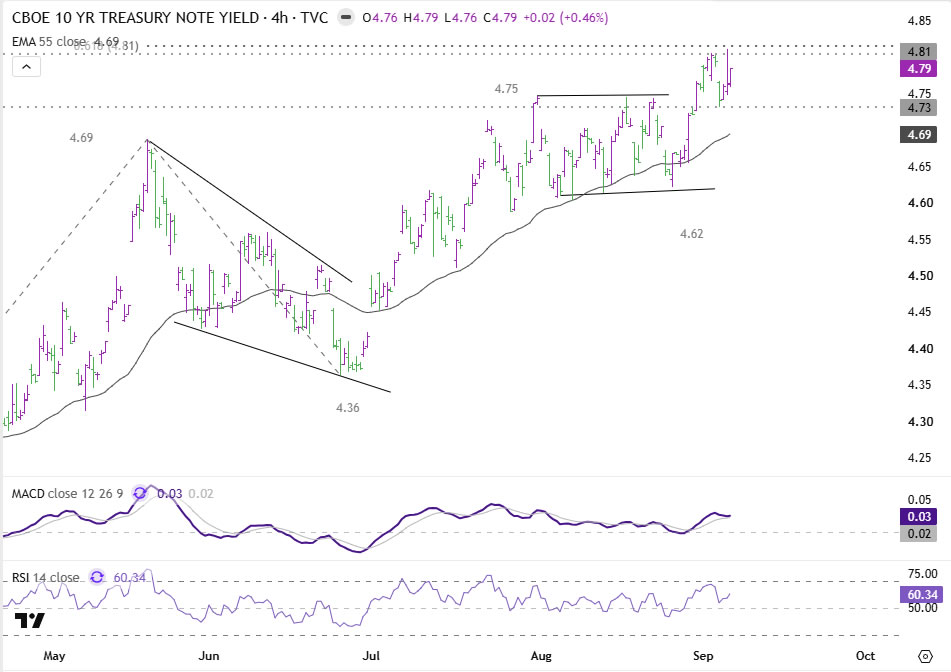

Conversely, a firm break below 4.73% would indicate a loss of upward momentum and bring a deeper decline back to the 55-day EMA near 4.63%.
The implications extend beyond chart structure. The 2-year yield’s failure at 4.42% indicates that markets are not yet fully committed to a more aggressive Fed path. The 10-year yield’s failure at 4.81% indicates that they are also not yet committing to a larger repricing of inflation expectations, term premium, and fiscal risk. Both ends of the curve reached levels where a major narrative shift could have been confirmed. Neither confirmed it.
Dow: Supported but Still Consolidating Below Record High
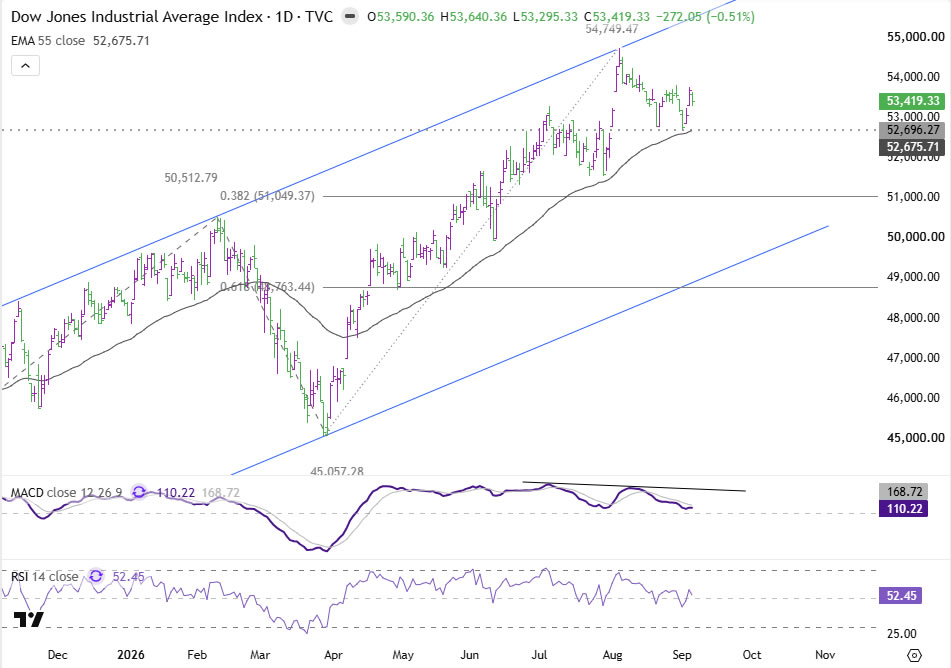
The Dow delivered the same message from the equity side. The index remained within its consolidation pattern from the 54,749.47 record high. The near-term structure continues to favor another upside attempt while 52,696.27 support holds, but buyers have yet to force a resumption of the larger uptrend.
A firm break above 54,749.47 would confirm uptrend continuation and target the medium-term channel ceiling, currently around 55,475.
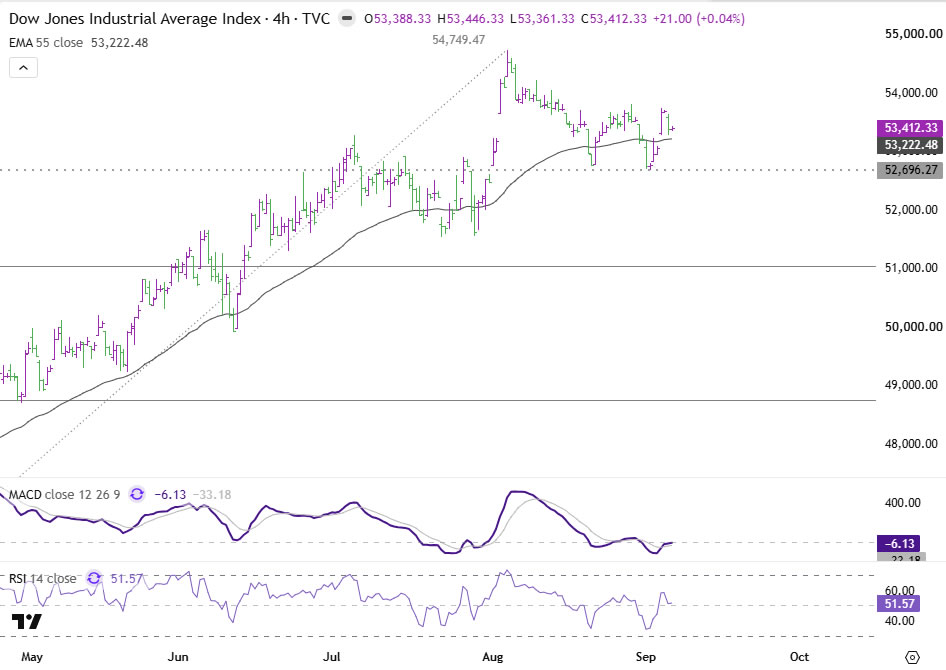
However, a loss of 52,696.27 would shift the tone more materially and suggest that consolidation has developed into a correction of the entire rise from 45,057.28. In that scenario, 51,049.37, the 38.2% retracement of that advance, would emerge as the next major downside target.
For now, equities are neither endorsing a major hawkish shock nor breaking into fresh risk-on acceleration. This balance represents another reason the cross-asset picture feels unusually unresolved.

September 11 CPI: The Data Point That Can Finally Break the Stalemate
If the employment report addressed questions regarding the labor market, CPI must now address questions regarding monetary policy. This explains why the August inflation report carries unusual weight.
The September Fed decision does not primarily concern whether the labor market is sufficiently weak to warrant protection. Friday’s report substantially reduced that concern. Instead, the central question is whether inflation has moderated sufficiently to justify holding rates steady despite stronger employment — or whether recent disinflation is beginning to reverse course.
A CPI report showing inflation broadly stable around recent levels may not alone be sufficient to force tightening. Waller has already indicated his willingness to allow disinflation more time if the underlying trajectory remains favorable. A one-month pause differs from renewed acceleration.
For markets to move decisively toward a September hike, evidence is likely required that the improvement observed since spring is not merely stalling but actively reversing. This would create a considerably more powerful combination:
- A labor market stronger than feared.
- Prior payroll weakness revised away.
- Wage growth remaining firm.
- Policy only modestly restrictive.
- Inflation trending higher once again.
Under this scenario, September hike odds would have room to climb materially above the current 59.4%, moving toward levels associated with a more settled policy decision. Treasury yields would then gain a fundamental catalyst for finally clearing technical resistance. The 2-year yield could establish itself above 4.42%. The 10-year yield could break 4.81%. The Dollar could challenge 99.86 again with rate-differential support behind it rather than merely a temporary post-data bounce.
A softer CPI report would produce nearly the opposite outcome. If August data confirm that underlying inflation continues to cool, Waller’s case for holding becomes considerably stronger even after the employment report. Markets could conclude that the Fed retains the luxury of waiting because the labor market is healthy enough to tolerate patience while inflation moves in the desired direction.
In that scenario, September hike probability could retreat toward an even split or below. The 2-year yield would struggle to sustain its current advance. DXY could return toward 98.55. Long-end yields could retreat from 4.81% as markets reduce the urgency for immediate tightening.
This is why CPI now represents more than another data release. It is the missing piece required to determine which of this week’s competing forces deserves primacy. The employment report settled one side of the dual mandate. CPI must now settle the other.
Key Takeaways
- August nonfarm payrolls (162K versus 58K consensus) combined with 55K in upward revisions to June and July restored confidence in the labor market, removing one of the Fed’s strongest arguments for patience.
- September hike odds rose from 49.4% to 59.4% following the employment report, but this merely restored the pre-Waller consensus rather than generating a fresh hawkish breakout.
- Waller has explicitly stated that his September vote depends more on August CPI than on payrolls, meaning strong employment raises the threshold for holding without clearing the threshold for hiking.
- Trump’s escalating pressure for rate cuts, connected to trade threats against surplus countries, creates a political axis running counter to the Fed’s own reaction function.
- The Dollar, 2-year yield, 10-year yield, and Dow all tested key breakout levels this week without confirming a move, leaving September 11’s CPI as the release with potential to resolve all four simultaneously.
Also Read
- Robinhood Defies AMC CEO’s Demand to Halt Token Offering Lacking Shareholder Rights
- XRP Breaks $1.40 Barrier as Institutional ETF Flows Surge Ahead of Key CLARITY Act Vote
- Wall Street is turning AI’s massive electricity appetite into a $61 billion bond market
- Gold Retreats Toward $4,440 as Robust US Jobs Data Halts August Surge


