






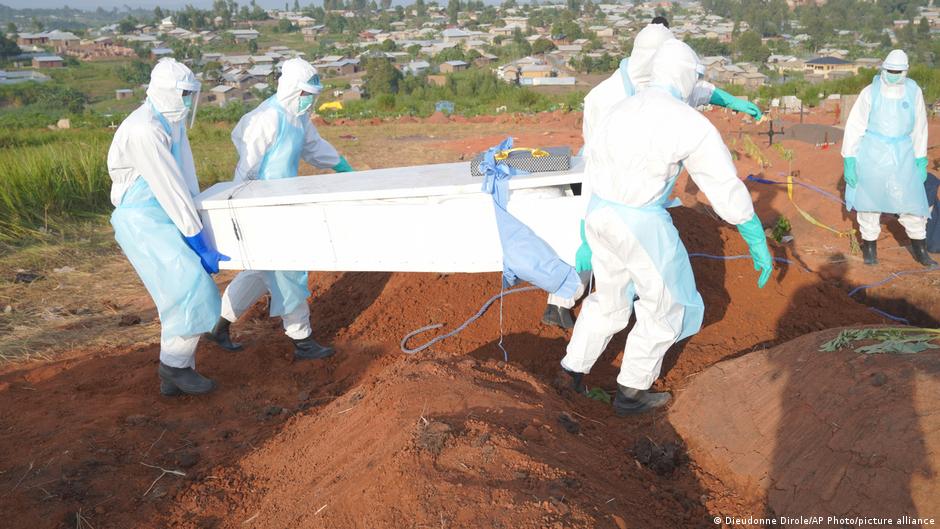
The Democratic Republic of Congo has reported that confirmed Ebola infections have now exceeded 6,000, with fatalities reaching 2,911, according to official figures.
The outbreak, driven by the Bundibugyo strain, has affected roughly 60 health zones across six provinces, prompting concerns that the virus is outpacing containment efforts.
“Around 60 health zones are now impacted, with new zones added each week. This pattern repeats everywhere: initial resistance and denial give way to gradual acceptance,” reported DW correspondent Jonas Gerding from Bunia, capital of Ituri province, the epicenter of the latest outbreak. “Unfortunately, many more people will die until this Ebola outbreak is brought under control,” he added.
UN Secretary‑General António Guterres described the epidemic as “the fastest‑growing Ebola outbreak on record. It is expanding faster and wider than the response to contain it, but it can be stopped,” he told journalists last week.
The United Nations has called for additional funding as humanitarian agencies struggle to keep pace with the rising case numbers.
“International attention, political focus and resources are still lagging behind the reality on the ground,” Guterres said, warning that the world “must also overcome another virus — the virus of indifference.”
Vaccination campaign gathers momentum
While researchers continue trials to license a vaccine for the Bundibugyo strain, Congolese authorities have launched a vaccination drive targeting front‑line health workers. The existing vaccine was originally developed for a different Ebola variant, but officials hope it will offer some protection against the current outbreak.
Health Minister Samuel Roger Kamba announced that more than 50,000 doses have already arrived in the country.
“We will cover all provinces surrounding Ituri, moving in a ring toward the outbreak’s center, which is Ituri itself. But we have enough doses for all health‑care providers,” he said on August 28.
Health worker Arnaud Batumbu expressed cautious optimism: “It is a vaccine that has already proven itself. We are dealing with Ebola Bundibugyo, of Ugandan origin. Yet the vaccine we are about to receive succeeded against the Zaire type. Since both are viral diseases, I hope it will work for us as well,” he noted.
Communities seek protection
Residents in hard‑hit areas say they are willing to be vaccinated if the benefits are clearly explained.
“I will get the vaccine if someone explains its importance to me,” said Clemency, a student in Tshopo province, speaking to DW.
Local resident Carine Lobwadji urged broader coverage: “Children need to be vaccinated too. They return to school; there are many of them in class.”
Others fear that supplies may be insufficient. “I have learned that the quantity is insufficient. I ask the authorities to add more doses for Tshopo and to vaccinate everyone, especially those who agree voluntarily, as some are afraid,” said photographer Onyeka Treasure.
Violence hampers response
The latest outbreak is unfolding amid violence and mass displacement in eastern DRC, complicating efforts to stop transmission.
Ebola response teams have reported attacks while carrying out their work, including during operations to handle Ebola‑related deaths.
“We demand greater security so we can operate in the field and do our work without endangering our lives,” said Floribert Magene, a team member, following an assault near Mambasa while responding to a call to secure a body.
Economic toll grows
Beyond the health emergency, the outbreak is increasing economic hardship for many families. Schools have reopened in towns such as Bukavu and Bunia, but many parents struggle to afford basic school supplies.
DR Congo launches Ebola trial for high-risk contacts
To view this video please enable JavaScript, and consider upgrading to a web browser that supports HTML5 video
Stationery shop owner Furaha Mpangu Esperance told DW that demand has collapsed as families prioritize food and other essentials.
“It isn’t working. The situation is serious because there are no customers. We have even lowered prices but nobody buys. Before, we sold ten or twenty boxes a day. Today not even three boxes, not even two! The situation is critical,” he said.
To reduce disruption to education, the government has proposed radio‑based learning for children unable to attend school.
“Our goal is twofold: ensure children continue attending school despite the epidemic and use distance learning as the tool to help them,” Education Minister Raissa Malu told DW.
Teachers, however, say many areas lack the infrastructure needed for effective distance learning.
“We, the teachers, are ready, but we don’t have the tools. In sensitive zones, even picking up frequencies is a problem,” said Patrick Girinegi, president of the Ituri teachers’ inter‑union alliance. “First‑grade children can’t read, nor can the parents. Several schools have no printers or computers. How will it work?”
Many students and parents would rather see classrooms remain open with stronger health measures.
“It’s easy for me to understand when my teacher explains it to me. Saying that the child stays home to listen to the radio, I don’t think it will work. We must find ways to go to school without contaminating ourselves,” said Viviane Tshipamba, vice‑president of the Ituri children’s committee.
Despite these challenges, health authorities point to a positive sign: more than 1,360 people have recovered from Ebola so far. For many Congolese, these recoveries offer hope that with stronger support, higher vaccination rates and improved security, the outbreak can still be brought under control.
Marcus Loika, Gaston Mukendi and Mitima Delachance contributed to this article.


