







Researchers have identified the strongest candidate yet for a “microblazar” — a dazzling cosmic phenomenon previously only theorized but never observed.
Observations of microblazars would grant astronomers unprecedented access to black holes unleashing powerful jets of energy and illuminate the extreme behavior of these puzzling objects.
Blazars constitute among the universe’s most energetic entities. As a subclass of quasars, they shine brilliantly thanks to supermassive black holes that siphon material from host galaxies and expel it outward in rapid, near-light-speed jets of particles and radiation. For classification purposes, one of these opposing jets must point directly toward Earth. Earlier surveys have uncovered smaller counterparts known as microquasars, and theory suggests analogous miniature blazars should exist.
An international consortium headed by scientists from Spain, the Netherlands, and Argentina has now described a concrete microblazar in a manuscript accepted for publication in the journal Astronomy & Astrophysics.
“This marks the first confirmed serious case,” explained José Martí, astrophysicist at the University of Jaén and lead author of the study.

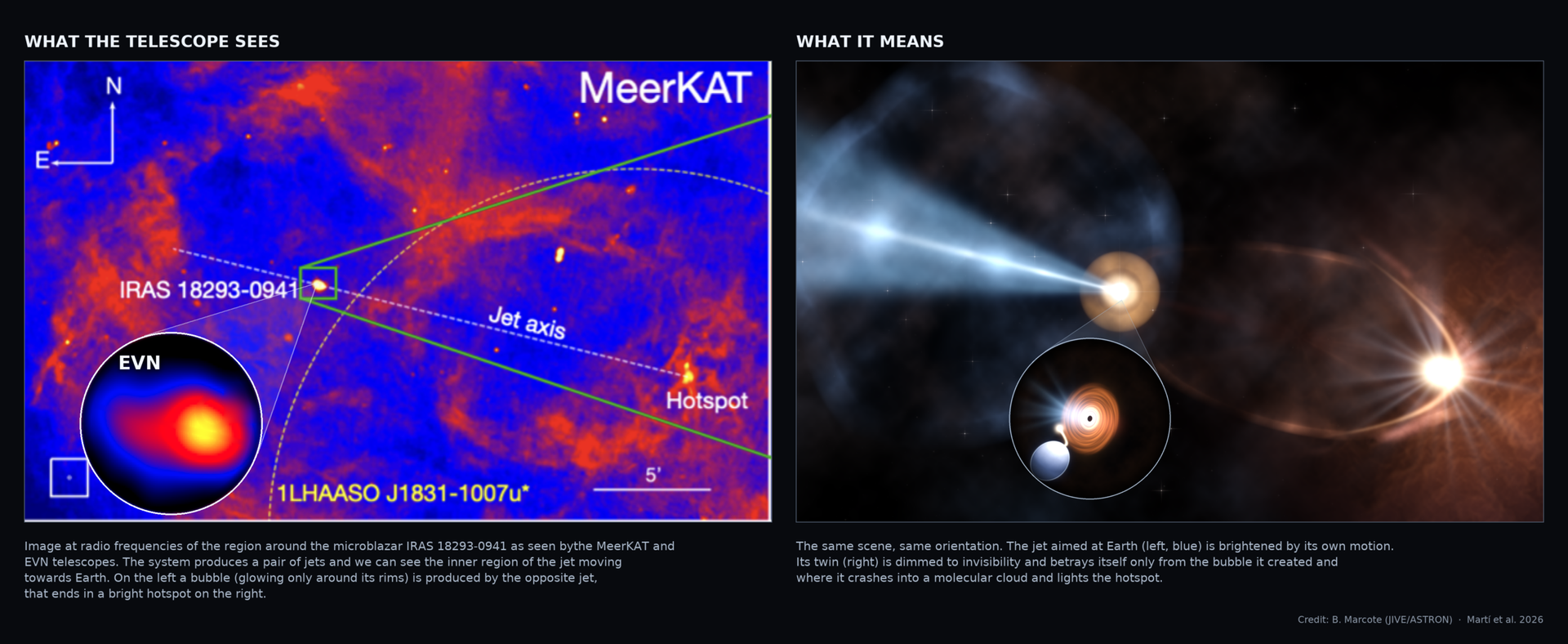
Examination showed that IRAS 18293-0941 displays essentially all anticipated microblazar properties, save for one notable deficiency: rapid variability. By definition, microblazars produce characteristic brightness swings on short timescales because a jet aimed at Earth amplifies modest intensity changes via Doppler boosting.
Despite this omission, Martí posited that a dense envelope of gas encircling the object could dampen fleeting flux increases. Investigators are currently probing whether the region behind the microblazar actually harbors a genuine jet hotspot, according to co‑author Pedro Luque‑Escamilla of the University of Jaén.
The findings merit strong endorsement from outside contributors. Kinwah Wu of University College London judged the methodology robust and conclusions sound. Svetlana Jorstad highlighted the study as both valuable and comprehensive. Itumeleng Monageng of the University of Cape Town remarked that the group’s observations reveal a previously underappreciated pathway for generating some of the universe’s most energetic emissions, emphasizing that microblazars likely accelerate exceptionally potent particle events.
Martí, J., Luque‑Escamilla, P. L., Marcote, B., Abaroa, L., Aguasca‑Cabot, A., Combi, J. A., Romero, G. E., Paredes, J. M., García, F., Fogantini, F., Saavedra, E. A., Del Ser, D., & Van Den Eijnden, J. (2026). *A Galactic microblazar as a potential accelerator of ultra‑high‑energy particles*. **Astronomy & Astrophysics**.
Also Read
- Paramount Skydance Finalizes $111 Billion Warner Bros. Discovery Merger After Supreme Court Denial
- Northrop Grumman Cygnus Departs ISS Following Successful CRS-24 Resupply Mission
- ASOS App Compromised by Hackers Sending Unauthorized Alerts to Millions of Users
- Finland orders halt to work on two Google data centres


%20ILLUSTRATION%20Isadora-Ayesa%20Lima%20SOURCE%20Amazon.jpg?w=1024&resize=1024,1024&ssl=1 "Prime Day Apple Deals 2026: Save Up to 0 on AirPods, Apple Watch, and iPads")
