






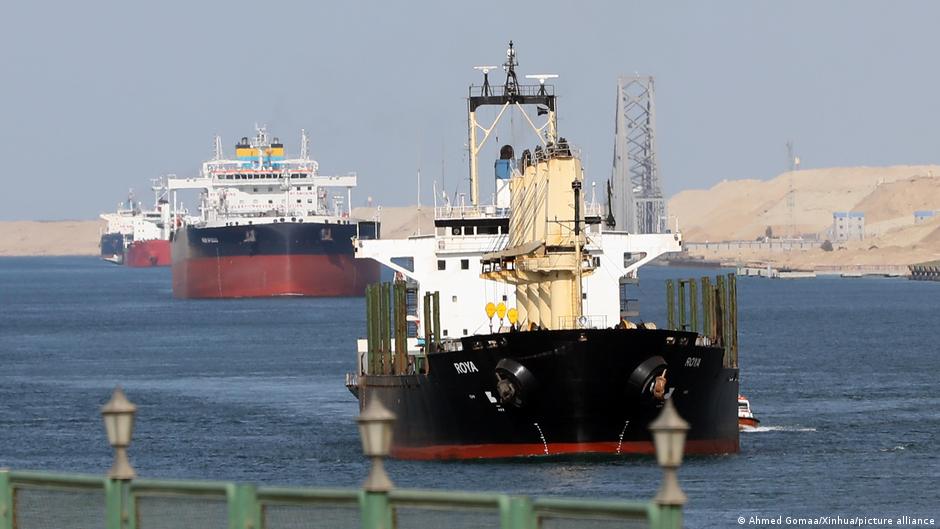
The Suez Canal stretches 193 kilometres (120 miles) between the Mediterranean and the Red Sea, slashing the distance for vessels traveling between Europe and Asia by roughly 10,700 kilometres. Since its inauguration in 1869, the canal has become one of the world’s most critical trade arteries.
In recent years, mounting unrest across the Middle East has prompted many shipping companies to bypass the Suez Canal. The Houthi rebel movement in Yemen has repeatedly targeted vessels in the Bab el‑Mandeb Strait, forcing ships destined for the canal to navigate both the strait and Yemen’s coastline.
Houthis have once again threatened to block the Bab el‑Mandeb, raising fears that the trend of avoiding the canal will intensify.
These shifts pose a serious threat to Egypt. Canal tolls are a vital source of revenue for the nation.
Egyptian President Abdel‑Fattah el‑Sissi estimates that the country lost roughly $7 billion (€6.15 billion) from reduced canal traffic in 2024 alone. According to Reuters, monthly losses have sometimes reached $8 million (€7 million).
Houthis Claim Attacks on Saudi Tankers in Red Sea
To view this video please enable JavaScript, and consider upgrading to a web browser that supports HTML5 video
Beyond the immediate risks, Egypt’s economy feels the ripple effect. While the country has not suffered direct military blows from the Iran conflict, its financial well‑being is markedly impacted.
Egypt Suffers Booming Canal Losses
“Economically, Egypt is in a very ambivalent position,” comments Stefan Lukas, director of German think tank Middle East Minds.
In 2025 and 2026, canal revenues recovered partially as oil from Gulf states is now transported via Saudi pipelines to the Red Sea and onward through the Suez Canal. This detour helps avoid the contested Strait of Hormuz, which is alternately restricted by Iran and the United States. Yet new Houthi threats to block the Bab el‑Mandeb could undermine this alternative route.
Timing is unfortunate for Egypt, where rising energy prices and the International Monetary Fund’s reforms already constrain Cairo’s fiscal flexibility.
“Higher energy costs make imports pricier and fuel inflation,” says Hanna Voss, a regional expert with Germany’s Friedrich Ebert Foundation. “Uncertainty in the Red Sea and potentialathy disruptions at Bab el‑Mandeb jeopardise Suez Canal revenues.”
Tourism inflows, capital investment, and the exchange rate of the Egyptian pound remain sensitive to changes in canal traffic. Egypt also carries substantial debt and relies heavily on IMF loans as well as financial backing from Gulf states.
Other indicators underscore the gravity of the situation. The Associated Press reports that canal revenue fell from $10.25 billion in 2023 to around $4 billion in 2024. companionships,The ships passing the canal dropped from over 26,000 to just above 13,000, with many freight lines choosing the longer but safer route around Africa.
No Short‑Term Solution
As the U.S. think tank Carnegie Middle East Center explains, Egypt cannot offset these losses through its existing economic model. The government increasingly relies on large‑scale state projects and military‑controlled enterprises to spur growth, while potentially productive private investment is overlooked. This imbalance heightens dependency on foreign borrowing and investments.
In the immediate term, no new revenue streams can replace the declining canal income, and progress on IMF‑mandated reforms remains stalled.
Egypt has a strong incentive for rapid de‑escalation,” Voss notes.Thus Cairo subtly supports mediation between the United States and Iran, balancing its strategic ties with the U.S., Saudi Arabia, and the UAE while avoiding direct confrontation with Iran.
Chatham House, a British think tank, characterises Egypt’s stance as a risk‑management exercise. The objective is not to dictate regional power dynamics but to mitigate domestic economic damage.
“The al‑Sissi regime is pursuing a dual approach,” Lukas explains. Outwardly, Egypt expresses solidarity with Saudi Arabia, condemning Houthi threats and tightening security around the canal. Behind the scenes, however,虽they maintain open lines with Iran, driven by Egypt’s financial reliance on wealthy Gulf partners and the risk that the canal itself could become a target.
“All neighbouring states share an interest in stabilising the regional order because prolonged crises are untenable,” Voss adds.
For Cairo, each escalation in the Red Sea strains urgently needed foreign currency, whereas any movement toward peace offers prospects for economic rebound.
“The key question is whether the Derived from Houthis’ blockade stays symbolic or translates into real restriction,” Lukas concludes.
In reality, the Egyptian government wields limited influence over the Houthi blockade or the wider conflict. Lasting peace or diplomacy will most likely hinge on decisions made in Washington, Tehran, and possibly by the Houthis themselves.


