







EUR/USD slipped to 1.1328 on Thursday, driven by mounting support for the US dollar as Treasury yields surged, reigniting concerns over inflationary pressures fueled by elevated energy costs that could prompt a more aggressive Federal Reserve policy.
Ten-year Treasury yields hovered near 5.3%, while 30-year bonds approached 5.64%, both reaching their highest levels since 2002. These elevated yields have strengthened the dollar’s appeal against its peers.
Simultaneously, oil prices remain elevated. Despite signs of recovery in Middle Eastern production, negotiations between the US and Iran have yet to produce tangible progress. Persistent energy costs continue to fuel inflation risks.
Wednesday’s PCE data revealed a softer inflationary trend, with the headline price index up 0.3% month-on-month in August, below the projected 0.4%. Core PCE grew 0.2%, also missing expectations of 0.3%. This data slightly reduced market confidence in an October rate hike, with the probability dropping to approximately 38% from 51% prior to the release.
Market attention now turns to Thursday’s initial jobless claims and Friday’s critical US labor market report for September.
Technical Analysis
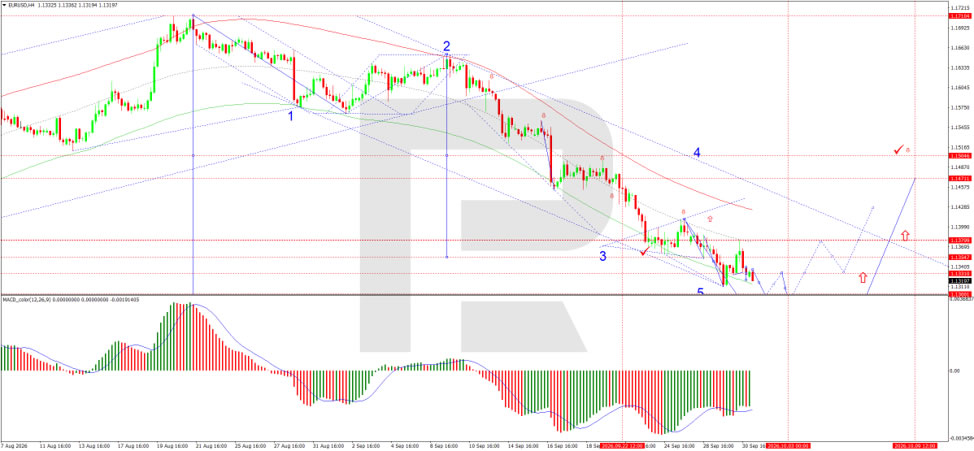

According to the H4 chart, EUR/USD continues to trade within a bearish trajectory. The pair retested 1.1313 after a short-covering rally peaking at 1.1379, then retreated to 1.1330, where it now consolidates below this resistance. The price remains confined within a descending channel, clearly under the 50-day moving average. The primary bias remains bearish, with the immediate target at 1.1300. A breach of this level could open the door to 1.1290–1.1283. However, a rebound above 1.1355 might delay the downtrend, potentially retracing toward 1.1379.
The MACD indicator stays below its zero line, reinforcing the bearish momentum. Meanwhile, the narrowing negative histogram suggests a potential slowdown in the decline, hinting at a technical consolidation or correction before further downward movement.
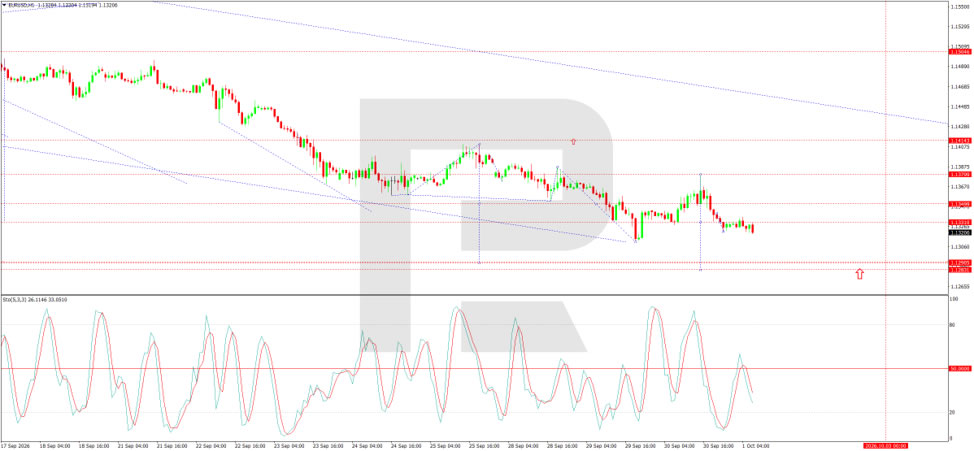
On the H1 timeframe, the trend confirms sustained selling pressure. After peaking at 1.1330, the market entered a narrow trading range, with rebound attempts failing to gain significant traction. The Stochastic oscillator remains below 50 and is turning downward, suggesting further momentum toward the oversold zone. As long as EUR/USD stays below 1.1355, the bearish sequence targeting 1.1300 and subsequently 1.1290 remains the dominant scenario. Confirmation of this outlook is reinforced by the continued decline in swing highs and lows, maintaining a bearish structure.
Conclusion
EUR/USD has reached new lows under the weight of surging US Treasury yields, which reflect persistent inflation fears tied to energy costs. While softer-than-expected PCE inflation data has tempered expectations for an October rate hike to 38%, broader inflation dynamics and stalled US-Iran negotiations prolong the possibility of further monetary tightening. Technically, the pair remains in a downtrend, with key supports at 1.1300 and 1.1290–1.1283. A sustained recovery above 1.1355 would be required to暂缓 the bearish trajectory. The overall technical structure of lower highs and lows indicates that the sell-off has not yet concluded. Friday’s US labor market report will serve as the pivotal catalyst for the next directional movement.
Also Read
- EU Regulators Scrutinize Binance’s Use of Reverse‑Solicitation Exemption: Report
- UK Manufacturing PMI Edges Up to 51.9 in September Amid Slowing Output and Rising Cost Pressures
- Base’s Cobalt Upgrade Introduces Separate Seizure Controls for B20 Tokens
- MetaMask Halts Ethereum Staking Operations Following Security Breach, User Funds Unaffected


