







EUR/USD fell to 1.1368 on Tuesday, lingering near its two‑month low. The dollar gained strength from expectations of further Federal Reserve tightening, driven by inflation concerns tied to high energy prices and uncertainty over US‑Iran relations.
Oil prices kept climbing after reports that Iranian officials doubt a deal can be reached before the US midterm elections in November. Earlier, Donald Trump dismissed Tehran’s latest proposal, raising fears of a prolonged conflict and sustained high energy costs.
US Treasury yields also stayed at multi‑year peaks, with 10‑ and 30‑year notes trading above 5%. This bolsters the dollar and tightens financial conditions.
Markets now price a 70% chance of another Fed rate hike in October. In September the Fed had already lifted rates for the first time in three years.
Fed Governor Lisa Cook warned yesterday that near‑term productivity gains from artificial intelligence may not be enough to counter inflationary pressures, increasing the risk of a broader inflation spread.
Technical Analysis
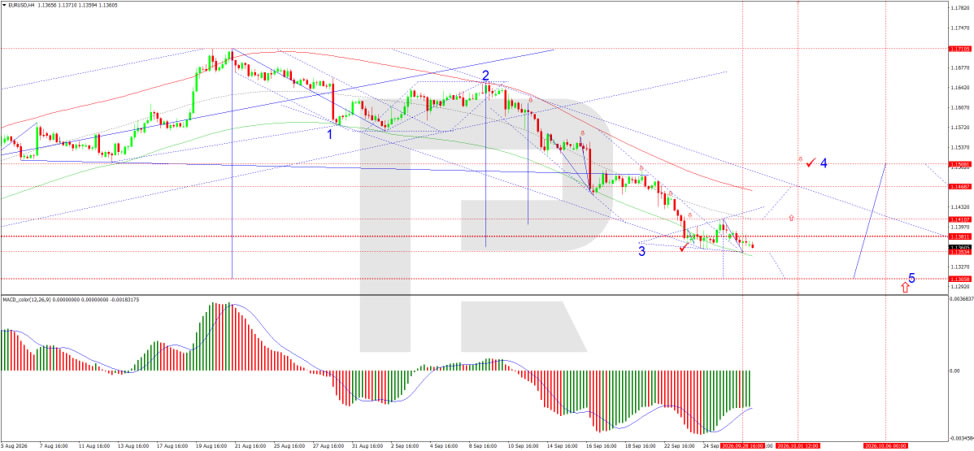

On the H4 chart, EUR/USD continues to trade within a descending pattern. After the second wave formed near 1.1640, the market has repeatedly posted lower lows. Price is now consolidating around 1.1360, with the nearest support and resistance at 1.1353 and 1.1410. A break below 1.1353 would set up the next downward leg toward 1.1306, regarded as the primary target of the current wave. A rebound above 1.1410 could allow a corrective move toward 1.1469, although that would not change the overall bearish bias. Stronger resistance is seen near 1.1508.
The MACD stays below zero, confirming bearish momentum, while the shrinking negative histogram hints at a slowing decline, suggesting the pair may pause or correct before resuming its fall.
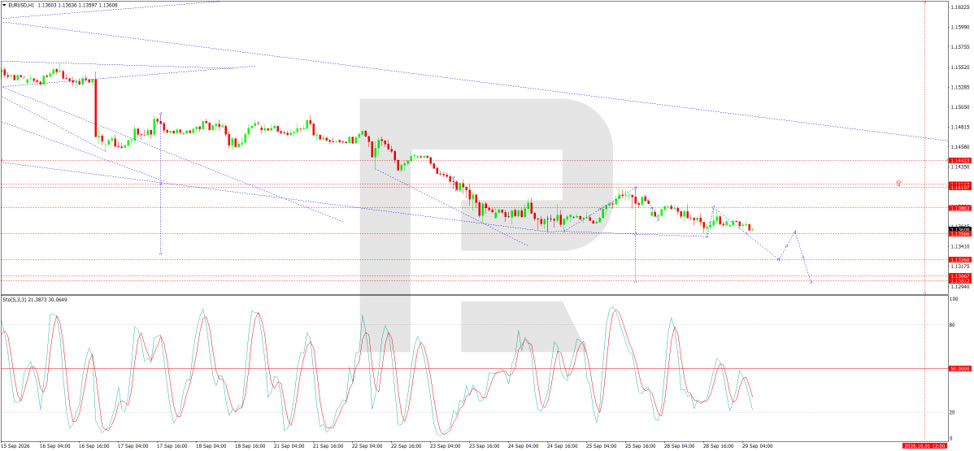
On the H1 timeframe, the structure remains downward. After rising to 1.1410, price created a series of lower highs and fell back to support at 1.1353. The Stochastic oscillator has dropped below 50 and is edging toward the 20 zone, indicating short‑term selling pressure. A breach of 1.1353 would open the path to the intermediate level of 1.1326, after which the main target of 1.1306 comes into view. A move back above 1.1386 would let price retest 1.1410, but to alter the current technical picture buyers would need to close above that level. Hence, the preferred scenario for 29 September is a continuation of the downtrend once the present consolidation ends.
Conclusion
EUR/USD remains pressured near its two‑month low, weighed down by expectations of further Fed tightening, elevated oil prices fueled by US‑Iran uncertainty, and multi‑year‑high Treasury yields. Trump’s dismissal of Tehran’s proposal and doubts about a pre‑election agreement have intensified fears of a protracted conflict, keeping energy costs high and inflation risks alive. Fed official Lisa Cook’s caution that AI‑driven productivity gains may not offset price pressures adds to the hawkish backdrop, with October rate‑hike odds now at 70%. Technically, the pair stays bearish; a break below 1.1353 would likely trigger a move toward 1.1306. A recovery above 1.1410 would be required to shift the short‑term outlook, though the longer‑term trend remains downward.
Also Read
- Cardano Breaks Multi-Year Resistance as Key Weekly Test Looms for ADA
- Anthropic Pre-IPO Derivatives Volume Reaches $643 Million Ahead of Liquidity Reckoning
- EUR/GBP Eyes Key 0.8551 Support as Correction Threatens Downside
- Quant’s QNT Token Surges 400% Following The Clearing House Partnership for On-Chain Settlement


