






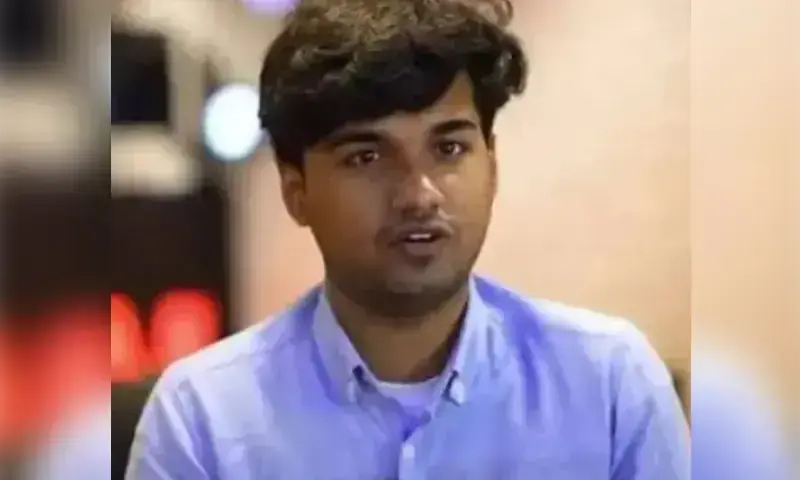
The remains of Mir Raza Ali, a young entrepreneur, were exhumed on Saturday after the Sindh authorities reinstated the original medical board, his father’s counsel reported.
The exhumation, originally set for Friday morning, was delayed following objections from Raza’s family regarding the swift reconstitution of the board and the inclusion of members from outside the Karachi division.
“The investigating officer witnessed the exhumation and the subsequent examination. All eight members of the medical team, along with the parents, were present, and notably, a judicial magistrate was also in attendance,” said Advocate Jibran Nasir to the media in Karachi on Saturday.
The lawyer argued that “incomplete CCTV footage and out‑of‑context messages” have been used to fuel speculation and draw premature conclusions since Raza’s death.
Raza, who owned the eatery Wafflix, went missing on July 28. His body was discovered the following day with a gunshot wound in a vacant lot near Shahi Qila Ground in Gulistan‑i‑Jauhar.
While his family maintains that he was abducted, tortured and murdered, investigators continue to explore the possibility that his death may have been self‑inflicted.
Regarding the medical board controversy, Nasir voiced concern that the government did not explain the abrupt change to the board on Friday.
The attorney emphasized that the family does not require “character certificates” for the board’s medical experts.
He expressed hope that the board’s report would be released by Saturday evening, shedding light on the circumstances surrounding the young businessman’s death.
According to Nasir, the report would clarify whether the incident was a homicide or suicide, and would increase pressure on law‑enforcement officials once the issue is resolved.
He reiterated that the findings would determine whether the death was “self‑inflicted or a murder”.
Nasir also noted his surprise that police had disclosed audio evidence to the media before informing the victim’s parents, who learned of it via television reports.
He thanked the judiciary for intervening in the case, observing that “the work the police could not accomplish in eight to nine days was achieved within two days after judicial involvement”.
Additionally, he conveyed gratitude to the courts for their timely assistance.
A separate delegation of the Pakistan People’s Party (PPP), comprising MPs Asif Moosa and Saima Agha, visited Raza’s family to extend condolences.
Moosa assured the bereaved family that Home Minister Ziaul Hassan Lanjar and Sindh Inspector General Javed Alam Odho are closely monitoring the investigation.
He affirmed that efforts are underway to ensure a transparent inquiry that delivers justice.
Saima added that the investigation will proceed pending the final post‑mortem report, and that the perpetrators will be held accountable. She reiterated that the PPP stands in solidarity with the victim’s family.
Medical board controversy
The originally scheduled exhumation on Friday morning was postponed after the deceased’s family objected to the rapid reconstitution of the medical board and the inclusion of members from outside the Karachi division.
On Thursday, a judicial magistrate permitted the exhumation of the body in response to an application filed by Mir Hussain Ali, Raza’s father, ordering the police surgeon and the Sindh health secretary to form a medical board for the procedure.
The court’s ruling followed a dispute between Karachi police officials and investigators over perceived inconsistencies in the medico‑legal post‑mortem report.
Police Surgeon Dr Summaiya Syed, whose assessment relied solely on the post‑mortem report and photographs — without direct examination of the body — pointed out that certain observations in the report did not align with the available images.
In response, the Sindh health department assembled an eight‑member board, with Dr Syed as convener. Its members included Prof Dr Naseem Ahmed of Dow University of Health Sciences, Prof Dr Farah Waseem of Jinnah Sindh Medical University, Amir Hassan Khan of the Citizens Police Liaison Committee, Additional Police Surgeon Dr Sirichand, Dr Kamran Khan and Dr Daniyal Mirza of Jinnah Postgraduate Medical Centre, and Dr Mohammed Yaseen, the administrative head of the police surgeon’s office.
However, in the early hours of Friday, the board was reconstituted through an order issued by the director general of the Sindh health department.
While Dr Syed remained convener of the new five‑member board, its composition was changed to include Prof Dr Zakiuddin of DUHS, Prof Dr Kazi Akbar and Prof Dr Abid Hussain Chang of Liaquat University of Medical and Health Sciences, and Dr Waseem Khan, the police surgeon of Hyderabad.
On Friday morning, Raza’s family gathered at the Tariq Road graveyard for the exhumation, which was subsequently deferred.
Standing alongside Raza’s father, Nasir accused the authorities of attempting to obscure the facts and held the police, health department and the Sindh government accountable for the delay.


