



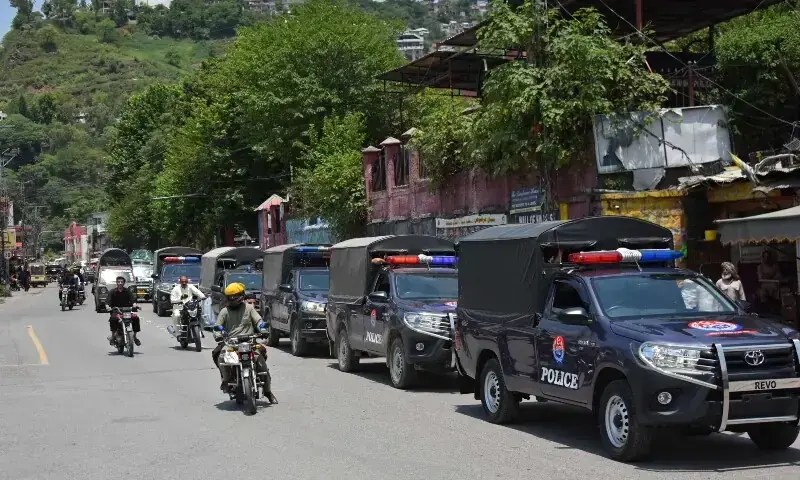
MUZAFFARABAD: At least seven civilians lost their lives during violent confrontations between police and protesters from the newly banned Joint Awami Action Committee (JAAC) in Rawalakot, Azad Jammu and Kashmir (AJK), an official confirmed to Dawn on Monday.
Poonch Commissioner Sardar Waheed Khan verified the civilian death toll a day after the unrest, which also resulted in the deaths of four law enforcement officers.
Both the Commissioner and AJK Inspector General (IG) Liaqat Ali Malik informed Dawn that 30 individuals were detained late Sunday. Furthermore, officials reported that 23 police officers sustained injuries during the violence.
The unrest was triggered by rising tensions following the death of a local trader, who was allegedly shot during a confrontation with law enforcement on Friday night. Authorities have further alleged that demonstrators targeted the Combined Military Hospital (CMH) in Rawalakot during Sunday’s clashes.
While the deceased’s family initially planned a Saturday funeral, they subsequently deferred the burial until Sunday, returning the body to the CMH for a post-mortem examination.
Although the body was moved to the hospital’s mortuary, a formal autopsy was not performed. During this period, a large crowd maintained a continuous sit-in outside the hospital.
Witnesses reported that when police arrived to disperse the gathering, they were met by an aggressive group of protesters. Riot police utilized baton charges and tear gas to break up the crowd, which responded by pelting officers with stones; however, no police injuries were reported during that specific exchange.
The family of the deceased has stated they will refuse to proceed with the burial until the home department rescinds its decision to proscribe the JAAC.
AJK has faced significant instability recently after the regional government designated the JAAC as a proscribed organization. The group continues to demand the abolition of 12 refugee seats in the AJK Legislative Assembly.
These seats are reserved for refugees from Indian-occupied Jammu and Kashmir who relocated to mainland Pakistan after 1947. The JAAC contends that these seats are frequently exploited by mainstream Pakistani political parties to manipulate government formation in Muzaffarabad.
On Friday, the AJK government banned the JAAC ahead of their scheduled June 9 protest, labeling the group as being “engaged in terrorism” and acting in a manner that threatens state peace and security. This was followed by a crackdown on Saturday, during which authorities arrested numerous JAAC leaders and activists across various regions.
Additionally, Radio Pakistan reported on Sunday that AJK police have sealed the JAAC headquarters.
The flow of information from the region remains restricted due to the suspension of mobile data services. Citing security risks ahead of planned demonstrations, AJK authorities have advised travelers to postpone visits to the area until June 20.
In response to the escalating situation, Islamabad has deployed federal paramilitary forces to support the local police force.