



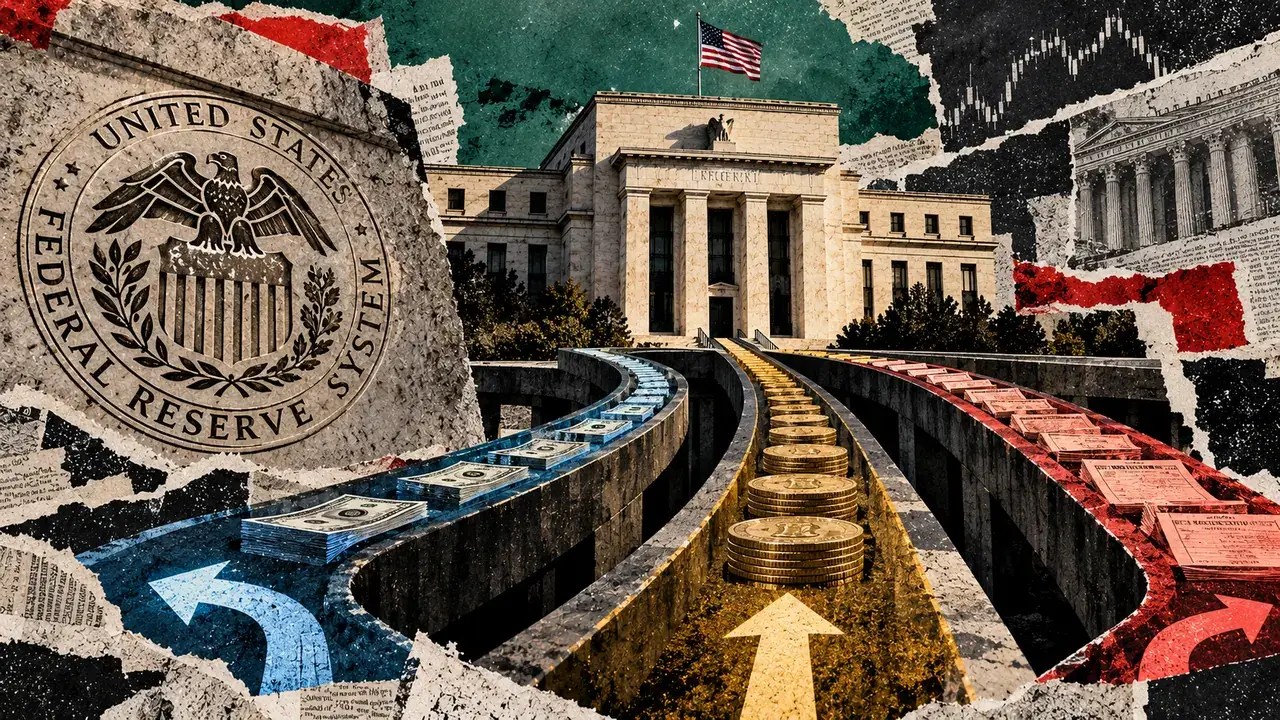
The Federal Reserve maintained its target range at 3.75%–4% on October 28, with operating instructions taking effect the following day detailing how that stance translates across bank reserves and overnight funding markets.
The Federal Open Market Committee’s decision passed 10–2, with Governors Lisa D. Cook and Beth M. Hammack dissenting in favor of a quarter-percentage-point increase.
The October 29 implementation note holds interest on reserve balances (IORB) at 3.9%, the standing overnight repo facility at 4%, and the overnight reverse repo facility at 3.75%.
The 3.75%–4% range represents the FOMC’s policy target for the federal funds market, where banks and other eligible institutions borrow and lend reserve balances held at the Fed overnight on an uncollateralized basis.
As the New York Fed explains, administered rates help keep the effective federal funds rate within the target band. An instruction to maintain the range is distinct from a report of where transactions actually cleared.
The target range sets the stance; IORB, repo and reverse repo help keep overnight rates inside it. Conditional reserve purchases are not a quantified QE announcement.
The graphic maps instructions and facility terms, not actual transaction results, the effective federal funds rate, completed asset purchases or crypto-market transmission. The directive gives no purchase amount.
The Federal Reserve Board sets the interest paid on eligible institutions’ reserve balances held at the Fed. Its IORB guidance describes the payment as a tool for implementing monetary policy and controlling short-term rates.

At the directive’s 4% rate, the standing overnight repo facility offers secured overnight funding. In a repurchase agreement, the New York Fed’s trading desk purchases securities with an agreement to resell them, temporarily adding reserves and helping limit upward pressure on money-market rates.
The overnight reverse repo facility operates in the opposite direction: the Desk sells securities with an agreement to repurchase them, temporarily draining reserves. The New York Fed notes that both tools support rate control and smooth market functioning.
The reverse repo terms also include a $160 billion daily limit per counterparty.
Conditional Purchases and Rate Implementation
The directive authorizes the Desk, when appropriate, to increase the System Open Market Account’s holdings through Treasury bill purchases to maintain ample reserves. If necessary, it may also purchase other Treasury securities with no more than three years remaining to maturity.
The note further directs the Desk to roll over all principal payments from Treasury holdings at auction and reinvest all principal payments from agency securities into Treasury bills.
The key takeaway for digital-asset markets is the distinction between the chosen interest-rate stance and the operational mechanics that sustain it. The October package describes a hold executed through an ample-reserves framework.
Transaction results and purchase records will reveal how the instructions are carried out. Separate evidence of crypto demand and transmission channels would be required to link those operations to Bitcoin or other digital assets.
Also Read
- Cardano’s Midnight Sidechain Integrates Directly With Ethereum via Sig Network Partnership
- GSK’s Earnings Momentum Wanes as Jefferies Cautions on HIV Patent Cliff
- Kalshi’s Senate contracts can settle on different answers to the same election
- Polymarket launches 15-minute ‘Up or Down’ contracts for the price of gold, plans to add stock and forex – Fortune