






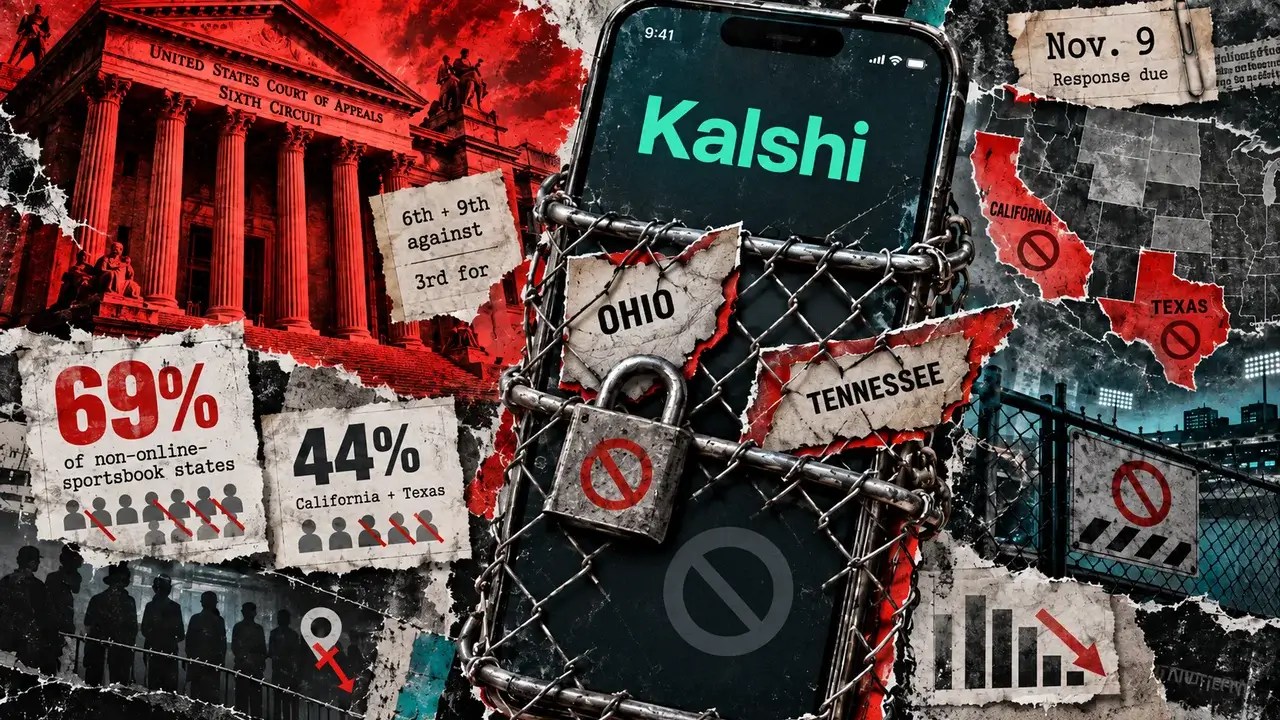
On September 25, the Sixth Circuit Court of Appeals ruled that Ohio and Tennessee may enforce their state gambling laws against Kalshi’s sports contracts.
The panel rejected Kalshi’s assertion that state-by-state compliance would conflict with its obligations as a federally regulated exchange, instead identifying geofencing as a viable method to satisfy both federal and state requirements.
This second appellate victory for states directly impacts the demand that Eilers & Krejcik Gaming identifies as most vulnerable, specifically the 69% of Kalshi’s retail sports demand originating from states without legal online sportsbooks.
Two Paths to an Identical Outcome
The unanimous panel determined that Kalshi failed to demonstrate that its sports contracts meet the Commodity Exchange Act’s definition of a swap, which was the foundation of its claim to exclusive CFTC oversight.
It additionally issued an alternative holding stating that even if the contracts qualified as swaps, federal commodities law would not preempt Ohio and Tennessee gambling statutes.
This alternative finding provides states within the circuit with two distinct avenues to prevail, as a subsequent ruling favoring Kalshi on the swap question would still leave the preemption conclusion intact.
| Legal Question | Kalshi’s Position | Sixth Circuit Ruling | Practical Consequence |
|---|---|---|---|
| Are the sports contracts “swaps”? | Yes, bringing them within the CFTC’s exclusive-jurisdiction framework | Kalshi failed to show the contracts meet the relevant swap definition | Kalshi cannot rely on the swap classification to block state enforcement |
| If they are swaps, does federal law preempt state gambling law? | Yes | No — Ohio and Tennessee laws can coexist with federal regulation | Even a later win on the swap question would not automatically eliminate state authority |
| Can state-by-state compliance coexist with DCM rules? | No; geographic segmentation conflicts with national-market obligations | Yes | State-specific access controls remain legally possible |
| What happens now? | Kalshi sought protection from enforcement | Ohio denial affirmed; Tennessee injunction vacated | Both states regain room to enforce while litigation continues |
The court affirmed an Ohio ruling against Kalshi, vacated the preliminary injunction that had previously shielded the platform from enforcement in Tennessee, and remanded both cases back to the lower courts.
Similar to earlier rulings in this ongoing dispute, the decision was issued at the preliminary-injunction stage and now governs federal courts across Ohio, Tennessee, Michigan, and Kentucky.
Kentucky filed suit against both Kalshi and Polymarket earlier this year, while Michigan’s state-court litigation continues on a separate trajectory.
The Court’s Response to Kalshi’s Geofencing Argument
Kalshi argued that its obligations as a designated contract market, including impartial access and national order matching, rendered compliance with Ohio’s geographic restrictions and Tennessee’s laws impossible.
The panel interpreted these federal requirements as applying to whatever markets an exchange chooses to list, thereby leaving room for contracts to be offered in some states while being withheld in others.
The court pointed to existing companies that successfully use geofencing to comply with both federal exchange rules and state gaming laws simultaneously. Kalshi countered that segmenting access by geography would be technically difficult, time-consuming, and expensive, to which the judges responded that “expensive does not mean impossible.”
In Michigan, a state-court injunction issued on September 1 requires Kalshi to keep covered sports contracts unavailable to users located within the state, verified through a qualifying third-party geolocation provider.
Violations carry penalties of up to $500,000 per day. The Kalshi application continues to function, though its sports markets disappear for anyone physically located inside the state line.
Where Kalshi’s Sports Demand Lies
EKG’s July model estimates that 69% of Kalshi’s retail sports demand originates from states without legal online sportsbooks, with California and Texas alone accounting for 44% of that total.
EKG derived these figures from surrounding indicators, as Kalshi keeps its state-level trading data private. The same research estimates that prediction markets displaced only 2% to 4% of sportsbook handle in the most competitive legal betting states, indicating that growth was primarily driven by customers in regions closed to licensed sportsbooks.
Sports drives the business, with more than 90% of Kalshi’s trades and 95% of its 2025 revenue tied to sports contracts, according to figures cited in the Ninth Circuit’s August opinion. As a sizing exercise, restrictions covering half of that non-sportsbook footprint would encompass a geography holding approximately 34.5% of EKG’s modeled retail sports demand.
California falls within the Ninth Circuit, which ruled against Kalshi’s preemption argument in Nevada on August 28. Texas belongs to the Fifth Circuit, which has yet to rule on the matter.
Ohio and Tennessee Already Permit Sports Betting
Both states legalized sports wagering and regulate it through a minimum age of 21, geographic limits, licensing, taxes, and consumer protections—rules Kalshi currently operates outside of.
The Sixth Circuit’s opinion noted that states collected more than $3.2 billion in sports-gambling tax revenue in fiscal 2025. Their position is that sports contracts are welcome in both states under the same rules that licensed sportsbooks follow.
Major sportsbook operators have leveraged the same regulatory arbitrage, with DraftKings stating that DraftKings Predictions now serves California and Texas, where its conventional sportsbook remains unavailable.
FanDuel states that FanDuel Predicts offers sports contracts in states where online betting is illegal and will withdraw them once a state legalizes conventional sportsbooks. Both companies have adopted the federal route Kalshi pioneered and already operate the state-by-state compliance systems the Sixth Circuit described.
EKG counted $31.1 billion in US sports prediction-market execution volume through September 20 in the third quarter and reported that Polymarket’s US exchange reached roughly 22% of sports contract volume in September. EKG now ranks state-by-state contraction of the addressable market as the industry’s top near-term policy risk.
The Appellate Map and the Calendar
The Third Circuit sided with Kalshi in New Jersey in April, finding the platform had a reasonable chance of proving that federal law preempts state gambling rules.
The Ninth Circuit ruled the other way in Nevada, and the Sixth Circuit has now joined it in opposition to Kalshi for Ohio and Tennessee, leaving the split at two circuits against the platform and one in its favor. A Fourth Circuit appeal involving Maryland remains pending and could reshape that balance.
New Jersey petitioned the Supreme Court on September 2 to resolve the circuit split. Kalshi’s response, originally due on October 8, is now due November 9 following a September 22 extension, and the Court has yet to decide whether to hear the case.
The first concrete test of the Sixth Circuit ruling will occur in Tennessee, where regulators regained their enforcement position once the injunction was vacated.
| Circuit | State Dispute | Current Preliminary-Injunction Result | What It Means for Kalshi |
|---|---|---|---|
| Third Circuit | New Jersey | Favorable to Kalshi | Kalshi showed a reasonable chance that federal law preempts state gambling restrictions |
| Ninth Circuit | Nevada | Against Kalshi | Court rejected Kalshi’s swap/preemption theory for the sports contracts at issue |
| Sixth Circuit | Ohio + Tennessee | Against Kalshi | Court rejected both the swap theory and, independently, the preemption argument |
| Fourth Circuit | Maryland | Pending | Could change the appellate balance again |
| Supreme Court | New Jersey petition | Review not granted | Kalshi response currently due Nov. 9 |
What a National Exchange Looks Like Going Forward
If the Supreme Court takes up the split and adopts the Third Circuit’s reading, sports contracts could remain available nationwide under a single federal rulebook. A favorable Fourth Circuit ruling would strengthen that case before the justices act.
Kalshi would then compete with DraftKings, FanDuel, and Polymarket on liquidity, pricing, and product design, and EKG’s projection of $279 billion in 2027 sports prediction-market execution volume would rest on a national market.
If Sixth- and Ninth-Circuit reasoning spreads, Kalshi faces a state-by-state permissions matrix. Some states could outright ban sports contracts, while others could demand licenses, a 21-and-over threshold, taxes, or local geolocation checks.
Markets fragmented by geography also fragment the pool of eligible traders, which could thin liquidity and push Kalshi toward different contract catalogs from one state to the next.
Kalshi would remain a CFTC-regulated exchange offering economic and political markets across the country, with its sports business tracing the same borders that conventional sportsbooks already work within.
Kalshi’s sports advantage stemmed from operating one federal market while sportsbooks answered to dozens of state regimes. Two appeals courts have now tied that geography to state law, and the Sixth Circuit named the tool that could redraw it.
Also Read
- Google Vids Unlocks Free 1080p AI Video Generation for All Users
- Peter Brandt Argues XRP’s Transactional Utility Doesn’t Guarantee Higher Valuation, Contrasts With Bitcoin
- XRP Price Analysis: Can Weekend Momentum Carry XRP to $1.76 or Higher?
- Profiting from the Narrative: How X’s Creator Fund Pays for Bitcoin Hype Independent of Price


